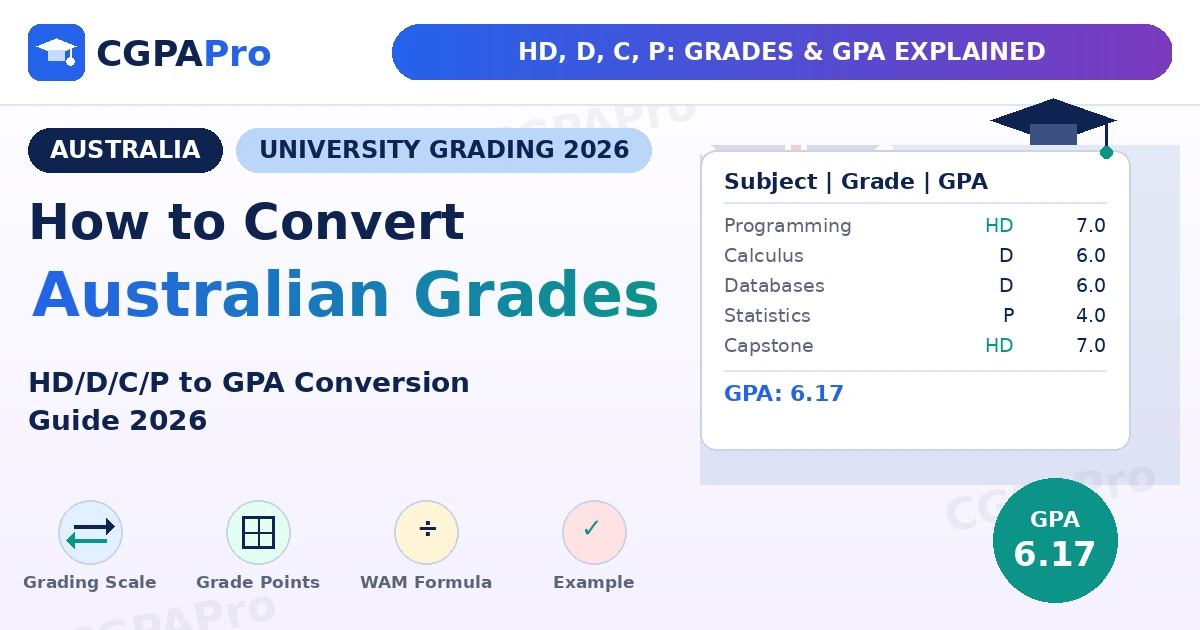
Short answer: most Australian universities grade on HD (85–100), D (75–84), C (65–74), P (50–64), F (below 50), and convert those grades to a 7.0 GPA scale: HD=7, D=6, C=5, P=4, F=0. Your GPA is the credit-weighted average of those points. But there are real exceptions — Monash starts HD at 80, UniMelb uses H1/H2A/H2B instead of HD/D/C, and some unis run a 4.0 scale — plus a separate number called WAM that is not the same thing as GPA. This guide covers all of it with real numbers, including a fully worked 6.17 GPA example.
If you are studying in Australia, applying there from abroad, or converting an Australian transcript for a US or UK application, you have probably noticed something frustrating: every calculator site shows you the same little 7.0 table, and none of them answer the questions students actually ask. Is an HD 85 or 80? Why does my transcript show a WAM instead of a GPA? Why did my friend’s “GPA” come out different when she applied through UAC? Let’s sort it out properly, with the official rules and the arithmetic done by hand.
Step 1: Get your own numbers straight first
Before converting anything, pin down your own results exactly — every unit, its credit points, and your mark. Use the CGPAPro calculator on the homepage to sanity-check the weighted-average mechanics: add each course with its credits and grade, and it does the credit-weighted math for you.
Here is the five-course scenario we will follow through this whole article. Same courses, same credits — we will calculate it three different ways:
- Programming Fundamentals — 88 — 6 credit points
- Calculus — 76 — 6 credit points
- Database Systems — 77 — 6 credit points
- Statistics — 58 — 6 credit points
- Capstone Project — 91 — 12 credit points
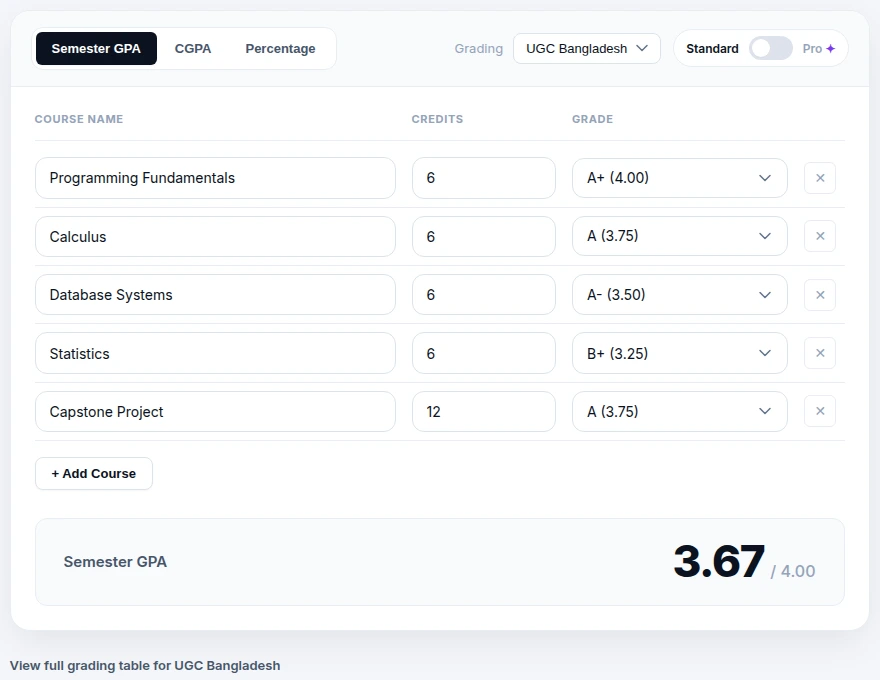
Screenshot: the same five courses run through the CGPAPro homepage calculator. Important honesty note — the homepage calculator uses its own generic 4.0 scale (UGC Bangladesh), not the Australian 7.0 scale, so it shows 3.67 here. The Australian 7.0-scale result for these exact results is 6.17, worked out by hand below. (Real capture from cgpacalculatorpro.com, October 2026.)
The screenshot is still useful: it shows the one mechanical idea behind every GPA on earth — credit weighting. The 12-credit Capstone counts double a 6-credit unit, wherever you study. Keep that in mind; it matters more than most students think.
The official Australian grade bands (and the two real exceptions)
At the majority of Australian universities — UNSW, USYD, UTS, UQ, QUT, Adelaide, ANU, Western Sydney, Macquarie and most others — the standard bands are (see the per-university grading table):
| Grade | Full name | Mark band | 7.0 grade points |
|---|---|---|---|
| HD | High Distinction | 85–100 | 7 |
| D | Distinction | 75–84 | 6 |
| C | Credit | 65–74 | 5 |
| P | Pass | 50–64 | 4 |
| F (N/FL) | Fail | Below 50 | 0 |
The pass mark is 50 at every Australian university — that part is universal. The HD boundary is where it gets interesting, because there are two genuine exceptions you need to know:
- Monash University: HD starts at 80, not 85 — HD 80–100, D 70–79, C 60–69, P 50–59. Monash also runs its official GPA on a 4.0 scale (HD=4, D=3, C=2, P=1, fail=0.3), not 7.0. We covered Monash’s whole system — WAM, GPA, and the Malaysia-campus CGPA — in our Monash grading guide.
- University of Melbourne: uses H1/H2A/H2B/H3/P instead of HD/D/C/P — H1 80–100, H2A 75–79, H2B 70–74, H3 65–69, P 50–64. And UniMelb’s headline transcript number is WAM, not GPA (more on WAM below).
There is also a quieter group of universities on a 4.0 scale rather than 7.0 — Adelaide, Bond, Murdoch, RMIT and a few others use HD=4, D=3, C=2, P=1. This is why you should never quote an Australian “GPA 3.2” without naming the scale: 3.2 out of 7.0 is a bare pass average, while 3.2 out of 4.0 is a solid distinction average. Completely different students.
How the 7.0 GPA is actually calculated
The formula is the same weighted average used everywhere:
GPA = Σ (grade points × credit points) ÷ Σ (credit points)
Step by step:
- Convert each unit’s result to grade points using the 7.0 table (HD=7, D=6, C=5, P=4, F=0).
- Multiply each unit’s grade points by its credit points.
- Add all of those up.
- Divide by the total credit points.
Failed units count as 0 grade points but their credit points stay in the denominator — that is what makes a fail so expensive on this scale. Ungraded passes (PGO-style) and withdrawn-without-penalty units are typically excluded entirely; check your own university’s policy for the exact exclusion list, because it varies.
Worked example: five units, GPA 6.17
Let’s run our scenario through the standard 7.0 scale. First, marks become grades:
| Unit | Mark | Grade | Points | Credit points | Weighted points |
|---|---|---|---|---|---|
| Programming Fundamentals | 88 | HD | 7 | 6 | 42 |
| Calculus | 76 | D | 6 | 6 | 36 |
| Database Systems | 77 | D | 6 | 6 | 36 |
| Statistics | 58 | P | 4 | 6 | 24 |
| Capstone Project | 91 | HD | 7 | 12 | 84 |
Total weighted points: 42 + 36 + 36 + 24 + 84 = 222. Total credit points: 6 + 6 + 6 + 6 + 12 = 36.
GPA = 222 ÷ 36 = 6.17 — a distinction average.
Notice what the arithmetic is really saying. The 58 in Statistics cost this student dearly: a Pass is only 4 points against a possible 7, and it still occupies 6 credit points in the denominator. Meanwhile the Capstone’s 12 credit points mean the 91 does double duty — that is credit weighting working for you. If the Capstone had been a 6-credit unit like the rest, the GPA would be (42+36+36+24+42) ÷ 30 = 180 ÷ 30 = 6.00. One unit’s credit load moved the needle by 0.17.
WAM vs GPA: the same transcript, two different numbers
This is the single most confusing thing about Australian results, so let’s settle it with the same student. WAM (Weighted Average Mark) averages your actual percentage marks. GPA averages the grade points those marks convert to. Same five units:
WAM = (88×6 + 76×6 + 77×6 + 58×6 + 91×12) ÷ 36 = (528 + 456 + 462 + 348 + 1092) ÷ 36 = 2886 ÷ 36 = 80.17.
So this student has WAM 80.17 and GPA 6.17 — related, but not convertible by any simple formula. The reason: GPA throws away information. A 76 and an 84 are both “D = 6”, but in the WAM they are 8 marks apart. A student with marks of 84, 84, 84, 84, 84 has WAM 84.00 but GPA 6.00; a student with 75, 75, 75, 75, 100 has WAM 80.00 but GPA 6.20. Higher WAM, lower GPA — or the reverse. You cannot turn one into the other without the original marks.
Where each one is used: universities like UniMelb, USyd and UNSW put WAM front and centre on the transcript; UQ, QUT, Griffith, Western Sydney and most others lead with the 7.0 GPA. Employers and graduate schools generally accept whichever your transcript shows — give them both numbers and name the scales, and nobody has to guess. (Monash is its own special case again: first-year units count at half weight in its WAM — see our Monash guide.)
The GEMSAS trap: graduate medicine ignores your letter grades
If you are aiming for graduate medicine or dentistry, stop thinking in HD/D/C/P entirely. GEMSAS — the admissions system used by most Australian graduate medical schools — calculates your GPA from your percentage marks, not your letter grades, whenever percentages appear on your transcript (which they do at most unis).
The GEMSAS bands are finer than the uni bands, with half-points:
| Percentage | GEMSAS grade point |
|---|---|
| 80–100 | 7 |
| 75–79 | 6.5 |
| 70–74 | 6 |
| 65–69 | 5.5 |
| 60–64 | 5 |
| 55–59 | 4.5 |
| 50–54 | 4 |
| Below 50 | 0 |
Then it weights by year of study: ((final-minus-2 year × 1) + (final-minus-1 year × 2) + (final year × 3)) ÷ 6. And every result from your last three full-time-equivalent years counts — including fails and repeated subjects.
Two consequences students keep tripping over:
- The “is HD 85 or 80?” debate is irrelevant for medicine. GEMSAS never looks at your letter grades, so Monash’s 80-boundary and everyone else’s 85-boundary produce the same GEMSAS number from the same percentages. An 83 is 7 GEMSAS points wherever you studied.
- Your GEMSAS GPA and your uni GPA are different numbers. Take our student’s marks as final-year units: (7×6 + 6.5×6 + 6.5×6 + 4.5×6 + 7×12) ÷ 36 = (42 + 39 + 39 + 27 + 84) ÷ 36 = 231 ÷ 36 = 6.42 — higher than the 6.17 uni GPA, because the 76/77 pick up half-points the flat D grade denied them. The reverse happens too: an 84 (D=6 at uni) is worth 7 under GEMSAS, while a 75 (also D=6) is worth only 6.5.
If medicine is the goal, calculate both numbers and plan around the GEMSAS one — that is the one that decides interviews.
Crossing state lines: UAC and QTAC re-normalize your GPA
Here is something no calculator site mentions: when you apply between universities or states, admissions centres recalculate your GPA on their own common scale. Your uni’s number is not portable.
UAC (NSW/ACT admissions) converts every institution’s grades to one 7-point scale — HD=7, D=6, C=5, P=4, conceded pass=3, fail or withdrawn-fail=0 — then computes GPA as Σ(credit value × grade) ÷ Σ(credit values). It also normalizes credit points across institutions (subjects worth 10 credit points at some unis are treated as 6 in UAC’s system), because a “credit point” is not the same size everywhere. Subject level does not change the weighting, and all results available at the time of assessment count. Some universities then layer their own year-weighting on top of the UAC number.
QTAC (Queensland) goes a step further for transfer entry: it converts your tertiary GPA into a selection rank — an ATAR-equivalent number. Published schedules show the shape of it: a GPA around 6.5 converts to a rank of 99, 5.0 lands around 96, 4.0 around 93, 3.0 around 79, and anything below 2.0 around 45. QTAC updates these tables, so check the current QTAC guide before relying on a specific number — but the principle is what matters: in Queensland, your GPA becomes a rank, and the conversion is published, not secret.
Practical takeaway: if you are transferring interstate or applying for postgraduate study through an admissions centre, compute your GPA on their scale, not your home uni’s. The numbers can move.
Taking Australian grades overseas: the US/UK conversion pitfalls
Australian students applying to the US or UK keep hitting the same three traps:
- Multiplying by 4/7. A GPA of 6.0 × 4/7 = 3.43 looks tidy and is wrong. There is no linear relationship between the scales, because grade boundaries do not line up. US evaluators (including WES) map letter grades: HD ≈ A+/A, D ≈ A, C ≈ B, P ≈ C, fail = F — then recompute from scratch. A transcript of straight Distinctions converts far better under letter mapping (all A’s ≈ 4.0) than under ×4/7 (6.0 → 3.43). Always convert via grades, never via the GPA number.
- Assuming the UK reads your GPA. UK universities mostly read your marks and honours class, not a GPA. Cambridge, for example, asks Australian four-year honours graduates for the equivalent of 70% — a mark, not a GPA. UCL asks for H2A or 75%. If you are UniMelb-bound for the UK, your H2A and your WAM are the numbers that matter.
- Forgetting how strict Australian marking looks from outside. An 83 that earned a plain Distinction in Sydney is an A-minus-ish performance being reported without plus/minus granularity. When a US form asks for GPA “on a 4.0 scale” and gives you no conversion table, report your home GPA with its scale stated (“6.17 on the Australian 7.0 scale”) and attach your transcript’s grading legend — admissions offices that handle international applicants know what to do with it.
6 mistakes that cost students real opportunities
- Treating WAM and GPA as interchangeable. WAM 80.17 vs GPA 6.17 for the same student, and no formula connects them. Quote the one your transcript shows; supply both when you can.
- Quoting a GPA without its scale. “3.2 GPA” is meaningless in Australia until you say 3.2 out of 7.0 (pass average) or 3.2 out of 4.0 (distinction average at Monash/Adelaide). Always write it as “6.17/7.0”.
- Ignoring the fail arithmetic. On the 7.0 scale a fail is 0 points with its credits still in the denominator — one failed 6-credit unit in our example would drop the GPA from 6.17 to (222 + 0) ÷ 42 = 5.29. Nearly a full point. If you have failed units, read how failed subjects and backlogs affect your CGPA before you estimate anything.
- Using letter grades for GEMSAS planning. GEMSAS uses percentages with half-point bands and year-weighting. Planning your medicine application off your uni GPA alone can mislead you by half a point in either direction.
- Assuming your GPA travels interstate unchanged. UAC re-normalizes grades and credit points; QTAC converts GPA to a selection rank. Recompute on the admissions centre’s scale.
- Chasing the boundary without knowing your uni’s scaling policy. An 84 vs 85 is the difference between D and HD — a full grade point. Some courses scale marks, some do not, and the policy lives in your unit outline, not on calculator blogs. If you are sitting on 83–84, find out whether your course scales before results are finalized, not after.
5 practical tips for 2026
- Photograph your transcript’s grading legend. The legend on the back of your academic record is the document every evaluator — WES, GEMSAS, UAC, employers — starts from. Keep a copy.
- Track marks, not just grades. Since WAM, GEMSAS, and borderline decisions all run on percentages, keep a spreadsheet of your actual marks per unit. Grades alone cannot reconstruct any of them.
- Weight your effort by credit points. Our example showed a 12-credit unit swinging the GPA by 0.17. When you are stretched thin, the high-credit units deserve the hours — the math says so.
- Know your number for each audience. Keep four figures current: your uni GPA (/7.0 or /4.0), your WAM, your GEMSAS GPA if medicine is on the table, and a letter-grade profile for US/UK applications. One number never serves all four.
- Check the current-year rules. GEMSAS updates its GPA guide yearly, QTAC updates its rank tables, and individual unis tweak exclusion and scaling rules. Anything in this article marked “check your handbook” means exactly that — policies dated before 2026 may have moved.
FAQ: the questions students actually ask
Is an HD 85 or 80?
85 at most Australian universities — but 80 at Monash, and UniMelb doesn’t use HD at all (its top grade is H1, also from 80). For GEMSAS medicine applications the question doesn’t matter: GEMSAS converts your percentage marks directly and never looks at the letters.
What is the difference between WAM and GPA?
WAM averages your percentage marks (e.g. 80.17); GPA averages the grade points those marks map to (e.g. 6.17). Same transcript, different numbers, no formula converting one to the other. UniMelb, USyd and UNSW lead with WAM; UQ, QUT, Griffith and most others lead with GPA.
How does GEMSAS calculate my GPA?
From your percentage marks using its own bands (80–100=7, 75–79=6.5, 70–74=6, down to 50–54=4, below 50=0), weighted by year — final year counts triple, second-last double, third-last single — over your last three full-time-equivalent years, including fails and repeats. Check the current GEMSAS guide for the year you apply.
Can I convert my 7.0 GPA to a US 4.0 GPA by multiplying by 4/7?
No — the scales aren’t linear. Convert via letter grades instead: HD ≈ A, D ≈ A, C ≈ B, P ≈ C is the rough WES-style mapping, then recompute the weighted average. Or state your GPA with its scale (“6.17/7.0”) and let the admissions office convert it.
My university uses a 4.0 scale. Is my GPA worse than a 7.0-scale GPA?
No — they’re just different rulers. A 3.2/4.0 at Monash or Adelaide is a distinction average, roughly comparable to about 6.0/7.0. Never compare the bare numbers; always compare with the scale stated.
Do failed subjects count in my GPA?
Yes — a fail contributes 0 grade points while its credit points stay in the denominator, so it drags the average down hard. In our worked example, one failed 6-credit unit would drop the GPA from 6.17 to 5.29. Withdrawn-without-penalty and ungraded-pass units are usually excluded instead.
What GPA do I need for honours?
It varies by university and discipline, but a credit average (5.0+) is the typical minimum, with competitive fields like law, medicine and engineering often wanting a distinction average (6.0+). Check your faculty’s handbook — some use WAM cutoffs (e.g. 65–70) rather than GPA.
Bottom line
Australian grading is simple once you separate the three numbers: your marks (percentages), your GPA (grade points on a 7.0 — or 4.0 — scale), and your WAM (marks averaged). Most confusion comes from mixing them up, quoting a GPA without its scale, or assuming the number on your transcript is the number an admissions centre will use. Work from your marks, weight by credit points, name the scale every time — like the 6.17/7.0 in our example — and check the current handbook or admissions guide before the number actually matters. Start with the mechanics on the CGPAPro calculator, then convert with the tables above, not with a guess.