The short version
Air University grades undergraduates on a 4.0 scale where A = 4.00 and F = 0.00, but with one twist most students only learn the hard way: undergraduate letter grades are assigned by relative grading — your instructor curves the class, so there is no fixed percentage that guarantees an A. Graduate programs use fixed (absolute) bands instead. SGPA is your semester average; CGPA is the credit-weighted average across your whole degree. The floor that matters most: a CGPA below 2.00 makes you an “Academically Deficient” case with a formal Warning, and falling below 1.50 means dismissal with no rejoining.
Everything below — the official tables, the formulas, the worked numbers, the retake strategy, and the recovery math — comes from Air University’s own Academic Regulations (Chapter IV, Revision 10, November 2021). Let’s get into it properly.
Calculate your AU GPA in under a minute
Before the theory, grab the practical tool. The Air University GPA calculator is pre-loaded with AU’s letter grades. Using it takes four steps:
- Pick Semester GPA or CGPA mode at the top.
- Click + Add Course and type each course name (optional) and its credit hours.
- Select the letter grade from the dropdown — A, A−, B+, B, B−, C+, C, D, F — exactly as it appears on your result.
- Hit calculate. You get the SGPA instantly, plus the option to save the semester toward your CGPA tracker.
One honest caveat: AU’s official grade-point values for plus/minus grades are the classic HEC-style decimals — A− = 3.67, B+ = 3.33, B− = 2.67, C+ = 2.33, C− = 1.67. Generic calculators floating around online often round these (3.70, 3.30, …) or even invent grades AU doesn’t award. Your transcript uses the official values, so always reconcile against it.
Air University’s official grading tables
AU’s Chapter IV regulations carry two official tables. The first maps marks to letters (these are the recommended thresholds for absolute grading, used for graduate programs):
| Marks (%) | Letter Grade |
|---|---|
| 85 – 100 | A |
| 80 – 84.99 | A |
| 75 – 79.99 | B+ |
| 70 – 74.99 | B |
| 65 – 69.99 | B |
| 60 – 64.99 | C+ |
| 50 – 59.99 | C |
| Below 50 | F |
Notice two things: A starts at 85, not 90 — and the table doesn’t even list A−, B−, C−, or D. That’s because for undergraduates, the instructor assigns letters relatively. The fixed bands are a reference, not a promise.
The second table — the one your transcript actually runs on — maps letters to grade points:
| Letter Grade | Grade Points (Undergraduate) | Graduate (MS/MPhil/PhD) |
|---|---|---|
| A | 4.00 | 4.00 |
| A− | 3.67 | 3.67 |
| B+ | 3.33 | 3.33 |
| B | 3.00 | 3.00 |
| B− | 2.67 | 2.67 |
| C+ | 2.33 | 2.33 |
| C | 2.00 | 2.00 |
| C− | 1.67 | — |
| D | 1.00 | — |
| F | 0.00 | 0.00 |
For graduate students, C− and D don’t exist — C (2.00) is the lowest passing grade at MS/MPhil/PhD level. For undergraduates, D (1.00) earns credit: it’s the lowest passing grade, which matters more than students think (we’ll come back to this in the retake section).
Special grades you should know
- F (Fail) — 0 grade points, and you must repeat the whole course when it’s next offered. But F is also the automatic punishment for three non-academic things: attendance below 75%, missing the End-Semester Exam, or dropping a course after the 5th week.
- I (Incomplete) — awarded when you’re barred from finals for short attendance but your internals are 50%+, when you miss the final for an approved reason, or when the university itself delays your result.
- W (Withdrawn) — dropping between weeks 3 and 5, or a disciplinary penalty.
- S / U (Satisfactory / Unsatisfactory) — PhD and Masters research progress reports only.
Relative vs absolute grading: the thing that actually decides your grades
This deserves its own section because it’s the biggest source of confusion at AU — and the reason fixed percentage tables you find online don’t match reality.
For undergraduate courses, AU mandates relative grading. The instructor takes every student’s total marks, draws a histogram, and assigns letter grades based on where each student sits relative to the class. In a brutal section, 78% might land you a B+; in an easy one, the same 78% could be a C+. Nobody — not even the instructor, until the curve is drawn — can tell you in week 3 what percentage earns an A.
For graduate courses, AU uses absolute grading: fixed percentage bands, no curve.
The practical takeaway is blunt: stop targeting percentages and start targeting class rank. The students who survive AU’s curve are the ones who consistently sit in the top slice of their section — attending every quiz (there’s a minimum of three internal exams per credit hour), because internals feed the histogram just as much as finals do.
How the exam weightage shapes your strategy
AU’s regulations fix the weightage splits, and they tell you exactly where marks are won and lost:
- Theory subjects: End-Semester Exam 45 · Mid-Semester Exam 25 · quizzes, assignments, CEP/CEA, labs and class participation make up the rest.
- Lab subjects: End-Semester 20 · Mid-Semester 15 · lab reports, viva, CEP/project/PBL a whopping 65.
Translation: in theory courses, the final exam is nearly half your grade — you cannot coast through the semester and rescue it in December. In labs, the opposite: 65% is coursework, so a lab is won week by week and almost never in the final. Also note the End-Semester Exam is mandatory to pass — miss it without an approved reason and you get an F regardless of how good your internals were.
Step-by-step: how SGPA and CGPA are calculated at AU
The official method, straight from the regulations:
- Convert each course: multiply the letter’s grade point by the course’s credit hours. That’s the course’s earned grade points.
- Add them up: total all earned grade points for the semester.
- Divide: SGPA = total grade points ÷ total credit hours attempted that semester.
- Extend it: CGPA = total grade points across all semesters ÷ total credit hours across the whole degree.
Formula:
SGPA = Σ (Grade Point × Credit Hours) ÷ Σ Credit Hours (semester)
CGPA = Σ (Grade Point × Credit Hours) ÷ Σ Credit Hours (all semesters)
AU rounds your overall subject percentage to two decimal places — so don’t round mid-calculation; keep the decimals until the final division.
Worked example 1: a 5-course semester (SGPA = 2.50)
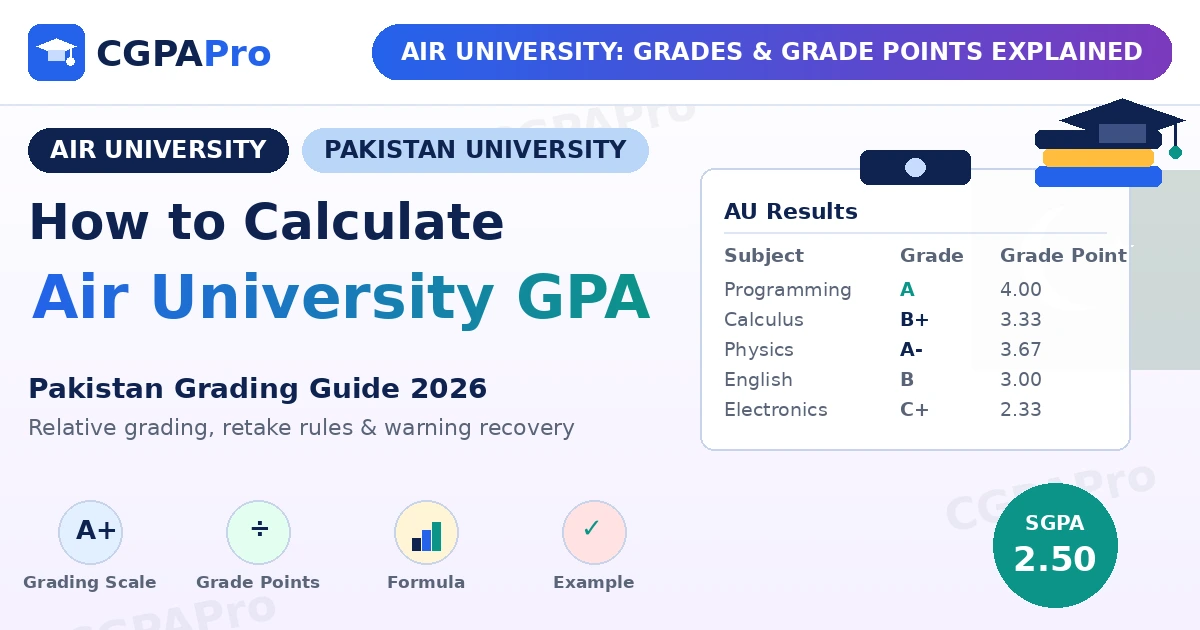
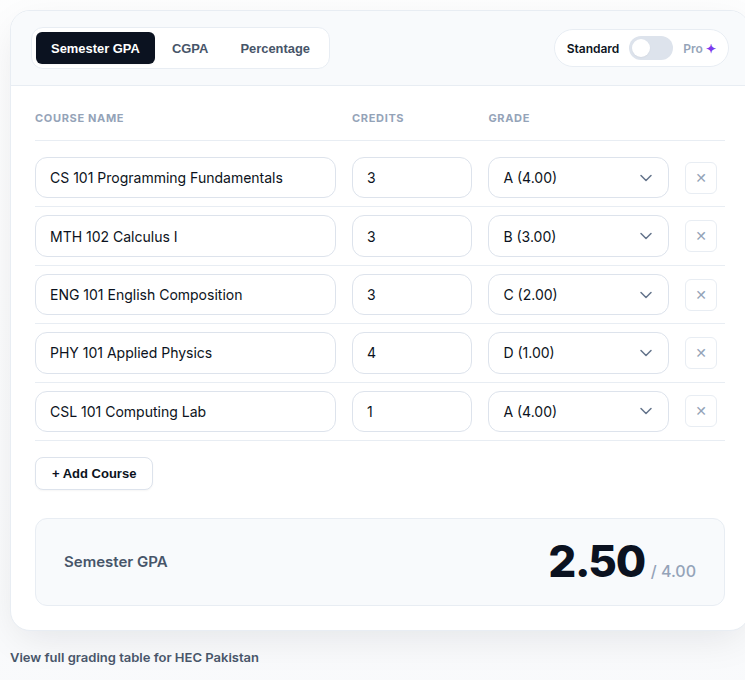
Take a first-semester-style load — the same one shown in the calculator screenshot above. All grades here use values identical on AU’s official table and any correct calculator:
| Course | Cr Hrs | Grade | Grade Point | Earned Points |
|---|---|---|---|---|
| CS 101 — Programming Fundamentals | 3 | A | 4.00 | 3 × 4.00 = 12.00 |
| MTH 102 — Calculus I | 3 | B | 3.00 | 3 × 3.00 = 9.00 |
| ENG 101 — English Composition | 3 | C | 2.00 | 3 × 2.00 = 6.00 |
| PHY 101 — Applied Physics | 4 | D | 1.00 | 4 × 1.00 = 4.00 |
| CSL 101 — Computing Lab | 1 | A | 4.00 | 1 × 4.00 = 4.00 |
| Total | 14 | 35.00 |
SGPA = 35.00 ÷ 14 = 2.50 — verified exactly, and it matches the calculator screenshot above. Notice how the 4-credit Physics D drags: it contributes only 4 points from 4 credit hours, while the 1-credit lab A contributes 4 points from a single hour. Credit hours are leverage — they amplify both your best and your worst grades.
Where does 2.50 sit? Right on the boundary of AU’s Fair band (2.50–2.999) — comfortably above the 2.00 graduation floor, but with no margin to spare.
Worked example 2: CGPA across two semesters
CGPA is just the same weighted math stretched over your whole degree. Say:
- Semester 1: 17 credit hours, SGPA 2.65 → 17 × 2.65 = 45.05 grade points
- Semester 2: 18 credit hours, SGPA 3.10 → 18 × 3.10 = 55.80 grade points
Total: 35 credit hours, 100.85 grade points.
CGPA = 100.85 ÷ 35 = 2.88 (Fair band). Notice it’s not the simple average of 2.65 and 3.10 (which would be 2.875 — close here, but the gap widens when semesters carry different credit loads). Always weight by credit hours. If you only remember your SGPAs, the AU calculator’s CGPA mode does this weighting for you.
Compare this with how other Pakistani universities run the same math — NUST, FAST-NU, IBA and COMSATS all use credit-weighted formulas, but their grade-point values and bands differ, so never mix tables between universities.
Worked example 3: official plus/minus values on a transcript
When your result shows plus/minus grades, AU’s official decimals apply. A second-semester-style example:
| Course | Cr Hrs | Grade | Grade Point | Earned Points |
|---|---|---|---|---|
| CS 201 — Data Structures | 3 | A− | 3.67 | 3 × 3.67 = 11.01 |
| MTH 203 — Discrete Structures | 3 | B+ | 3.33 | 3 × 3.33 = 9.99 |
| ENG 201 — Technical Writing | 2 | B− | 2.67 | 2 × 2.67 = 5.34 |
| EE 202 — Circuits & Electronics | 4 | C+ | 2.33 | 4 × 2.33 = 9.32 |
| Total | 12 | 35.66 |
SGPA = 35.66 ÷ 12 = 2.97. The difference between B+ (3.33) and B (3.00) on a 3-credit course is a full 0.99 grade points — nearly a point of SGPA swing per semester if it happens twice. Under relative grading, those plus/minus boundaries are where the curve bites hardest: a few marks can flip you across a grade boundary worth a third of a point.
GPA vs SGPA vs CGPA at Air University
AU’s regulations use the terms precisely, and mixing them up causes real confusion:
- GPA — the generic term: grade points earned ÷ credit hours, however you scope it.
- SGPA (Semester GPA) — scoped to one semester only. This is what each semester’s result slip reports.
- CGPA (Cumulative GPA) — scoped to your entire degree: every semester’s points over every credit hour attempted. This is the number on your transcript, the number employers and foreign universities ask for, and the number that determines your academic standing.
Your standing, warnings, honors — everything official — runs on CGPA, never on a single semester’s SGPA.
Academic standings: where your CGPA puts you
At the end of every semester, AU slots your CGPA into one of these bands (undergraduate):
| CGPA | Academic Standing |
|---|---|
| 3.75 – 4.00 | High Honors |
| 3.50 – 3.749 | Honors |
| 3.00 – 3.499 | Good |
| 2.50 – 2.999 | Fair |
| 2.00 – 2.499 | Satisfactory |
| 1.80 – 1.999 | Warning |
| 1.50 – 1.799 | Serious Warning |
| Below 1.50 | Dismissed — ineligible to rejoin AU |
Falling below 2.00 makes you an Academically Deficient case, and the consequences escalate fast:
- Warning (1.80–1.99): reduced course load, some new courses allowed. You must clear your F grades or retake low-grade courses, and you must drag your CGPA back to at least 2.00 within the next two semesters.
- Serious Warning (1.50–1.79): reduced load, no new courses at all — you repeat and repair only.
- Dismissal: a third consecutive Warning/Serious Warning, or accumulating unresolved F grades across 21+ credit hours. Below 1.50, dismissal is immediate and you cannot rejoin.
Two relief valves: the summer semester can’t generate warnings or dismissals, and F-grades in electives can be replaced with an alternative elective (with the Dean’s approval) instead of repeating the same course.
Warning recovery: the exact math to climb back to 2.00
This is the calculation AU students on Warning actually need, and almost nobody writes it down. Say your CGPA is 1.85 over 30 completed credit hours. Your earned grade points: 30 × 1.85 = 55.5.
You must reach 2.00 within two semesters. Take a normal 15-credit semester and call your needed SGPA x:
(55.5 + 15x) ÷ 45 ≥ 2.00 → 55.5 + 15x ≥ 90 → x ≥ 2.30
So one 15-credit semester at SGPA 2.30 lifts you to exactly 2.00 (verify: (55.5 + 34.5) ÷ 45 = 2.00). With a heavier 18-credit semester, the bar drops slightly to 2.25 — but you also risk more if a course goes badly. The strategic insight: on Warning, fewer, safer credits beat a packed schedule, because every credit hour is a chance for the denominator to punish you. Pair this with repeats: retaking a 3-credit D and turning it into a B adds (3 × 3.00 − 3 × 1.00) = 6 grade points at zero new credit hours — the fastest CGPA repair in the book, since only your highest attempt counts.
Retake and repeat rules: AU’s actual policy
Straight from the regulations, because this is where money and semesters get wasted:
- Failed a core course? You must repeat it and pass before graduation. No alternative.
- Grade below B−? You may repeat the course purely for improvement — unless you’re on the academically-deficient dismissal track, in which case the option is closed.
- Which attempt counts? Every attempt stays visible on your transcript, but only the highest grade counts toward your CGPA. The old grade doesn’t average in — it’s replaced in the math.
- Early retake trap: if you retake early (as a graduating student, or because the course is next semester’s prerequisite), the highest grade you can be awarded is B — retaking a B− early can never become an A.
- Summer trap: in the summer semester, the highest awardable grade in any course is B+.
- Missed a mid-term? There’s no automatic makeup. Only the AU Review Committee can allow a retake in extreme cases, and it costs Rs 5,000 per course.
- Missed the final? You get an F unless the Vice Chancellor approves a retake — and you must apply within one week of missing it. On an approved retake, your internal grades stand.
- Failed a lab? Fail the theory and you must retake the associated lab too; fail only the lab and you repeat just the lab.
The three hidden F-traps (non-academic failures)
These end more AU transcripts than difficult exams do:
- Attendance below 75% — you’re barred from the final and handed an F (or an I if your internals were 50%+, which still forces a repeat). Attendance isn’t pastoral advice at AU; it’s a grading rule.
- Missing the End-Semester Exam — automatic F, whatever your internals were, unless you secure VC approval within a week.
- Dropping after week 5 — the course converts to an F. Drop between weeks 3 and 5 and you get a W instead; drop in the first two weeks and it vanishes cleanly.
Common mistakes AU students make
- Trusting fixed percentage tables from random websites. Undergrad grading is relative — an online table promising “85% = A” is describing the graduate bands, not your curve.
- Averaging SGPAs instead of credit-weighting. (2.65 + 3.10) ÷ 2 looks right until your semesters carry 17 vs 21 credits.
- Ignoring the attendance rule until the barred-from-finals notice arrives.
- Retaking early without knowing the B cap — burning a semester to convert a B− into a B.
- Letting a D sit in a core course. D earns credit, so students leave it — but anything below B− is repeatable, and a D-to-B repeat is the cheapest CGPA repair available.
- Missing the 5-day grievance window. If a grade looks wrong, your written complaint must reach the HoD within five days of results. After that, the result stands.
Tips that actually move your AU CGPA
- Front-load quizzes and assignments. With 3+ internal exams per credit hour and results on AUAS within two weeks, your curve position is built long before finals.
- Protect your high-credit courses. A 4-credit A is worth four 1-credit As. Schedule study time proportional to credit hours, not course count.
- Use repeats surgically. One repeated D→B on a 3-credit course adds 6 grade points with zero new credit hours — no new course can match that efficiency.
- Check AUAS, not rumors. Quiz and assignment marks must be posted within two weeks. If they’re missing, ask — errors caught early get fixed; errors found at result time become grievances.
- Plan summer deliberately. No warnings can come from summer, but grades cap at B+ — use it to clear backlogs, not to chase an A.
- Same rules, every campus. Chapter IV applies to Islamabad, Multan, and affiliated colleges alike (campuses only adjust their own exam schedules), so this guide holds wherever you study at AU. Confirm local schedules with your campus exams office.
Frequently asked questions
Does Air University use relative grading?
Yes — for undergraduate courses. Instructors assign letter grades from the class’s mark distribution (a histogram), so the percentage needed for each letter shifts every semester. Graduate programs (MS/MPhil/PhD) use fixed absolute bands instead.
What is the minimum CGPA required to graduate from Air University?
Effectively 2.00. Any undergraduate below 2.00 is classified as Academically Deficient and placed on Warning, and you must also have repeated and passed every failed core course. Check your current program handbook for any department-specific additions.
If I repeat a course at AU, which grade counts toward my CGPA?
Only the highest grade among your attempts counts in the CGPA math — but every attempt remains visible on your transcript. Remember the caps: B max on an early retake, B+ max in summer.
Is D a passing grade at Air University?
Yes for undergraduates — D (1.00 grade points) earns credit and is the lowest passing grade. For graduate students D doesn’t exist; C (2.00) is their floor. A D still drags your CGPA, and since you may repeat anything below B−, repeating a D is often worth it.
Can short attendance fail me at Air University?
Yes. Below 75% attendance you can be barred from the final exam and awarded an F — or an I (Incomplete) if your internal assessment was 50% or higher, which still means repeating the course.
What CGPA do I need for High Honors at Air University?
3.75 to 4.00 earns the High Honors standing; 3.50–3.749 is Honors. Both are determined by CGPA at the end of each semester.
How is AU’s admission aggregate different from GPA?
Completely different math. The admission aggregate (for entry) blends your matric/intermediate percentages with the entry test score — see our Pakistan admission aggregate guide. GPA/CGPA only starts once you’re enrolled and measures semester performance.
Bottom line
Air University’s system rewards two things above all: consistency across the semester (because the curve and the 45/25 weightage punish coasting), and strategic repeats (because only your best attempt counts, and a D-to-B repeat is the highest-leverage move on the board). Keep your attendance above 75%, never miss a final without filing within a week, and run every “what-if” through the AU GPA calculator before you commit to a course load. The students who treat the regulations as a playbook — not fine print — are the ones sitting in the Honors bands.
Sources: Air University Academic Regulations, Chapter IV (Rev. 10, Nov 2021) — official PDF; grade tables B-1/B-2, standings C-1, deficiency rules Appendix D. Policies may be amended — confirm against your current program handbook.