If you google “GIKI grading system,” the top calculator page tells you GIKI uses A+ 4.0, A 3.7, A− 3.3, B+ 3.0 — neat little HEC bands with percentage ranges attached. It’s completely wrong. GIKI has no A+ at all, its A− is worth 3.67 (not 3.3), its B+ is worth 3.33 (not 3.0), and the Institute has never published percentage cut-offs for those letters. Students who plan their semesters on that page are computing a GPA their transcript will never show.
This guide fixes that. Every table, rule and number below comes from the GIK Institute Undergraduate Prospectus 2024 (the Institute’s own document on giki.edu.pk), verified line by line. You’ll get the real fractional grade table, the exact GPA formula, two hand-checked worked examples, the probation-and-dismissal ladder that can end your enrollment, and the repeat rules — including one trap almost nobody tells freshmen about.
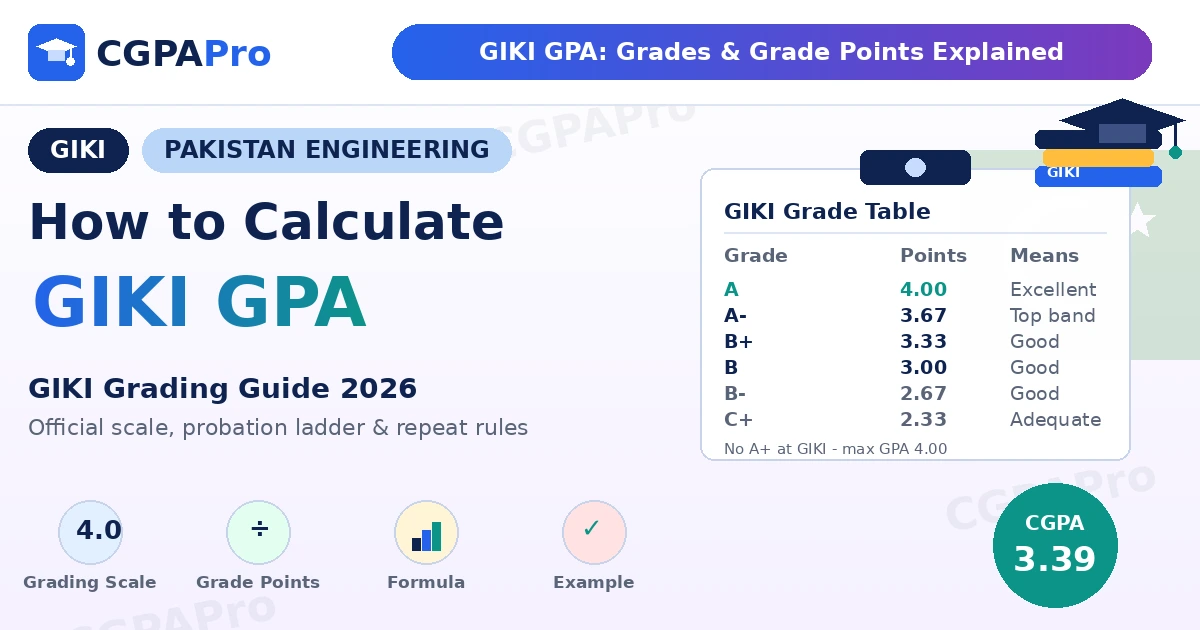
Quick answer: GIKI grades on a 4.00 scale with no A+: A = 4.00, A− = 3.67, B+ = 3.33, B = 3.00, B− = 2.67, C+ = 2.33, C = 2.00, C− = 1.67, D+ = 1.33, D = 1.00, F = 0.00. Semester GPA and CGPA are credit-weighted: Σ (credit hours × grade points) ÷ Σ credit hours. You need a 2.00 semester GPA to stay off probation and a 2.00 CGPA (with 132–136 credits) to graduate. Two consecutive sub-2.00 semesters and your name comes off the roll.
Try it: calculate your semester GPA
Before the tables, a feel for the math. Type in your courses — name, credit hours, letter grade — and the calculator runs the credit-weighted formula for you. One honest heads-up: GIKI doesn’t have a dedicated calculator page on this site yet, so the screenshot shows our general homepage calculator, which runs a generic grade scale (not GIKI’s official one). That’s why the worked example below uses only B and F grades: B is worth 3.00 and F worth 0.00 on both scales, so the result — 2.50 — is exact either way. The full official-scale example, with A− and B+ and all the thirds, comes right after the screenshot.
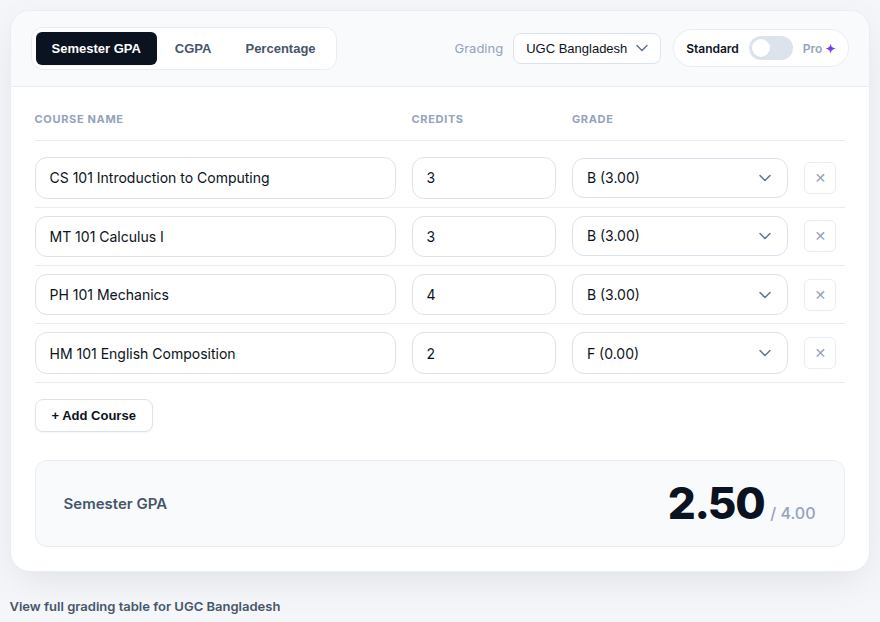
GIKI’s official grading table (Undergraduate Prospectus 2024)
Here is the “Grading System” table from the Examinations section of GIKI’s own prospectus. There are no percentage bands in the official document — the Institute publishes grade points per credit, not percentage cut-offs — so ignore any site that tells you “85–89% = A.” Each grade also carries an official performance descriptor:
| Grade | Grade points per credit | Official meaning |
|---|---|---|
| A | 4.00 | Excellent — the ceiling. There is no A+ above it |
| A− | 3.67 | Within the Excellent band |
| B+ | 3.33 | Within the Good band |
| B | 3.00 | Good — the honest middle of a GIKI transcript |
| B− | 2.67 | Within the Good band |
| C+ | 2.33 | Within the Adequate band |
| C | 2.00 | Adequate |
| C− | 1.67 | Within the Adequate band |
| D+ | 1.33 | Within the Minimum-acceptable band |
| D | 1.00 | Minimum acceptable — the lowest passing grade |
| F | 0.00 | Failure — you earn no credit and must repeat the course |
| I | — | Incomplete — not counted in GPA |
| E | — | Exemption — not counted in GPA |
| W | — | Withdrawn — not counted in GPA |
Three things to notice. First, the plus/minus grades use fractional thirds — 3.67, 3.33, 2.67, 2.33, 1.67, 1.33 — not the rounded 3.7/3.3/2.7 values generic Pakistani calculators use. Over a full transcript, that rounding error compounds: a student with six A− grades “loses” 0.02 per credit hour on a rounded table, which is the difference between a 3.61 and a 3.65 on paper. Second, D (1.00) still passes at GIKI — it earns credit, it’s just the floor. Third, an I, E or W contributes nothing to the GPA math: no points, no credits in the denominator. A withdrawn course doesn’t “drag” anything; it simply vanishes from the average (though it stays visible on the transcript).
About those missing percentage bands: GIKI doesn’t fix them institute-wide. Each course’s outline sets its own thresholds — one official Mechanics of Solids outline, for instance, required students to clear the higher of a minimum 35% score or the class average minus 1.5 standard deviations just to pass. That means two students with identical percentages in different courses can legitimately get different letters. When in doubt, the course outline your instructor hands out in week one is the real document, not a blog table.
Read more: Air University Grading System 2026: GPA & CGPA Guide — another top Pakistani university, but one that publishes explicit percentage bands and grades relatively. Seeing the two side by side shows exactly why “the HEC scale” is a myth: each university runs its own table.
How to calculate your GPA, step by step
The prospectus defines academic standing as “the ratio of the total number of grade points earned to the total number of credits attempted,” with 4.00 as the maximum. In plain steps:
- Convert each letter grade to grade points using GIKI’s official table above — A = 4.00, A− = 3.67, B+ = 3.33, and so on down to F = 0.00.
- Multiply each course’s grade points by its credit hours. The product is the course’s quality points (GIKI calls the per-credit value “grade points per credit,” or GPC).
- Add up all quality points across graded courses.
- Add up all credit hours of graded courses. Skip I, E and W grades entirely — they don’t enter either total.
- Divide total quality points by total credit hours. That’s your semester GPA (SGPA).
Your CGPA is the same division stretched across your whole degree: every graded course from your first semester to your last, credit-weighted together. One credit-hour subtlety that trips people up: a 4-credit lab (3 contact hours of practical work per week = 1 credit hour at GIKI) weighs the same as a 4-credit theory course. Credits are credits — the formula doesn’t care what type of course they belong to. If you want more practice with the mechanics, our step-by-step SGPA guide with formula examples walks through the same method on different numbers.
Worked example: a first-year semester, fully calculated
Five typical first-year courses with realistic GIKI grades. Every grade point is the official value from the table above:
| Course | Credits | Grade | Grade points | Quality points |
|---|---|---|---|---|
| CS 101 Introduction to Computing | 3 | A | 4.00 | 3 × 4.00 = 12.00 |
| MT 101 Calculus I | 3 | B+ | 3.33 | 3 × 3.33 = 9.99 |
| PH 101 Mechanics | 3 | B | 3.00 | 3 × 3.00 = 9.00 |
| HM 101 English Composition | 2 | A− | 3.67 | 2 × 3.67 = 7.34 |
| PH 111 Physics Lab | 1 | C+ | 2.33 | 1 × 2.33 = 2.33 |
| Total | 12 | 40.66 |
Semester GPA = 40.66 ÷ 12 = 3.388… → 3.39
Verify the addition: 12.00 + 9.99 = 21.99; + 9.00 = 30.99; + 7.34 = 38.33; + 2.33 = 40.66. And 40.66 ÷ 12 = 3.3883, which rounds to 3.39.
Now watch what the wrong table does to the same transcript. A generic “HEC” calculator uses A− = 3.7, B+ = 3.3, C+ = 2.3 (rounded) and computes 12.00 + 9.90 + 9.00 + 7.40 + 2.30 = 40.60 ÷ 12 = 3.38. One hundredth lower. That sounds trivial until it’s your last semester and the scholarship cut-off is 3.40, or a graduate school asks for “3.5+” and your real 3.51 shows as 3.49 on a bad tool. Use the official thirds, always.
CGPA across semesters: the weighting trap
GIKI’s CGPA is not the average of your semester GPAs — it’s the average of your quality points over all credits. Take the student above into a second semester:
- Semester 1: 15 credits, SGPA 3.20 → quality points = 15 × 3.20 = 48.00
- Semester 2: 16 credits, SGPA 3.60 → quality points = 16 × 3.60 = 57.60
CGPA = (48.00 + 57.60) ÷ (15 + 16) = 105.60 ÷ 31 = 3.406… → 3.41
The naive average of the two SGPAs is (3.20 + 3.60) ÷ 2 = 3.40 — close, but wrong, because the second semester carried one more credit. With unequal credit loads (GIKI semesters run 15–18 credits normally, up to 21), the simple average always misleads. The credit-weighted CGPA is the only number the Institute recognizes.
There’s a second lesson buried in those numbers: the 3.20 semester contributed 48.00 of the 105.60 total points — nearly half the CGPA. Early semesters anchor your CGPA because they represent real credits. A rough first year can’t be “averaged away” by one good semester later; digging out takes several strong semesters or targeted repeats, which is exactly what the next two sections are about.
Semester GPA vs CGPA: which one GIKI actually watches
At GIKI the two numbers have different jobs, and confusing them is how students get blindsided:
- Semester GPA (SGPA) — one semester’s credit-weighted average. This is the number the probation rule watches: fall below 2.00 in any semester and you’re on probation. SGPA is a tripwire, not a verdict.
- CGPA — everything, from admission day onward. This is what graduation requires (minimum 2.00 at the end of 132–136 credits), what scholarships check, and what employers and foreign universities ask for.
So yes, you can be on probation (SGPA 1.85) while your CGPA sits comfortably at 3.10 — the probation is about the semester’s slide, not the degree’s standing. And the reverse is possible too: a 2.10 semester GPA that technically clears probation while your CGPA drifts under the 2.00 graduation floor. Both numbers matter, in different ways, at different times.
Read more: Dean’s List & Academic Probation: CGPA Thresholds Across Pakistani Universities — how GIKI’s 2.00 probation floor compares with other universities’ warning and dismissal bands, and what dean’s-list cut-offs typically look like where they’re published.
The probation ladder: warning, probation, removal from the roll
GIKI’s academic-standing machinery is one of the strictest and most clearly written in Pakistan. It runs on your semester GPA, and it has three rungs:
Rung 1 — Warning. One semester with SGPA below 2.00 earns a formal warning for poor performance. No credit restriction yet; it’s the Institute telling you the floor is getting close.
Rung 2 — Academic probation. If the sub-2.00 performance continues, you’re placed on probation. The practical sting: a probationer may register for only 10–13 credit hours (normally 15–18), which stretches the degree and makes CGPA recovery mathematically slower — fewer credits per semester means each bad semester’s credits weigh longer. This is deliberate: the Institute forces you to take a lighter load so you can actually fix the problem.
Rung 3 — Removal from the roll. If your SGPA stays below 2.00 for two consecutive semesters (summer school excluded), your name is removed from the roll of the Institute. That’s dismissal — the degree ends.
Two mercy clauses exist. Freshmen who hit two consecutive probations in their first two semesters may, on request, start fresh with no credit transfer — a full reset of the academic record, at the cost of losing everything earned. And summer school sessions don’t count toward the “two consecutive semesters” clock, so the eight-week summer term is genuinely a lifeline: it exists precisely for students who failed courses or want to repair D/D+ grades before the ladder advances.
A final sobering detail from the prospectus: the maximum duration of bachelor studies is 6 years (normal: 4). Probation’s credit caps plus the hard six-year ceiling mean you can’t recover indefinitely — every recovery plan has a clock on it.
Repeating courses: the rule and the trap
GIKI’s repeat policy is generous in scope and ruthless in one detail. The scope first:
- An F in a degree-required course must be repeated in full — there is no way around it. A substitute course is allowed only if the curriculum offers a genuine alternative.
- You may repeat any course in which you earned F, C−, D+ or D, provided you do it within 3 semesters of the semester you got the grade. Miss that window and the low grade is permanent.
- C or above cannot be repeated for grade improvement — the Institute won’t let you re-sit a B to chase an A.
Now the detail that catches students: all grades achieved appear on your transcript, but only the latest grade in chronological order counts toward the CGPA — even if the repeat grade is worse than the original.
Read that again. If you repeat a C− (1.67) hoping for a B and instead earn a D+ (1.33), your CGPA now uses the 1.33. The 1.67 is gone from the math (though still visible on the transcript). A repeat is a replacement, not a “best of both.” Repeat only when you’re confident of doing better — a panicked re-sit can literally lower your CGPA. If backlogs are weighing on your planning, our guide to calculating CGPA with failed subjects and backlogs shows how repeats and uncleared courses interact in the math.
Withdrawal, Incomplete, attendance and summer school
Four administrative rules that directly touch your GPA:
Withdrawal. With your Dean’s approval, you may withdraw from one or more courses between the 4th and 10th week of a semester. A W appears on the transcript but carries no grade points and enters neither side of the GPA division — it’s GPA-neutral. Withdraw after the 10th week and you’re awarded an F. The calendar math is unforgiving: week 11 of a bad course is worth 0.00 either way, but week 9 costs you nothing.
Incomplete. An I grade is given when a minor course component is outstanding for reasons beyond your control. You must complete it within the first two weeks of the next semester — you arrange this with the instructor yourself — or the I converts to an F. You also can’t re-register for the course while holding the I. Semester GPA is computed excluding the I and recalculated once the real grade lands.
Attendance. You must attend at least 80% of lectures and lab work per course to be allowed to sit the final examination. Since the final typically carries 50% of a course’s weightage, missing the exam for attendance reasons is effectively an F — regardless of your internal marks.
Summer school. An eight-week summer session runs each year for students who failed a course or want to improve D or D+ grades. Which courses run is decided by each Dean’s office based on demand, and students pay separately per course. Remember: summer sessions don’t count in the two-consecutive-semesters dismissal clock, so a summer repeat is often the safest recovery move.
Five mistakes GIKI students make with the math
1. Using the wrong grade table. The most common and most costly. Generic Pakistani GPA tools round GIKI’s thirds to tenths (3.7/3.3/2.7) or invent an A+ (4.00) that GIKI doesn’t award. A transcript of straight A− grades is a 3.67 at GIKI and a 3.70 on a rounded tool. Small per course, compounding across a degree.
2. Averaging semester GPAs instead of credit-weighting. (3.20 + 3.60) ÷ 2 = 3.40 is not a CGPA. With 15 and 16 credits, the real number is 3.41. With a 21-credit semester against a 12-credit one, the error gets much bigger.
3. Assuming an F disappears when you repeat. It stays on the transcript forever; only the math changes. And as shown above, a bad repeat can replace a mediocre grade with a worse one.
4. Treating “2.00” as one number. GIKI watches SGPA for probation and CGPA for graduation. A 1.90 semester triggers probation even with a 3.20 CGPA; a 2.05 semester is “safe” from probation while a 1.95 CGPA still blocks your degree.
5. Ignoring the attendance floor. The 80% rule is per course, not per semester. You can attend 95% of your classes overall and still be barred from one final if that one course dipped to 75%.
Tips that actually move a GIKI CGPA
Attack the credit-heavy courses first. A 4-credit course contributes 4 × grade points to your numerator. Moving a 4-credit course from C (2.00) to B (3.00) adds 4.00 quality points — the same as moving four 1-credit labs one full letter. Plan effort by credit weight, not by which course feels urgent.
Use the 3-semester repeat window early. F, C−, D+ and D grades can only be repeated within three semesters. A sophomore D+ that’s left to fester becomes permanent in senior year, when you need it gone most.
Time your withdrawals. If a course is clearly heading for an F, withdrawing in week 8–10 (Dean’s approval, W on transcript, zero GPA impact) beats the 0.00 every single time. Decide by week 9, not week 12.
Know what “good” means at GIKI. With no A+ and thirds-based bands, a 3.50+ CGPA at GIKI is genuinely strong — it typically needs a transcript dominated by A− and B+ grades, since A (4.00) is the ceiling. For context on how a 3.5 plays for jobs, scholarships and MS-abroad applications, see is 3.5 CGPA actually good for jobs, scholarships and studying abroad.
Track both numbers monthly. Keep a running SGPA projection for the current semester (probation tripwire) and a CGPA projection including planned repeats (graduation floor). Students who discover they’re at 1.95 in week 14 have options; students who discover it on result day have a warning letter. Our CGPA improvement strategies guide has the semester-planning math for climbing out of a hole.
Frequently asked questions
Does GIKI have an A+ grade?
No. GIKI’s scale tops out at A = 4.00, which the prospectus labels “Excellent.” Any calculator or article showing “A+ = 4.00” for GIKI is using a generic table — treat its numbers with suspicion.
What are GIKI’s exact grade points for A−, B+, C− and the other plus/minus grades?
A− = 3.67, B+ = 3.33, B− = 2.67, C+ = 2.33, C− = 1.67, D+ = 1.33. These fractional thirds are the official values from the Undergraduate Prospectus 2024 — not the rounded 3.7/3.3/2.7 figures you see on generic Pakistani GPA sites.
What CGPA do I need to graduate from GIKI?
A minimum 2.00 CGPA at the end of 132–136 credits (depending on your faculty). Below 2.00, you don’t graduate — regardless of how many credits you’ve earned.
What happens if my semester GPA drops below 2.00?
First a warning; then academic probation with a 10–13 credit-hour cap; then removal from the roll if your SGPA stays below 2.00 for two consecutive semesters (summer excluded). Freshmen who hit two consecutive probations in their first two semesters may request a complete restart with no credit transfer.
If I repeat a failed course, does the F disappear from my CGPA?
From the CGPA math, yes — but with a catch. Only the latest attempt counts toward your CGPA, even if it’s worse than the original, and every attempt stays visible on your transcript. You can repeat F, C−, D+ or D grades, but only within 3 semesters of earning them.
Can I withdraw from a course without hurting my GPA?
Yes, if you time it right. Withdraw between weeks 4 and 10 with your Dean’s approval and you get a W — no grade points, no credits in the GPA math. Withdraw after week 10 and you get an F. There is no middle ground.
Is there really an 80% attendance requirement?
Yes — per course. You need at least 80% attendance in each course’s lectures and lab work to sit its final examination, and the final typically carries 50% of the course’s weightage.
The bottom line
GIKI’s grading system is unusually honest: a published fractional table, a single clear formula, and a probation ladder with no surprises. The danger isn’t hidden rules — it’s wrong rules from generic calculators that invent an A+, round the thirds, and attach percentage bands the Institute never published. Calculate with the official table (A 4.00 down to F 0.00, thirds in between), credit-weight everything, keep your semester GPA at or above 2.00, and use the repeat window and summer school before the ladder moves. Do that, and the math is always on your side.
Sources: GIK Institute Undergraduate Prospectus 2024 (Examinations section), giki.edu.pk. Grading details and academic rules verified 2026-10-10. Percentage bands are not published institute-wide — check your individual course outlines. Dean’s List criteria are not documented in the prospectus; confirm with your Dean’s office.