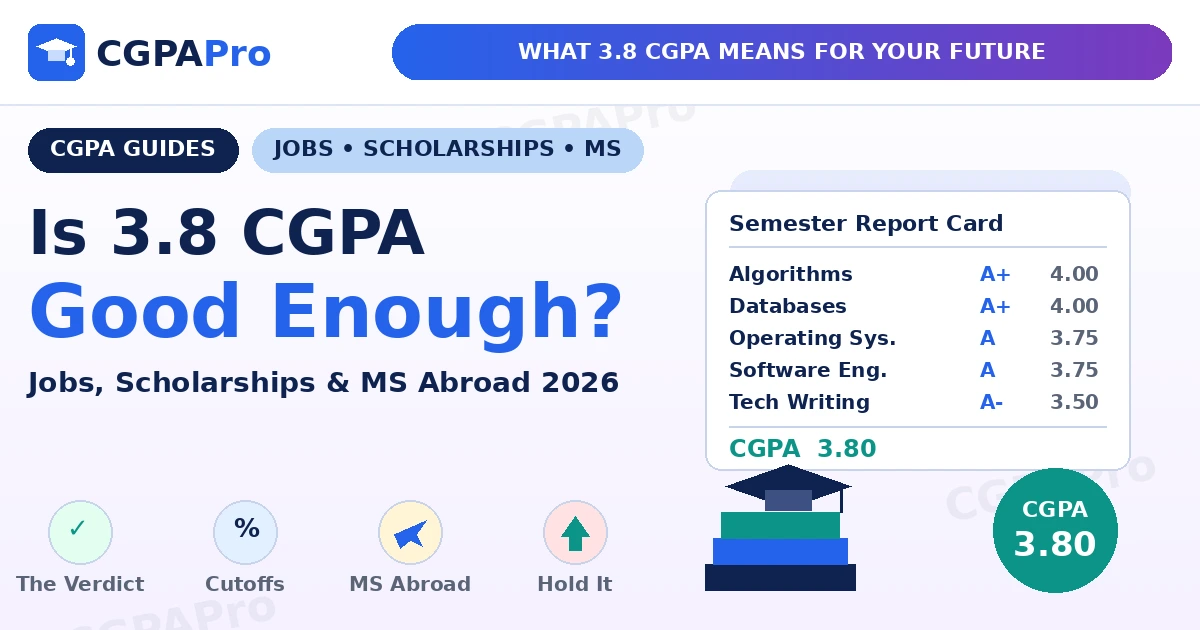
Short answer: yes — a 3.8 CGPA is genuinely excellent, and it changes the conversation. It doesn’t just clear the academic bar for jobs, scholarships, and MS programs abroad — it puts you on the strong side of the most competitive ones. Full-merit scholarship tiers that start at 3.7, ETH Zurich’s excellence-scholarship line at ~3.5, First Class honours in Malaysia and most of the UK’s 2:1-to-First borderline: a 3.8 is at or above all of them. But “excellent” is not the same as “guaranteed,” and the last 0.2 of a CGPA buys you less than most students think. This guide gives you the real numbers: the actual published cutoffs for Fulbright, Chevening, DAAD, MEXT, HEC, and Commonwealth; what universities in the US, UK, Germany, Canada, and Australia expect from a 3.8 applicant; where employers actually filter on CGPA — plus the honest math of raising a lower CGPA to 3.8, and the playbook for holding 3.8 through your final semesters.
If you’re still studying, start with your exact number — not the one you hope it is, but the one a university or employer will calculate. A CGPA calculator does that in about two minutes.
Step 1: Check Your Real CGPA Before Anything Else
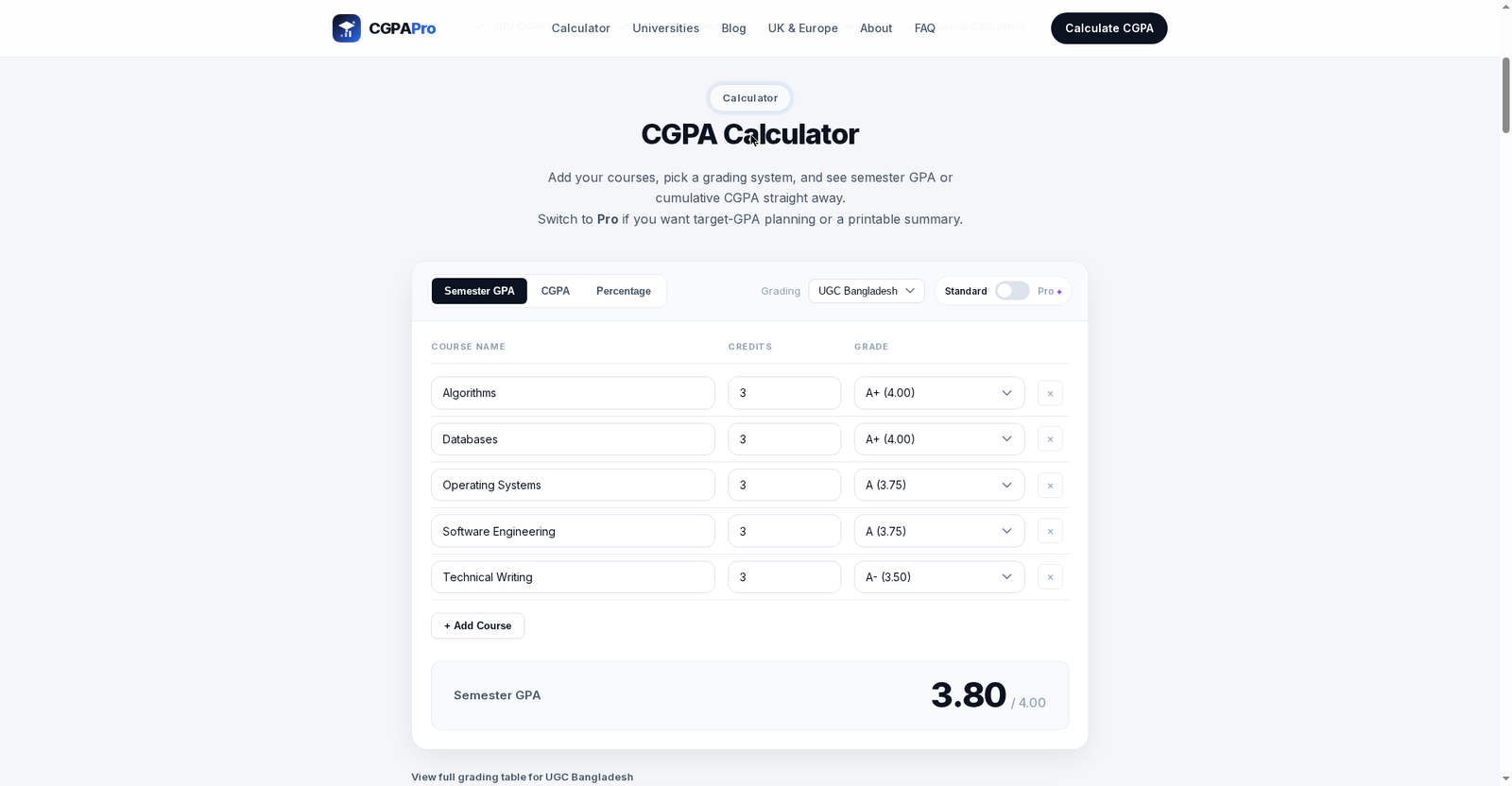
Don’t plan your applications around a rough guess. Pull up your transcripts and enter every course, grade, and credit hour into the free CGPA calculator at cgpacalculatorpro.com. It weights each course by its credit hours — the way universities actually compute it — instead of just averaging your semester GPAs, which is the mistake most students make.
Here’s a worked example on the calculator’s official UGC-Bangladesh 4.0 scale (A+ 4.00, A 3.75, A− 3.50, B+ 3.25, B 3.00, B− 2.75, C+ 2.50, C 2.25, D 2.00, F 0.00):
Once you have your number, confirm which scale your university uses. The rest of this guide assumes the 4.0 scale unless stated otherwise — and note that a 3.8 on a 4.0 scale is a completely different animal from anything on India’s 10-point scale (where 3.8/10 would be a disaster). If you’re on a 10-point scale, read our 10-point to 4.0 conversion guide before doing anything else.
What a 3.8 CGPA Actually Means, in Plain Numbers
A CGPA of 3.8 out of 4.0 means you’ve averaged roughly an A− across your entire degree — mostly A’s with a few A−’s sprinkled in. For perspective, the national average GPA in the US is around 3.0. You’re nearly a full point above average. Here’s how that translates across the systems you’ll actually encounter:
| System | 3.8 CGPA equivalent | What it signals |
|---|---|---|
| 4.0 scale | 3.8 (A− average) | Excellent — top-decile performance at most universities |
| Naive percentage (×25) | ≈ 95% | Only a communication shortcut — not an official conversion |
| HEC Pakistan | Deep inside First Division (3.0–4.0) | Elite bracket on every Pakistani application form |
| 10-point scale (India) | ≈ 9.5 CGPA | First Class with Distinction at most Indian universities |
| UK degree classification | High 2:1, borderline First | Meets the 2:1 bar every major UK scholarship asks for — and touches First |
| German grade system | ≈ 1.4–1.5 (“sehr gut”) | Very good, via the modified Bavarian formula |
| Malaysia public universities | Above First Class (3.67) | Clears First Class at UM, UiTM, UKM, USM and all the rest |
| US Latin honors | Magna cum laude territory (typically 3.7–3.8) | Varies by university — summa usually starts around 3.9 |
Two honest caveats before you quote these numbers anywhere important:
First, the ×25 percentage conversion is a rough shortcut, not an official formula. 3.8 × 25 = 95%, but no credential evaluator works that way. HEC Pakistan’s own band-conversion rules map CGPAs to percentage bands using band minimums, not multiplication. And WES — the evaluator most US/Canadian universities use — looks at your actual grades, your university’s grading scale, and institutional norms. So 95% is a fine number for a conversation; it is not a number for a transcript. Our CGPA-to-percentage conversion guide walks through which method to use in each situation.
Second, grading standards differ wildly between universities. A 3.8 from a department famous for strict grading often impresses admissions officers more than a 3.9 from an easy-grading one — which is exactly why Fulbright’s selection panel reviews transcripts holistically rather than on the number alone. Keep this in mind the next time you panic that someone else has a 3.85 and you have a 3.8: reviewers see the context, not just the digit.
Jobs: Where a 3.8 Clears Every Cutoff (and What Actually Gets You Hired)
Let’s be blunt: for most jobs, a 3.8 CGPA is a complete non-issue — in your favor. The real question is whether you clear the automated filters companies use at the first screening stage. Here’s the honest map:
Pakistan
Corporate recruiters in Karachi and Lahore commonly use 3.0 as the minimum screen, and bank Management Trainee Officer (MTO) programs — HBL, UBL, MCB and the rest — typically ask for CGPA 3.0/4.0 or 70% marks from an HEC-recognized university. Meezan Bank’s Meezanship trainee program (2026 batch) listed a minimum CGPA of 2.60 or 60% marks; Allied Bank’s MTIT program didn’t publish a GPA floor at all. At 3.8, you clear every one of these with room to spare. You’re also deep in HEC’s First Division bracket (3.0–4.0), which is the classification most government application forms expect when they ask for “division.” Selection at banks runs on an aptitude test, assessment center, and panel interview — the CGPA just gets you through the door, and at 3.8 the door is wide open.
Bangladesh
Multinational companies, banks, and large local groups in Dhaka typically set fresher filters at 3.0–3.25 CGPA. Nestlé’s Nesternship internship asks applicants to keep their CGPA above 3.00. At 3.8 you’re a top-decile number on any Dhaka CV. Government jobs (BCS and similar) work on division-based criteria, not CGPA cutoffs — a 3.8 is comfortably First Class with Honours territory. And if you’re at a Bangladeshi private university: merit scholarship tiers often need 3.75+ for full tuition waivers, so a 3.8 sits right at the full-waiver line (check your university’s current circular — continuation usually requires holding ~3.5+).
India
India uses the 10-point scale, and your 3.8/4.0 converts to roughly 9.5/10 — which clears every IT cutoff in the country:
- TCS (Ninja): minimum 60% / 6.0 CGPA — cleared with enormous margin
- Infosys: minimum 65% / 6.5 CGPA — cleared
- Wipro: minimum 60% — cleared
- Premium tracks (Infosys Power Programmer, TCS Digital, Cognizant GenC Next): 7.0–7.5 cutoffs — cleared
- Google / Microsoft / Amazon: reported 8.0+ campus screens — you’re above 8.0, but these companies screen mostly on coding tests and interviews; CGPA alone won’t carry you, and none of them publish official GPA floors for general hiring
The pattern is the same everywhere: 3.8 clears every standard corporate cutoff. The only question left is the one students keep asking on Reddit and Quora: “is my 3.8 enough for a job at a high-tech company?” The answer is that once you’re past the screen, nobody hires a 3.8 over a 3.6 for the number — they hire for skills, projects, and interview performance. Your CGPA opened the door; your portfolio walks you through it. And after your first job, employers stop asking about CGPA almost entirely — experience and skills take over within two to three years.
Scholarships: The Real GPA Bars
This is the section every other “is 3.8 CGPA good” article gets wrong by being vague. Here are the actual published criteria, as stated for recent cycles. Always check the current cycle’s official page before applying — criteria shift year to year.
| Scholarship | Published CGPA/academic bar | Does 3.8 clear it? |
|---|---|---|
| Fulbright (Pakistan, via USEFP) | No official minimum GPA — holistic review; strong undergraduate record expected; GRE carries heavy weight | Yes — comfortably. You’re in the “strong record” group |
| HEC Overseas (MS/MPhil & PhD) | Minimum 3.0/4.0 or first division; max one second division before the final degree | Yes — by a wide margin |
| Commonwealth (HEC Pakistan) | First-division 16-year bachelor’s + HAT ≥ 60/100; CSC requires at least UK 2:1 | Yes |
| Chevening (UK) | Degree equivalent to UK 2:1 — “usually a strong First Class or CGPA 3.0+/4.0” — plus 2 years’ work experience | Yes — exceeds it; selection turns on leadership + experience |
| DAAD (Germany) | No strict fixed GPA; roughly 2.5–3.0/4.0 expected; 3.0+ competitive; EPOS needs above-average record + 2 yrs experience | Yes — well into competitive territory |
| MEXT (Japan) | Minimum 2.30/3.00 on MEXT’s own scale for the university track | Yes — easily; the real filter is the supervisor/university track |
| Australia Awards | Academic excellence assessed in context; competitive applicants hold strong first-class records | Yes — 3.8 is a strong first-class record |
| US university full merit | Typically 3.7–3.9/4.0 for full-tuition awards; continuation usually requires holding 3.5–3.7 | Yes — you’re AT the line; strong at most schools |
| ETH Zurich ESOP | Top 10% of bachelor’s cohort, ≈ 3.5/4.0+ equivalent; CHF 13,500/semester + tuition waiver | Yes — clears the scholarship line |
Fulbright (Pakistan)
The Fulbright Degree Program administered by USEFP is the scholarship Pakistani students ask about most — and it’s the one with the most misunderstood criteria. There is no official minimum GPA to apply. The selection panel looks at your transcripts holistically: where you studied, what courses you took, how you performed in your major subjects, and the fact that grading standards differ across Pakistani universities. A 3.8 puts you squarely in the “strong undergraduate record” group. The harder filter is the GRE — 145+ per section is the published minimum, and a 310+ combined score is commonly recommended; a strong GRE can compensate for a weaker CGPA, so at 3.8 plus a strong GRE you’re a genuinely competitive applicant. Always check the current cycle’s official page before applying — USEFP’s published GRE minimums and deadlines shift between cycles (for a recent cycle-by-cycle walkthrough, see PakEra’s Fulbright Pakistan application guide).
HEC Overseas Scholarships
The HEC Overseas Scholarship (Phase-III, Batch-IV in the 2026 round) needs a minimum 3.0/4.0 under the semester system or a first division under the annual system, with at most one second division anywhere in your academic record before the final degree. Successful applicants are placed at universities ranked in the top 200 worldwide. A 3.8 clears the eligibility bar by a full 0.8 — the competitive part is the HAT/GAT test score and the field-specific shortlisting, not the CGPA. (For the 2026 round’s full eligibility and thematic areas, see this HEC Overseas Scholarship 2026 breakdown.)
Chevening (UK)
Chevening wants a degree equivalent to a UK upper second-class (2:1) honours — described as “usually a strong First Class or a CGPA of 3.0+ out of 4.0.” Your 3.8 exceeds that. But note what Chevening really selects on: leadership potential and two years of work experience (2,800 hours). A 3.8 with a thin profile loses to a 3.2 with a strong one. If Chevening is your target, your CGPA is already fine — invest your energy in the experience and essays.
DAAD (Germany)
DAAD doesn’t publish a hard GPA cutoff for most programs. The working expectation is roughly 2.5–3.0 on a 4.0 scale, with 3.0+ being genuinely competitive — and a 3.8 is well into competitive territory. For the EPOS development-related postgraduate courses, the requirement is an above-average degree plus two years of relevant professional experience. Many German Master’s programs are fully English-taught, so don’t let the language question stop you; IELTS 6.0+ or a medium-of-instruction certificate is commonly accepted.
MEXT (Japan) — the scale that confuses everyone
Here’s a trap nobody explains: MEXT’s published minimum is 2.30 on MEXT’s own 3.00 scale — which is NOT the same as 2.30/4.00. On MEXT’s conversion, 80–89% bands map to 3.0 MEXT points and 70–79% to 2.0, so a 3.8/4.0 (≈90%+) converts to roughly 2.8–3.0 on the MEXT scale. You clear it easily. The real MEXT filter for the university-recommendation track is getting a supervisor’s recommendation and fitting the age pattern — not your CGPA. (See this MEXT eligibility breakdown for how the 2.30/3.00 scale is calculated.)
US university merit scholarships
Here’s where 3.8 shows its specific muscle. Competitive full-tuition merit awards typically expect 3.7–3.9/4.0 — which means at 3.8 you are at the line rather than safely above it. Partial merit (25–75% waivers) usually sits at 3.5–3.7. So a 3.8 makes you eligible for the top tier at many schools, but at the most selective ones the 3.9+ crowd is your competition. Note the continuation clause: most merit scholarships require you to maintain 3.5–3.7 in college or they shrink or disappear — read that fine print before you count the money.
The honest summary: a 3.8 CGPA makes you academically eligible for every major scholarship program on this list. The remaining game is test scores, work experience, essays, and recommendations. And here’s the thing students at 3.8 always ask on forums: “should I push for 3.9?” For scholarships, the honest answer is that the difference between 3.8 and 3.9 matters far less than a strong GRE score, a publication, or two years of relevant experience. Grades got you to the door; the rest of your profile walks you through.
MS Abroad With a 3.8 CGPA: Country by Country
Admissions expectations vary more by country than most students realize. Here’s a realistic map:
United States
A 3.8 is considered strong-to-excellent for US graduate admissions, and 3.0 is the minimum for most programs. Mid-tier and good state universities will welcome a 3.8 happily. Top-20 programs (Stanford, MIT, and peers) admit at averages around 3.7–3.9+, so a 3.8 is in the band — this is the tier where your number alone is genuinely competitive, and a 3.8 with a 320+ GRE, research experience, and strong recommendations is a serious application. Funded MS/PhD positions care more about research fit than about the difference between 3.7 and 3.9.
United Kingdom
UK universities think in classifications, not CGPA. A 3.8/4.0 lands at roughly a high 2:1, borderline First — some departments will map it straight to a First. That clears the 2:1 requirement that covers the vast majority of taught Master’s programs. The handful of programs that demand a First (Oxbridge, LSE, Imperial in competitive fields) are the only places where a 3.8 is a question mark rather than a green light — and even those assess international qualifications in context. Our UK degree classification to CGPA conversion guide has the full mapping.
Germany
German public universities charge little to no tuition, which makes Germany the best value-for-money destination on this list. Most Master’s programs require a first-division bachelor’s. Your 3.8/4.0 converts to approximately German grade 1.4–1.5 using the modified Bavarian formula — that’s “sehr gut” (very good) in the German system, comfortably above what most programs require. For the Swiss benchmark: ETH Zurich’s Excellence Scholarship (ESOP, CHF 13,500 per semester plus a tuition waiver) asks for top-10% of your cohort, roughly 3.5/4.0+ equivalent — a 3.8 clears that line too, though ETH admission itself is per-department.
Canada
Most Canadian universities ask for a minimum of 3.0/4.33 for Master’s admission, with competitive programs wanting 3.3+, and the top tier (Toronto, UBC, McGill, Waterloo) expecting 3.3–3.5+. A 3.8 is comfortably competitive for funded thesis-based Master’s and PhD positions. Grades get you past the cutoff; the research proposal, supervisor fit, and references decide.
Australia
Australian Group of Eight universities typically look for the equivalent of 3.0–3.5 for Master’s entry. A 3.8 is at the top of that band — a high-Distinction average. Australia Awards scholarships assess academic excellence in context alongside leadership and development impact, so a 3.8 with a strong story is a credible application.
Read More: Is 3.5 CGPA Good? Jobs, Scholarships & MS Abroad 2026
Wondering where the next tier down sits? Our Is 3.5 CGPA good guide covers the same jobs, scholarships, and country map for a 3.5 — useful if you’re comparing where you stand.
Below 3.8? The Real Math of Getting There
If you’re reading this with a 3.5 or 3.6 and a 3.8 target, here’s the part nobody else writes: the actual numbers. Wishful thinking doesn’t move CGPAs.
The formula: Required GPA = (Target CGPA × Total Credits − Current CGPA × Completed Credits) ÷ Remaining Credits
Example 1 — possible, but brutal: You’ve completed 60 credits at 3.6 and have 60 credits left. Required GPA = (3.8 × 120 − 3.6 × 60) ÷ 60 = (456 − 216) ÷ 60 = 240 ÷ 60 = 4.00. You’d need a perfect 4.00 average — straight A+’s on the UGC scale — across everything remaining. Mathematically possible, humanly extraordinary. One A− and you’re done.
Example 2 — impossible: You’ve completed 80 credits at 3.5 and have 40 credits left. Required GPA = (3.8 × 120 − 3.5 × 80) ÷ 40 = (456 − 280) ÷ 40 = 176 ÷ 40 = 4.40. That’s above the 4.00 maximum, so 3.8 is mathematically impossible. Your ceiling with straight A+’s: (280 + 160) ÷ 120 = 3.67 — which is still First Class in Malaysia and comfortably above every scholarship bar. Aim for the ceiling, not the fantasy.
Example 3 — the one-F disaster: You’re at 3.8 across 100 credits and take an F in a 3-credit course (no retake). New CGPA = (380 + 0) ÷ 103 = 3.69. A single failed 3-credit course costs you 0.11 — it knocks you out of the full-merit tier and the 3.75+ waiver line. This is why final-semester students at 3.8 should treat every course as load-bearing. (If your university lets you retake the F, do it immediately — one retaken course is the highest-leverage move in your entire transcript.)
The strategic takeaway: the closer you are to graduation, the more each remaining credit is worth and the less a retake can help. Run your own numbers with the CGPA calculator, set a target the math actually allows, and read our how to improve your CGPA guide for the full playbook.
Common Mistakes 3.8 Students Make
1. Rounding 3.79 (or 3.75) up to 3.8 on your CV
This is the single most common trap at this tier. If your transcript says 3.79, your CV says 3.79/4.0 — never 3.8. Recruiters and admissions offices verify against transcripts, and a rounded-up number reads as misrepresentation. The only exception: if your university officially rounds (some do at the second decimal), then the rounded figure is your real number. Otherwise, write the scale too — “CGPA: 3.79/4.0” — so nobody has to guess.
2. Confusing 10-point and 4-point scales
A 3.8 on India’s 10-point scale is roughly 1.5/4.0 — a failing-adjacent number. A 3.8/4.0 is roughly 9.5/10. Students mix these up on international application forms more often than you’d think, and an evaluator who sees “3.8/10” on a form will bin the application. Always write the scale: 3.8/4.0.
3. Claiming “95%” from the ×25 trick
3.8 × 25 = 95% is a fine party-trick conversion and a terrible official one. WES and other credential evaluators don’t do simple multiplication — they map your actual grades against your institution’s norms, and they routinely deflate grades from strict-grading universities. If a form asks for percentage, use your university’s official conversion table (HEC’s band rules in Pakistan, your university’s own table elsewhere). Our WES conversion guide explains exactly how evaluators handle this.
4. The retake trap
At 3.8, retaking a course you scored a B− in to squeeze out 0.03 of CGPA is almost always the wrong move. One retaken 3-credit course (B− → A+) on a 120-credit transcript moves your CGPA by about 0.03. That same semester spent on an internship, a research project, or GRE prep does more for your Fulbright/Chevening/MS application than the 0.03 ever will. Retakes are for D’s and F’s — at 3.8, you don’t have those.
5. Coasting in the final semesters
The number-one killer of 3.8s is the “I’m already safe” semester. Remember the disaster math above: one F in a 3-credit course costs 0.11. Even a lazy B− semester (say 2.75 across 15 credits on top of 3.8 × 10⁵) drops you to ~3.67 — out of the full-waiver tier at many Bangladeshi private universities, and out of the 3.75+ merit line at several US schools. The final year is where 3.8s are lost, not made.
6. Listing CGPA on your CV forever
Put your 3.8 on your CV for campus placements and your first job — it clears automated filters and signals strong academics. Once you have two to three years of experience, drop it; your work history replaces it. A senior engineer with “CGPA: 3.8/4.0” still on their CV looks like they haven’t done anything worth listing since graduation.
How to Protect (and Hold) Your 3.8 in the Final Semesters
Raising a 3.8 to a 3.9 is a terrible return on effort — the math barely moves. Protecting the 3.8 is where the real game is:
- Weight your remaining credits ruthlessly. Your final-year project or thesis often carries 6 credits — double or triple a normal course. One A in a 6-credit project counts as much as two A’s in regular courses. Prioritize high-credit courses; that’s where the math works hardest for you.
- Treat every 3-credit course as load-bearing. At 100+ credits, each 3-credit course is still worth ~0.025 of your CGPA. An F costs 0.11 (see the disaster example). Never let a “boring elective” become the course that eats your merit tier.
- Front-load the hard courses. If you know which remaining courses are graded strictly, take them while your motivation is highest — not in the final semester when you’re also job-hunting or writing applications.
- Know your Dean’s List line. Most universities set it at 3.5+ for the semester (some, like Malaysia’s public universities, at 3.50 over 12+ credits). Holding Dean’s List every remaining semester is both a transcript signal and a forcing function. Our Dean’s List & probation guide has the thresholds by system.
- Redirect the “push to 3.9” energy. A 3.8 with a 320+ GRE, a publication, or two years of relevant experience beats a 3.9 with none of those for Fulbright, Chevening, and funded MS positions. Grades got you to the door — spend final-year effort on what walks you through it.
Read More: Is 3.0 CGPA Good? Jobs, Scholarships & MS Guide 2026
Helping a friend at the other end of the scale? Our Is 3.0 CGPA good guide covers the same jobs-scholarships-MS map for a 3.0, including the rescue playbook and ceiling math.
Frequently Asked Questions
Is 3.8 CGPA good enough for the Fulbright scholarship?
Yes. Fulbright (via USEFP in Pakistan) has no official minimum GPA — selection is holistic. In practice, successful candidates have strong undergraduate records, and a 3.8 is comfortably in that range. The GRE matters a great deal in Fulbright selection (145+ per section is the published minimum, 310+ combined commonly recommended), so a strong GRE alongside your 3.8 makes a genuinely competitive application. Always check the current cycle’s criteria on USEFP’s official page.
Is 3.8 CGPA good for jobs in Bangladesh and Pakistan?
Yes — it’s excellent. Corporate and bank fresher filters in both countries sit at 3.0 (banks) to 3.25 (MNCs), and programs like Meezan Bank’s Meezanship ask for just 2.60. A 3.8 clears every published screen with margin, sits deep in HEC’s First Division bracket, and reads as top-decile on any Dhaka or Karachi CV. After your first job, employers stop asking about CGPA almost entirely.
What is 3.8 CGPA in percentage?
Roughly 95% using the common ×25 conversion — but that’s an approximation, not an official formula. For scholarship forms and credential evaluations, use your university’s official conversion table (HEC’s band rules in Pakistan), not multiplication. Check our CGPA-to-percentage guide for which conversion method to use in each situation.
Can I get into a top-20 US university with a 3.8 CGPA?
Yes — 3.8 is in the 3.7–3.9+ admitted-average band for top-20 programs (Stanford, MIT, and peers), so your number alone is genuinely competitive there. What decides it is the rest: GRE (where still considered), research experience, publications, and strong recommendations. Funded MS/PhD positions care more about research fit than about the difference between 3.7 and 3.9.
Is 3.8 CGPA enough for a full merit scholarship in the US?
You’re at the line: full-tuition merit awards typically expect 3.7–3.9/4.0, so a 3.8 makes you eligible at many schools but the 3.9+ crowd is your competition at the most selective ones. Partial merit (3.5–3.7) is comfortably yours. Watch the continuation clause — most awards require you to maintain 3.5–3.7 or they shrink. Apply widely; merit money is a numbers game.
I have a 3.6 CGPA. Is reaching 3.8 realistic?
It depends on how many credits you have left. With 60 credits done at 3.6 and 60 to go, you’d need a perfect 4.00 across everything remaining — mathematically possible, humanly extraordinary. With 80 done and 40 left, it’s mathematically impossible (you’d need 4.20), and your ceiling is 3.67. Run the formula in the math section above with your own numbers, aim for the ceiling the math allows, and remember that 3.67 still clears every scholarship bar on this page.
Should I put a 3.8 CGPA on my CV?
Yes, for campus placements and your first job — write it as “CGPA: 3.8/4.0” so recruiters see the scale. Never round 3.79 up to 3.8. Once you have two to three years of experience, remove it; your work history replaces it.
The Bottom Line
A 3.8 CGPA is not “good enough” — it’s genuinely excellent. It clears the academic requirements for Fulbright, HEC Overseas, Commonwealth, Chevening, DAAD, MEXT, Australia Awards, and US university full-merit tiers; it’s competitive for top-20 MS programs and the ETH Zurich excellence scholarship; and it clears every standard corporate cutoff in Bangladesh, Pakistan, and India. The students who lose out with a 3.8 aren’t losing on grades — they’re losing on weak test scores, thin experience, or generic essays. And if you’re below 3.8, the math section above gives you real targets: run your numbers, aim for the ceiling the formula allows, and remember that a 3.67 still unlocks everything on this page. Know your exact number with the CGPA calculator, protect it in your final semesters, and spend your energy on the parts of your profile that grades can’t buy.