KUET Grading System Bangladesh 2026: Grades, GPA & CGPA
At Khulna University of Engineering & Technology — KUET — your marks turn into letter grades, those letters turn into grade points, and those grade points run on the national UGC 4.00 scale that decides everything from your term GPA to your eligibility for graduate school abroad. The scale looks straightforward, with ten letter grades from A+ down to F, but the parts that actually affect your future are the ones nobody explains in one place: KUET has its own official formula for converting CGPA back into equivalent marks — the number foreign universities and employers actually ask for — and it is printed on the Controller of Examinations’ own certificate application form. Meanwhile, the M.Sc. programs on the same campus use a completely different grading table, a confusion that has wrecked more than a few conversion attempts.
Here is the short version. KUET’s undergraduate programs follow the UGC-prescribed 4.00 grading scale: 80+ marks is A+ (4.00), 75–79 is A (3.75), down through B+ (3.25), B (3.00), B− (2.75), C+ (2.50), C (2.25), and D (2.00) at 40–44 marks is the lowest passing grade. Anything below 40 is an F (0.00), and the course must be retaken and cleared. Your term GPA and cumulative CGPA are credit-weighted: Σ(grade point × credits) ÷ Σ(credits). You must finish your B.Sc. within 7 academic sessions of first enrolment, and the minimum CGPA to graduate is 2.20. Need your CGPA as a percentage for an application? KUET’s official formula says a 3.00 is 64%, a 3.50 is 74%, and a 3.90 is 91% — the exact math is in the conversion section below.
This guide is built from KUET’s own documents — the Controller of Examinations application form that prints the official CGPA-to-marks conversion formula, and the university’s academic clearance records that set the 7-session completion rule and the credit anatomy of a KUET degree — cross-checked against the independent CGPA calculators that KUET students built for their own use, which all implement the identical grade table. Where a rule comes from student-built tools or UGC norms rather than a published KUET ordinance, this guide says so plainly — and tells you to confirm it with your department.
The Short Answer: KUET Grades at a Glance
- Official scale (UGC 4.00, undergraduate): A+ 4.00 (80–100) | A 3.75 (75–79) | A− 3.50 (70–74) | B+ 3.25 (65–69) | B 3.00 (60–64) | B− 2.75 (55–59) | C+ 2.50 (50–54) | C 2.25 (45–49) | D 2.00 (40–44) | F 0.00 (below 40). The middle bands are where students misjudge their GPA.
- Passing grade: D (40 marks and above) is the lowest passing grade. F is a fail — the course must be retaken and cleared.
- GPA = total grade points ÷ total credits in that term. CGPA = total grade points ÷ total credits across all completed terms — always credit-weighted, never a simple average of term GPAs.
- Graduation floor: minimum CGPA 2.20 for the B.Sc. degree, and you must finish within 7 academic sessions of your first enrolment.
- CGPA-to-marks conversion: KUET’s official formula — 44 + 20×(CGPA − 2.00) for CGPA 2.20–3.75, and 79 + 80×(CGPA − 3.75) for CGPA 3.75–4.00. KUET literally issues a paid Grade Conversion Certificate (Tk. 50) using this math.
- Watch out: KUET’s M.Sc. programs (e.g. at IICT) use a different scale entirely — do not apply the B.Sc. table to postgraduate transcripts, or vice versa.
Calculate It Yourself: The CGPAPro KUET Calculator
Before the theory, the practical shortcut. CGPAPro’s KUET GPA calculator computes your term GPA and cumulative CGPA on KUET’s official UGC 4.00 scale — enter each course exactly as it appears on your academic record, and it does the credit-weighted math for you.
How to use it in about a minute:
- Add each course with its credit hours and the grade you earned (or expect), using KUET’s grades from A+ down to F — including sessional courses with their fractional credits (0.75, 1.50).
- Include every course — including fails. An F still costs you its credits in the divisor, so leaving it out gives you a number your transcript will never match.
- Enter sessional credits exactly. KUET engineering programs are full of 0.75 and 1.50-credit sessionals; the single most common “my calculator said 3.42 but the portal says 3.38” complaint traces back to rounding a sessional to 1 credit.
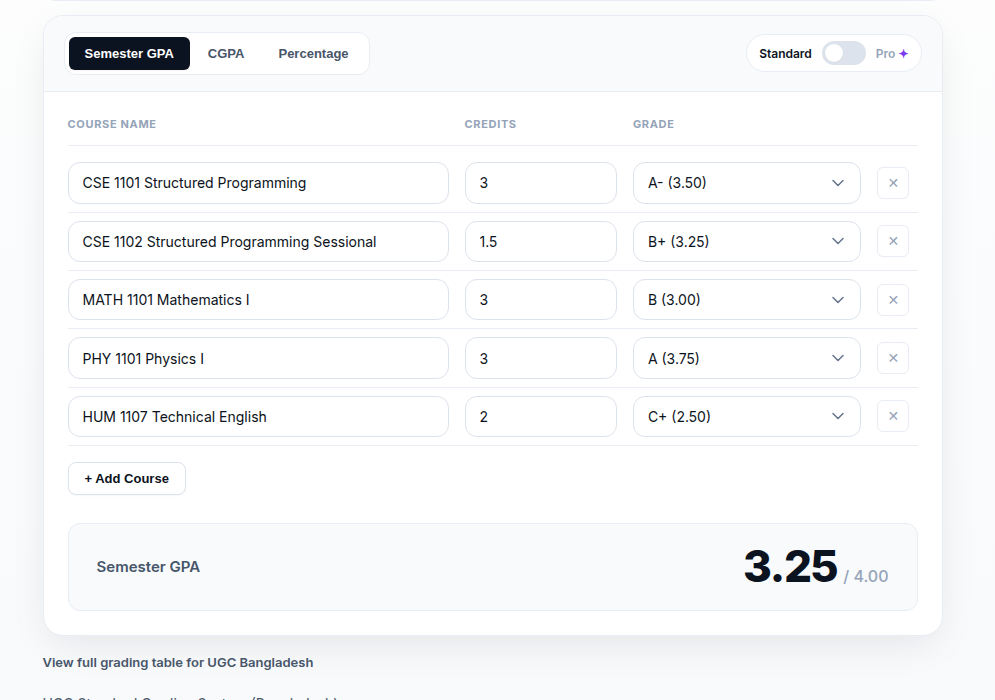
The general CGPA calculator is handy for what-if planning: plug in your current CGPA and completed credits, add next term’s expected grades, and see whether your target — say 3.50 — is reachable before results are even released.
Read More: CUET Grading System Bangladesh 2026: Grades, GPA & CGPA — KUET’s sister engineering university in Chattogram runs the same UGC scale, but with its own signature rule: CUET truncates your CGPA instead of rounding it.
The Official KUET Grading Table (2026)
This is the UGC-prescribed 4.00 scale used across KUET’s undergraduate programs — the same table the KUET student-built calculators implement as KUET’s official scale, and the same one locked into the university’s calculator tooling. Ten grades, fixed bands, no surprises except the ones that cost you:
| Marks | Grade | Grade Point | Status |
|---|---|---|---|
| 80 – 100 | A+ | 4.00 | Pass |
| 75 – 79 | A | 3.75 | Pass |
| 70 – 74 | A− | 3.50 | Pass |
| 65 – 69 | B+ | 3.25 | Pass |
| 60 – 64 | B | 3.00 | Pass |
| 55 – 59 | B− | 2.75 | Pass |
| 50 – 54 | C+ | 2.50 | Pass |
| 45 – 49 | C | 2.25 | Pass |
| 40 – 44 | D | 2.00 | Pass (lowest) |
| Below 40 | F | 0.00 | Fail — must retake |
The 39/40 line is the sharpest cliff in the table. A 40 gives you D (2.00) and the course counts as passed. A 39 gives you F (0.00) — zero grade points and a mandatory retake. One mark at this boundary is worth 2.00 grade points per credit, the single biggest per-mark swing anywhere on the scale. If you are anywhere near the pass line in a course, that is where your study hours buy the most.
The point steps are even — until the bottom. Every band from A+ down to D moves in clean 0.25 steps, which makes KUET’s scale unusually predictable: one grade band on a 3-credit course is always worth 0.75 grade points. The only break in the pattern is the bottom: D (2.00) to F (0.00) is a brutal 2.00-point drop. In practical terms, lifting a course from F to D moves your term GPA more than lifting a B to an A+. When you are choosing where to spend the last week before finals, rescue the near-fails first.
40 is the hard pass line, but D is not a “safe” grade. A D earns credit and keeps the course off your retake list, but at 2.00 it drags a term GPA down hard — one D in a 3-credit course costs you the same as dropping every other course a quarter grade. Students aiming for higher studies should treat D as a signal to look into improvement options, not as a result to keep.
How KUET Calculates Your GPA and CGPA — Step by Step
KUET evaluates you term by term — the GPA is the term average and the CGPA is the cumulative average across every term you have completed — both credit-weighted. The process works like this:
- Convert each course’s marks to a letter grade, then to its grade point using the official table (A− → 3.50, B+ → 3.25, C+ → 2.50, and so on).
- Multiply each grade point by the course’s credit hours. A 3-credit theory course with a B+ contributes 3 × 3.25 = 9.75 grade points. A 1.5-credit sessional with the same grade contributes 1.5 × 3.25 = 4.875.
- Add up all the grade points — your total grade points for the term.
- Add up all the credit hours — including the credits of any course you failed. Failed courses stay in the divisor until you clear them.
- Divide: GPA = total grade points ÷ total credits registered that term. CGPA = total grade points across all completed terms ÷ total credits across all completed terms.
The formula:
GPA = Σ (grade point × credit hours) ÷ Σ (credit hours)
CGPA = Σ (grade point × credit hours, all terms) ÷ Σ (credit hours, all terms)
One rule students get wrong constantly: your CGPA is not the average of your term GPAs. A 3.80 in a 12-credit term and a 3.00 in a 20-credit term do not average to 3.40 — the credit weights pull the CGPA toward the heavier term. Always recompute from grade points and credits, which is exactly what the calculator does.
Worked Example: A Real KUET Term, Calculated by Hand
Take a typical first-year term: five courses, including one sessional with fractional credits — the kind of mix that makes students reach for a calculator. Here is the full math:
| Course | Credits | Grade | Points | Grade Points |
|---|---|---|---|---|
| CSE 1101 Structured Programming | 3.00 | A− | 3.50 | 10.500 |
| CSE 1102 Structured Programming Sessional | 1.50 | B+ | 3.25 | 4.875 |
| MATH 1101 Mathematics I | 3.00 | B | 3.00 | 9.000 |
| PHY 1101 Physics I | 3.00 | A | 3.75 | 11.250 |
| HUM 1107 Technical English | 2.00 | C+ | 2.50 | 5.000 |
| Total | 12.50 | 40.625 |
GPA = 40.625 ÷ 12.50 = 3.25. Lands exactly — no rounding decisions needed.
Now watch what one grade change does. Suppose the Physics result had been B+ (3.25) instead of A (3.75): the row contributes 9.750 instead of 11.250, total grade points drop to 39.125, and the GPA becomes 39.125 ÷ 12.50 = 3.13. One grade band on one 3-credit course costs 0.12 GPA — which is why the “which course do I rescue” math matters more than vague “study harder” advice. And because KUET’s bands move in even 0.25 steps, you can do this arithmetic in your head: every band you lift on a 3-credit course is worth 0.06 GPA on a 12.5-credit term.
Read More: RUET Grading System 2026: Grades, GPA & CGPA Guide — the Rajshahi engineering university on the same UGC scale, with its own backlog and earned-credit rules documented from the official ordinance.
The Official KUET CGPA-to-Marks Conversion Formula (The Part Nobody Covers)
Here is the detail that makes this guide worth bookmarking. When you apply for a job, a foreign university, or a scholarship that asks for your result “in percentage,” a CGPA number alone is not enough — and every university converts differently. KUET publishes its own official conversion, printed on the Controller of Examinations’ application form for the Grade Conversion Certificate (the certificate itself costs Tk. 50). This is KUET’s math, from KUET’s own paperwork:
Equivalent Marks = 79 + 80 × (CGPA − 3.75) for 3.75 ≤ CGPA < 4.00
Equivalent Marks = 44 + 20 × (CGPA − 2.00) for 2.20 ≤ CGPA < 3.75
Worked through, so you can sanity-check your own certificate:
- CGPA 2.20 → 44 + 20 × 0 = 44% — the floor of the formula, and no coincidence: 2.20 is the minimum graduation CGPA.
- CGPA 3.00 → 44 + 20 × 1.00 = 64% — the classic “first class” line in old percentage terms.
- CGPA 3.50 → 44 + 20 × 1.50 = 74%.
- CGPA 3.74 → 44 + 20 × 1.74 = 78.8%.
- CGPA 3.75 → 79 + 80 × 0 = 79% — the two branches meet almost seamlessly (78.8 → 79.0).
- CGPA 3.90 → 79 + 80 × 0.15 = 91%.
Three things to notice. First, the formula has a kink at 3.75: below it, every 0.01 of CGPA is worth 0.2 marks; above it, every 0.01 is worth 0.8 marks. The top of the scale converts far more generously — one more reason the A− (3.50) to A (3.75) climb matters. Second, this formula is KUET-specific: do not use the generic “CGPA × 25” shortcut you will see on forums, and do not borrow another university’s conversion — a 3.50 means 74% at KUET and something else elsewhere. Third, if you need this number on paper, KUET’s Controller of Examinations will issue an official Grade Conversion Certificate — apply with the Tk. 50 fee form, and quote the certificate (not a forum formula) on serious applications.
GPA vs CGPA at KUET: What Each One Actually Controls
GPA is a snapshot of one term: every course you registered that term, credits and all, run through the formula once. CGPA is the running total — every course from your first term to the latest completed one, recomputed from scratch. Because it is cumulative, the CGPA gets harder to move the more credits you accumulate: by your sixth term, one brilliant term barely nudges the total, while one bad early term keeps haunting it until you retake and improve those specific courses.
Both numbers travel with you. Employers and graduate schools look at the final CGPA; scholarship committees and departmental decisions mid-degree look at term GPAs. Keep both healthy, but if you must choose where to fight, fight for the early terms — their credits anchor everything after.
Where Your Marks Actually Come From: How KUET Courses Are Assessed
Every KUET course is assessed out of 100 marks, split between continuous assessment during the term and the term-final examination. KUET’s departmental course outlines commonly show a split along these lines — roughly 10% class participation and attendance, 20% continuous assessment (quizzes, class tests, assignments), and 70% term-final examination — but the exact split is set per course outline, so confirm yours on the first day of classes rather than assuming.
What matters for your GPA strategy is the implication: the 30% continuous-assessment chunk is where borderline grades are won or lost. A student sitting at 68 (B+) needs only a few quiz marks to cross into A− territory — and because KUET’s bands are only 5 marks wide in the middle (65–69 is B+, 70–74 is A−), a single quiz can literally move a grade band. Students who bank the attendance and quiz marks walk into the term final needing far less.
And the credits themselves come in the fractional sizes students forget to enter correctly. A KUET CSE degree, for example, runs 161.25 total credits — split across Basic Science (8.25), Mathematics (12.00), Humanities (9.75), Allied Engineering (20.25), CSE core courses (93.75), CSE optional courses (12.75), and Project/Thesis (4.50). Sessional courses at 0.75 or 1.50 credits are the ones that break hand calculations: entering a 1.50-credit sessional as 1 credit shifts both your grade-point total and your divisor.
Graduation Rules: The 2.20 Floor and the 7-Session Clock
Two hard rules from KUET’s own academic records govern whether you graduate:
- Minimum CGPA 2.20. You need a cumulative 2.20 to earn the B.Sc. Engineering degree — the same floor that anchors the bottom of KUET’s official conversion formula. Fall below it and you are in repeat-and-improve territory.
- Maximum 7 academic sessions from first enrolment. KUET’s academic clearance documents require the degree to be completed within seven academic sessions of the date you first enrolled. Retakes and backlogs eat into this clock, which is why clearing failed courses at the earliest opportunity is not just GPA advice — it is calendar advice.
Students also cite 3.75+ as the distinction/honours track threshold at KUET — consistent with the kink in the conversion formula, where the scale suddenly treats your CGPA as worth four times more per point. Treat the exact honours nomenclature as department-confirmed, but the number itself keeps showing up in KUET’s own paperwork.
Retakes and Improvements: Clearing Fails and Lifting Weak Grades
Two different situations, one shared reality at KUET:
- Retaking a failed course (F): you must clear it — a failed course cannot stay failed on your record, and its 0.00 keeps dragging your GPA until you do. The student-built KUET calculators and result trackers handle repeated courses, which tells you retakes are a normal, expected part of the system.
- Improving a passed course: KUET students commonly re-sit passed courses dragging their average down (the typical targets are C+, C, and D grades) to lift the grade. The student-built tooling supports “improvement” courses as a first-class feature.
One honest qualification: the exact retake mechanics — registration deadlines, fees, how many courses you may improve, and whether the latest grade fully replaces the old one — are department-specific and live in your department’s current notices and ordinance. The principle (clear fails early, improve weak grades) is universal; the paperwork details are not. Check your department before planning an improvement term — a missed registration deadline costs you a full session of waiting.
Strategically, improvements have the highest ROI of any GPA tactic on a 0.25-step scale. Lifting a 3-credit D (2.00) to a B (3.00) injects 3.00 full grade points into your cumulative total — the equivalent of earning an A in a brand-new 3-credit course, without adding a single credit to your workload. If your CGPA is below where you want it, audit your transcript for D and C grades first: those are the cheapest points on the board.
Common Mistakes KUET Students Make With Their GPA Math
- Using the M.Sc. scale for a B.Sc. transcript (or vice versa). KUET’s IICT postgraduate scale is a different table entirely (A+ at 90%, no A−/B− bands, fail below 50). Converting with the wrong table produces a nonsense number — check which program level your transcript is before you touch a calculator.
- Using a generic CGPA×25 conversion. KUET has its own official formula with a kink at 3.75 — CGPA × 25 overstates a 3.50 (it gives 87.5% vs the official 74%). On formal applications, quote KUET’s formula or the Grade Conversion Certificate.
- Averaging term GPAs. CGPA = 3.40 and 3.00 does not average to 3.20 unless the credit loads were equal. Recompute from grade points.
- Forgetting sessional credits. Entering a 1.5-credit sessional as 1 credit, or skipping a 0.75-credit course entirely, shifts the divisor and the GPA.
- Ignoring the 30% continuous assessment. Quizzes and attendance decide the B+/A− and C+/B− boundaries far more often than the term final does — and KUET’s 5-mark middle bands mean a single quiz can flip a grade.
- Treating a D as fine. It passes, but at 2.00 it is a GPA anchor — and it is the single best improvement-exam candidate on your transcript.
- Letting fails sit. Every session an F stays on your record, it holds your CGPA down AND burns your 7-session clock. Clear failed courses at the earliest opportunity.
Tips for Protecting (and Raising) Your KUET CGPA
- Rescue near-fails first. The F-to-D boundary is worth 2.00 points per credit — nothing else in exam week pays like it.
- Bank the 30% early. Attendance and quizzes are the cheapest marks in every theory course. Students who max the participation + quiz chunk walk into the term final needing far less.
- Run the numbers before results. Plug expected grades into the KUET calculator before the portal updates — knowing your real number early beats discovering it in the results notice.
- Audit D and C grades for improvement. One improved 3-credit course can move a mid-degree CGPA more than a perfect new term.
- Weight your effort by credits. A 4-credit theory course moves the GPA more than twice as much as a 1.5-credit sessional. Allocate revision hours proportionally.
- Know your conversion number. Memorise your KUET official equivalent marks (the formula above) — you will need it on every foreign application, and quoting the official math instead of a forum shortcut is one less thing to go wrong.
Frequently Asked Questions
What is the passing grade at KUET?
D — 40 marks out of 100 — is the lowest passing grade on KUET’s official undergraduate scale (grade point 2.00). Anything below 40 is an F (0.00), a fail, and the course must be retaken and cleared. Note the difference from some other universities: at KUET, C is not the pass line — D is. That said, a D is a weak pass that drags your GPA, so treat it as a candidate for an improvement exam rather than a result to keep.
How do I convert my KUET CGPA to percentage or equivalent marks?
Use KUET’s official formula, printed on the Controller of Examinations’ own application form: 44 + 20 × (CGPA − 2.00) for CGPA between 2.20 and 3.75, and 79 + 80 × (CGPA − 3.75) for CGPA between 3.75 and 4.00. So a 3.00 converts to 64%, a 3.50 to 74%, and a 3.90 to 91%. Do NOT use the generic CGPA × 25 shortcut — it overstates KUET results significantly. For formal applications, KUET issues an official Grade Conversion Certificate (Tk. 50 application fee) — quote that, not a forum formula.
What is the minimum CGPA required to graduate from KUET?
2.20. You need a cumulative CGPA of at least 2.20 to earn the B.Sc. Engineering degree — the same floor that anchors the bottom of KUET’s official conversion formula. If your CGPA is below 2.20, you are in repeat-and-improve territory: audit your transcript for D, C, and F grades and clear them at the earliest opportunity.
What happens if I get an F in a course at KUET?
An F contributes 0.00 grade points while its credits stay in your GPA divisor, and the course must be retaken and passed — it cannot remain failed on your record. Every session it sits there, it holds your CGPA down and burns time on your 7-session completion clock. Clear failed courses at the earliest opportunity. Registration deadlines and any repeat limits are department-specific, so confirm them with your department.
Can I retake a course I already passed to improve my grade at KUET?
Yes — improvement re-sits are part of the system. Students commonly re-sit passed courses that drag their average (typically C+, C, and D grades), and the KUET student-built calculators handle improvement courses as a standard feature. This is the single highest-ROI GPA move available: lifting a 3-credit D to a B adds a full 3.00 grade points to your cumulative total without adding workload. Confirm the administrative details — deadlines, fees, course limits — with your department, since those are not uniform.
What is the maximum time to complete my degree at KUET?
KUET’s academic records require the B.Sc. degree to be completed within 7 academic sessions of first enrolment. Retakes, backlogs, and improvement terms all consume this clock, which is another reason to clear failed courses immediately rather than letting them accumulate.
Is the grading different for KUET M.Sc. students?
Yes — completely different table. KUET’s postgraduate programs (for example at the Institute of Information and Communication Technology) grade on a separate scale: A+ 4.0 at 90%+, A 3.5 at 80%+, B+ 3.0 at 70%+, B 2.5 at 60%+, C 2.0 at 50%+, and F below 50 — with no A−/B− bands at all. Never apply the undergraduate table to a postgraduate transcript or vice versa; the conversion formula in this guide is for undergraduate (B.Sc.) CGPA only.
Is a 3.50 CGPA good at KUET?
Yes — 3.50 is a strong CGPA at KUET. It sits at the A− threshold and comfortably clears the bars most Bangladeshi employers and foreign graduate schools look for (commonly 3.00+, officially 64% equivalent at KUET). It also puts you within striking distance of the 3.75 distinction zone, where KUET’s conversion formula suddenly values every 0.01 four times more. One rescued grade band per term compounds fast on KUET’s even 0.25-step scale.
The Bottom Line
KUET’s grading system is the national UGC 4.00 scale, and its rules are simpler than students fear — but the details that matter are the ones nobody prints on the result slip: KUET’s own CGPA-to-marks conversion formula (and the Tk. 50 certificate that makes it official), the 39/40 fail cliff worth 2.00 points per credit, the 2.20 graduation floor paired with the 7-session clock, the fractional sessional credits that quietly break hand calculations, and the separate M.Sc. scale that must never be mixed with the B.Sc. one. Learn the table, enter your courses honestly, and run your numbers on the KUET GPA calculator before every results day — the students who do are never surprised by their transcript.