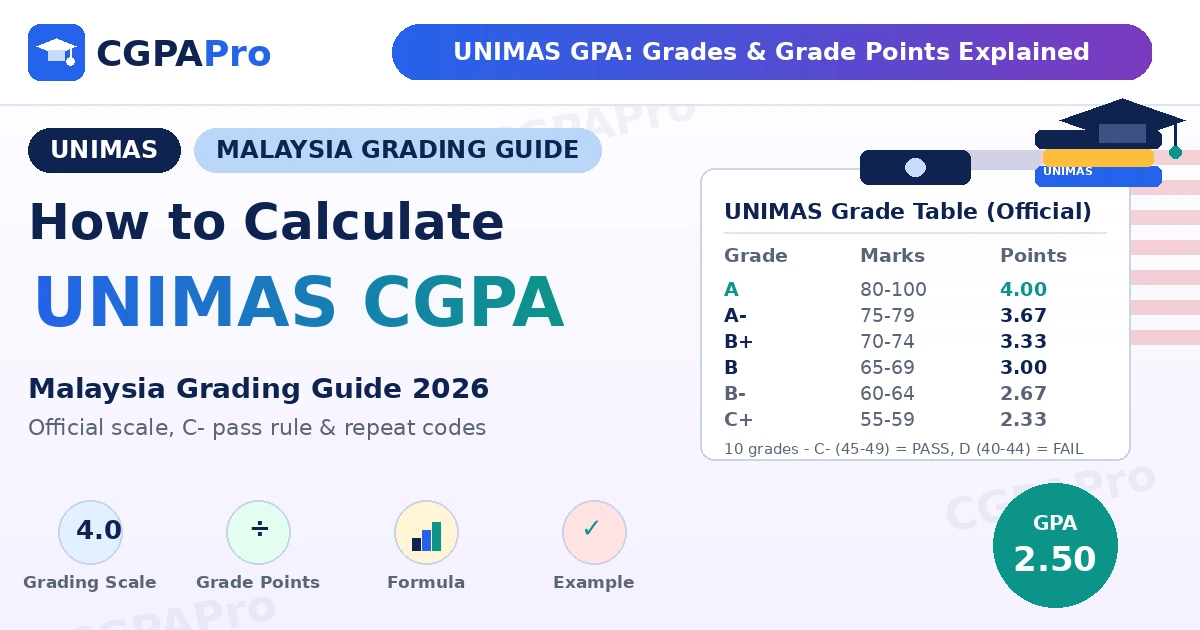
Universiti Malaysia Sarawak grades every course on a 4.00 scale — but its grade table has two features that catch almost every new student off guard. First, the grade points aren’t the rounded numbers most calculators assume: at UNIMAS, A− is 3.67, B+ is 3.33, B− is 2.67 and C+ is 2.33. Second, the pass/fail boundary sits somewhere most Malaysians don’t expect: a C− (45–49) counts as a pass at UNIMAS, while a D (40–44) is a fail. If you transferred in from another public university where 40 marks meant a pass, that one line of the regulations is worth real money to you. This guide gives you the official grade table from UNIMAS’s own Academic Regulations for Undergraduate Studies, shows exactly how the university computes your GPA (PNG) and CGPA (PNGK), decodes the academic-status codes on your result slip, and answers the questions students actually argue about — the C− pass rule, the Rn/KBn repeat distinction, the 3.67 First Class change, and the special re-examination for final-year students.
Quick answers: you need at least a C− (45 marks) to pass a course — D and F both fail; GPA = total grade points ÷ total credits; CGPA below 1.75 gets you a Fail-and-Dismissed status, while 1.75–1.99 lands you on Conditional Pass (LB) with one semester to climb back to 2.00; and First Class under the current rules starts at CGPA 3.67.
Try the UNIMAS GPA calculator
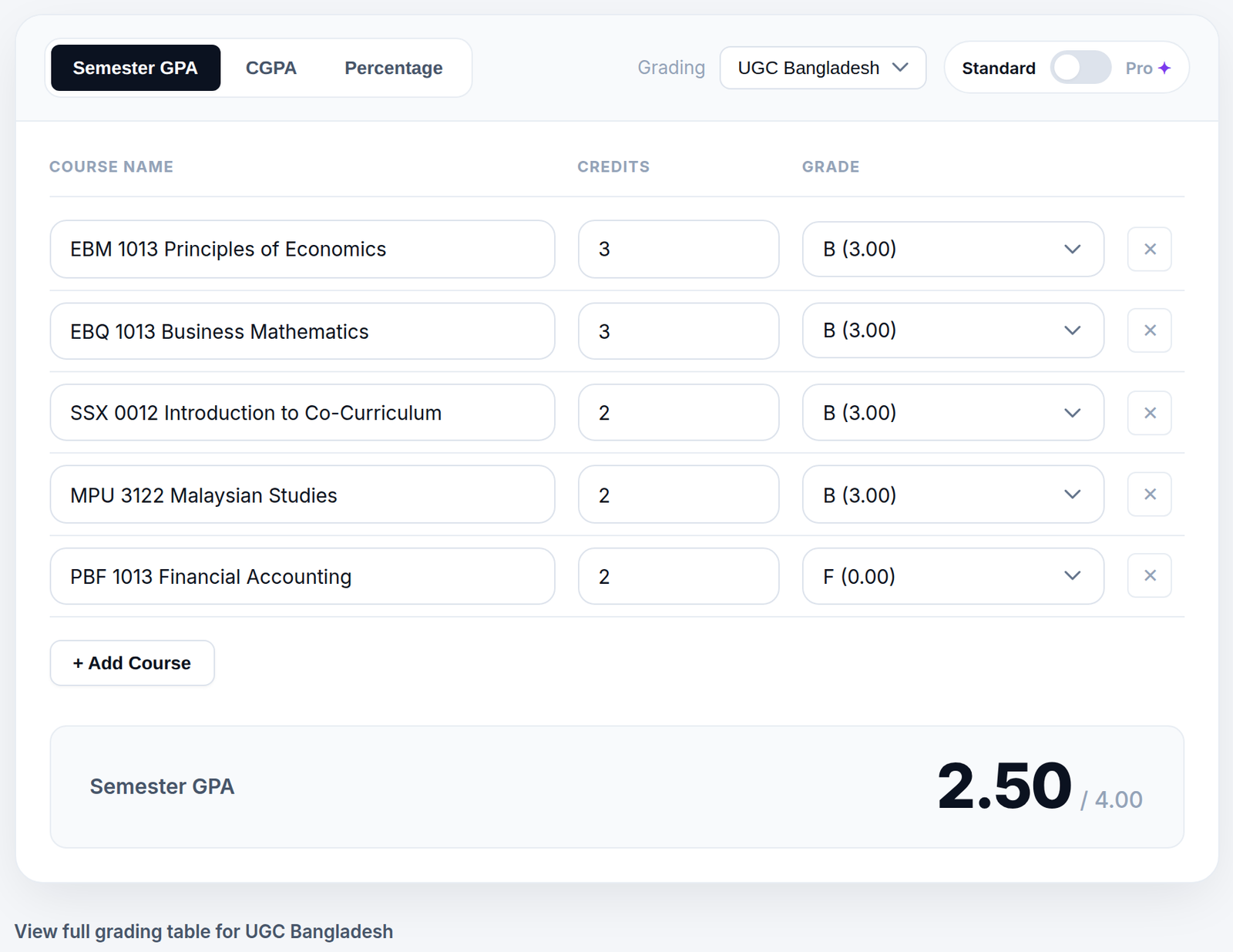
The fastest way to check your standing is to run your actual courses through a calculator. Add each course with its credit hours and the grade you expect, and it does the weighted maths for you. Here’s a real example — five first-semester-style courses:
The official UNIMAS grade table (verified)
This is the grade table from UNIMAS’s Academic Regulations for Undergraduate Studies (section 10.2.2, “The grade and grade point given for a course”), the university’s official published regulations approved by the Senate — the same table printed in the Faculty of Engineering’s 2022/2023 student handbook. It applies to intakes from the 2015/2016 academic session onward.
| Score | Grade | Grade point | Standard |
|---|---|---|---|
| 80–100 | A | 4.00 | Excellent |
| 75–79 | A− | 3.67 | |
| 70–74 | B+ | 3.33 | Credit |
| 65–69 | B | 3.00 | |
| 60–64 | B− | 2.67 | Good |
| 55–59 | C+ | 2.33 | |
| 50–54 | C | 2.00 | Pass |
| 45–49 | C− | 1.67 | Pass |
| 40–44 | D | 1.00 | Fail |
| Below 40 | F | 0.00 |
Three things to lock in. First, the pass line is 45 marks, not 50 and not 40: a C− at 45–49 carries 1.67 grade points and is explicitly calculated as a pass for all courses. Second, the fail line is correspondingly sharp — D (40–44) is a fail — its 1.00 grade point still counts in your GPA calculation but is useless toward passing the course. If you came from another Malaysian public university where 40+ meant a pass, forget that reflex here. Third, the .67/.33 decimals are the UNIMAS signature: if a calculator gives you A− = 3.70 or B+ = 3.30, it’s using someone else’s table, not UNIMAS’s.
Two caveats from the regulations themselves. Passing grades are “subjected to the course standard set by the programme/faculty” — some faculties set higher pass bars for core courses, so check your faculty handbook. And where the English and Malay versions disagree, the Malay version prevails.
How your scores become grades
Each course’s total score is built from continuous assessment (assignments, quizzes, presentations, lab work) plus the final examination — but the exact split is not fixed by the university-wide regulations. Faculties set their own assessment schedules, so a course in Engineering and a course in Social Sciences can weight their components differently. If your faculty publishes its own assessment rules (UNIMAS calls these the faculty’s evaluation sub-regulations), that’s the document that governs your course — check your faculty handbook rather than assuming a uniform 50/50 split.
What the regulations do fix is your right to question a result: you can appeal for a recheck of a course assessment through your faculty’s dean, accompanied by proof of payment — the fee is RM50 per course. The re-evaluation goes through the faculty examination committee and university committees before Senate endorsement, and the decision after Senate confirmation is final.
GPA and CGPA: the formula (and PNG vs PNGK)
UNIMAS’s own regulation states the semester GPA formula directly:
GPA = Total grade points for the semester ÷ Total credits for all courses in the semester
In plain words: convert each grade to its grade point, multiply by that course’s credit hours (that’s your “grade value”), add them all up, and divide by your total credit hours for the semester. Credit hours are the weight — a 4-credit course moves your GPA twice as much as a 2-credit course with the same grade.
CGPA uses the same formula stretched across everything you’ve completed — total grade points accumulated to date divided by total credits taken to date.
On UNIMAS systems you’ll meet the Malay terms: PNGK (Purata Nilai Gred Kumulatif) is your CGPA — the regulations themselves head the cumulative section “PNGK” — and PNG is the semester GPA. When your result slip or the SPP student portal says PNGK 3.20, it means your cumulative GPA is 3.20. All courses with grades count; audit courses and incomplete (Tidak Lengkap, TL) grades are excluded until the Senate endorses the actual grade.
Worked example 1: a 5-course semester → 2.50
The same five courses from the calculator screenshot above, worked by hand — check every number:
| Course | Credits | Grade | Point | Credits × Point |
|---|---|---|---|---|
| EBM 1013 Principles of Economics | 3 | B | 3.00 | 9.00 |
| EBQ 1013 Business Mathematics | 3 | B | 3.00 | 9.00 |
| SSX 0012 Introduction to Co-Curriculum | 2 | B | 3.00 | 6.00 |
| MPU 3122 Malaysian Studies | 2 | B | 3.00 | 6.00 |
| PBF 1013 Financial Accounting | 2 | F | 0.00 | 0.00 |
| Total | 12 | 30.00 |
GPA = 30.00 ÷ 12 = 2.50 — matching the screenshot exactly.
Notice what the F does: it contributes zero points but its 2 credit hours still sit in the denominator. That’s why a failed course is so expensive — and why UNIMAS’s repeat rules (covered below) matter so much.
Worked example 2: UNIMAS’s signature grades in action → 3.50
The first example used only grades where every calculator agrees. Now let’s use the grades where UNIMAS’s table is unique — A− and B+ at their official .67/.33 values — and work them by hand:
| Course | Credits | Grade | Point | Credits × Point |
|---|---|---|---|---|
| EBF 1013 Principles of Management | 3 | A | 4.00 | 12.00 |
| EBM 1013 Principles of Economics | 3 | A− | 3.67 | 11.01 |
| EBQ 1013 Business Mathematics | 3 | B+ | 3.33 | 9.99 |
| PBF 1013 Financial Accounting | 3 | B | 3.00 | 9.00 |
| Total | 12 | 42.00 |
GPA = 42.00 ÷ 12 = 3.50.
Run those same letters through a generic calculator that assumes A− = 3.70 and B+ = 3.30 and you’d get about 3.53 — a three-hundredths gap from nothing but the wrong table. Small numbers, but at UNIMAS small numbers cross real boundaries: 3.50 is the exact line for the Dean’s Honors certificate, and 3.67 is the line for First Class. The wrong table can tell you you qualified for an honour you didn’t, or missed one you earned. And under the current degree classification (explained below), this 3.50 sits squarely in Second Class Upper.
GPA vs CGPA — and the averaging trap
Your GPA (PNG) is one semester. Your CGPA (PNGK) is everything you’ve completed, credit-weighted from semester one. The trap: never just average your semester GPAs. Take a student with semester 1 at 3.00 (14 credits, 42.00 points) and semester 2 at 3.60 (16 credits, 57.60 points). The naive average is (3.00 + 3.60) ÷ 2 = 3.30. The real CGPA is (42.00 + 57.60) ÷ 30 = 99.60 ÷ 30 = 3.32. Different numbers, because semester 2 carried more weight. The more uneven your credit loads, the bigger the error.
Why most online calculators get UNIMAS wrong
There is no shortage of “Malaysia GPA calculator” sites — and almost all of them get UNIMAS subtly wrong in one of three ways:
- The rounded .70/.30 table. The most common Malaysian calculator template uses A− = 3.70, B+ = 3.30, B− = 2.70, C+ = 2.30. UNIMAS uses 3.67 / 3.33 / 2.67 / 2.33. The errors compound across a full transcript — on a 120-credit degree, a student with mostly A− and B+ grades can be mis-measured by a full tenth of a CGPA point.
- Treating C− as a fail. Many generic tables mark C− 1.67 as fail or “conditional pass”. At UNIMAS, C− (45–49) is an outright pass — no repeat required.
- Treating D as a pass. The mirror error: templates where 40+ passes will mark a UNIMAS D (40–44) as a pass when it’s actually a fail that must be repeated.
Run your own transcript through any calculator with the two UNIMAS numbers — A− at 3.67 and C− as a pass, D as a fail — before trusting its headline figure.
Academic status: what L, LB, LMK, LBMK and GB mean
Every semester, UNIMAS assigns you one of five academic statuses based on your CGPA. These codes appear on your result slip and determine whether you continue:
- L — Pass (Lulus). CGPA of 2.00 and above. You continue normally.
- LMK — Pass by Course Repeat (Lulus Mengulang Kursus). CGPA is 2.00 or above, but you failed a course that must be repeated.
- LB — Conditional Pass (Lulus Bersyarat). CGPA between 1.75 and 1.99. You’re warned to lift both GPA and CGPA to 2.00 or more the next semester. This is UNIMAS’s probation.
- LBMK — Conditional Pass by Course Repeat. CGPA 1.75–1.99 plus a failed course to repeat — probation and a mandatory repeat at the same time.
- GB — Fail and Dismissed (Gagal dan Diberhentikan). Given when your CGPA drops below 1.75 in a semester; when you fail to reach 2.00 after an LB semester; or when you fail to reach 2.00 after a GB semester in which you were allowed to resume. You can appeal to continue your studies (a RM50 fee applies), and a committee reviews the case.
The practical reading: 2.00 is the survive line, 1.75 is the danger line. Above 2.00 you’re safe; 1.75–1.99 buys you exactly one warned semester to fix it; below 1.75 the regulations move straight to dismissal.
Repeating courses: Rn vs KBn, fees, and PUK
UNIMAS draws a distinction that most students learn only when they need it — there are two different repeat tracks, and they score differently:
- Rn — Repeat Course (Kursus Ulangan): you failed the course and are repeating it. Only the latest grade counts in your GPA/CGPA; the earlier attempts stay on record but don’t touch the maths. The “n” is the number of times you’ve repeated it. Failed core courses must be repeated (within your maximum study duration); failed elective courses can be repeated or replaced with another elective — but the failed attempt’s credit still counts in the CGPA.
- KBn — Improved Course (Kursus Baiki): you passed but are retaking to improve the grade (needs faculty approval). Here the best grade counts. You can keep improving within your maximum study duration — but every attempt costs you the per-credit fee, and the fee is non-refundable if you drop the course after the fourth week of lectures.
That asymmetry is worth understanding before you choose: for a failed course the repeat grade replaces the failure (latest counts), so even a modest improvement helps a lot; for an improvement repeat you keep the better of the two, so the downside is capped at the fee. On the fee side, repeats cost local students RM30 per credit (Arts), RM40 (Sciences), RM60 (Medical) — international students pay RM90/RM120/180 per credit.
One more safety net exists for final-year students: the Special Re-Examination (PUK). If you fail a course in your last year, you can take a special re-examination covering the final-exam topics (plus your continuous-assessment marks), up to two courses per semester, for graduation purposes. PUK isn’t available for industrial training or final-year projects, and it needs the dean’s approval with the per-credit fee.
Degree classification and graduation
To graduate with a Bachelor’s Degree with Honours, UNIMAS requires you to pass all programme courses within the set period, hold a CGPA of at least 2.00, complete the Senate-determined credits, and be endorsed by the faculty examination committee and the Senate.
The class of your degree depends on your final CGPA — and the bands changed in 2020. Under the current rules (Semester 1, 2020/2021 onward):
- First Class: CGPA 3.67 and above
- Second Class Upper: CGPA 3.00–3.66
- Second Class Lower: CGPA 2.00–2.99
Before that change, First Class required 3.70 (with Second Upper at 3.00–3.69). So if a senior tells you “First Class is 3.70”, they’re quoting the old regulation — the current bar is 3.67. Note there is no “Third Class” band in UNIMAS’s table: anything at or above 2.00 that isn’t Second Upper is Second Lower.
For context on how these bands compare across the country, our Malaysia degree classification guide walks through Second Upper requirements university by university.
Dean’s Honors: GPA 3.50 + 12 credits
UNIMAS’s semester excellence award is officially called Dean’s Honors (not “Dean’s List” — though students say both). You qualify with a GPA of 3.50 or above in one semester while taking a minimum of 12 credits with grades. You’re ineligible if you had an incomplete (Tidak Lengkap) grade that semester, if you’re beyond your minimum study period, or if you’ve been convicted of a disciplinary offence — academic or otherwise.
Compare with how other Malaysian universities handle semester honours and probation in our Dean’s List & probation guide.
Common mistakes UNIMAS students make
- Assuming 40 marks is a pass. At UNIMAS, D (40–44) is a fail. The pass floor is 45 (C−). This is the single most expensive misunderstanding for transfer students.
- Assuming 45 marks is a fail. The mirror mistake by students from other unis: at UNIMAS, C− (45–49) is a clean pass — no repeat needed.
- Using A− = 3.70 / B+ = 3.30. UNIMAS uses 3.67 and 3.33. The rounded values drift your CGPA by hundredths that cross real honour boundaries.
- Quoting the old 3.70 First Class. It’s 3.67 since Semester 1, 2020/2021.
- Thinking a repeated failed course still drags the CGPA. Under Rn, only the latest grade counts — the failure stops hurting you the moment the repeat grade lands.
- Averaging semester GPAs instead of credit-weighting. Always sum grade points over all credits, as shown above.
- Calling it “Dean’s List” in formal queries. The official award is Dean’s Honors; using the right name helps when you ask the faculty office about eligibility.
Tips for a strong UNIMAS CGPA
- Weight your effort by credits. A 4-credit B+ (13.32 points) outweighs two 2-credit courses combined. Protect high-credit courses first — our CGPA improvement guide shows the maths.
- Guard the 45 line, not the 50 line. At UNIMAS, 45–49 still passes. Panicking at 47 and burning an improvement repeat on a course you already passed wastes a fee.
- Use KBn where it pays most. Improving a 4-credit C+ (9.32 points) to a B (12.00) buys 2.68 grade points — more than improving two 2-credit courses. Since the best grade counts, the downside is just the fee.
- For a failed core course, repeat early. Under Rn the new grade fully replaces the failure in your CGPA — one of the most powerful recoveries the regulations offer.
- Track against 2.00 and 3.67, not round numbers. 2.00 is your graduation/survival line, 3.67 is First Class. Set your semester targets on the real boundaries.
- Check how your faculty weights assessment components. The university-wide regulations don’t fix the coursework/exam split — your faculty handbook does.
- Compare grading quirks across Malaysian unis — UKM and USM have their own tables; knowing the differences helps if you ever transfer credits.
FAQ — real student questions
What are the passing marks at UNIMAS?
45 marks — a C− (45–49, 1.67 grade points) is officially calculated as a pass for all courses. Anything from 40–44 is a D, which is a fail, and below 40 is an F. Note that individual faculties can set higher pass standards for specific courses, so check your faculty handbook for core courses.
Is an A− at UNIMAS 3.67 or 3.70?
3.67. UNIMAS’s official table uses A− = 3.67, B+ = 3.33, B− = 2.67 and C+ = 2.33. Calculators showing 3.70/3.30 are using a generic rounded table — the difference is small per course but compounds across a full degree.
What CGPA do I need for First Class at UNIMAS?
3.67 and above under the current rules (effective Semester 1, 2020/2021). Before that, the bar was 3.70 — so older guides and seniors may still quote 3.70. Second Class Upper is 3.00–3.66 and Second Class Lower is 2.00–2.99.
I failed a course — does it stay in my CGPA forever?
No. When you repeat a failed course (recorded as Rn), only the latest grade counts in your GPA and CGPA calculations — the earlier failure stays on record but stops affecting the maths. If you’re repeating a passed course to improve it (KBn), the best grade counts instead. One exception: if a failed elective is replaced with a different elective rather than repeated, the failed attempt’s credit still counts in the CGPA.
What happens if my CGPA falls to 1.8?
You get Conditional Pass (LB) status — CGPA 1.75–1.99 — with a warning to lift your GPA and CGPA to 2.00 or more the next semester. If you don’t reach 2.00, you move to Fail-and-Dismissed (GB) status, against which you can appeal to continue (RM50 fee, committee review). Below 1.75 in any semester, GB applies immediately.
What is Dean’s Honors at UNIMAS?
It’s the university’s semester excellence certificate: GPA of 3.50 or above in one semester with at least 12 graded credits. You can’t get it with an incomplete grade that semester, beyond your minimum study period, or with a disciplinary conviction — even if your GPA qualifies.
What do PNG and PNGK mean on my UNIMAS result slip?
PNG (Purata Nilai Gred) is your semester GPA and PNGK (Purata Nilai Gred Kumulatif) is your cumulative GPA — the Malay terms UNIMAS uses on its student portal and examination slips. You’ll also see Rn (repeated failed course — n = times repeated) and KBn (retaken for improvement).
Conclusion
UNIMAS’s grading system rewards students who read the regulations instead of trusting generic calculators: A− is 3.67 not 3.70, C− (45–49) is a pass while D (40–44) is a fail, First Class starts at 3.67 under the current rules, and the Rn/KBn repeat system gives failed courses a genuine second life. Calculate with the official table, weight everything by credit hours, keep your CGPA above the 2.00 survival line, and check your faculty handbook wherever your programme sets its own standards. Do that and your PNGK will hold no surprises — because at UNIMAS, every number that matters is printed in the Academic Regulations for anyone who bothers to look.
Sources: UNIMAS Academic Regulations for Undergraduate Studies (§§10–11, 21; approved 197th Senate Meeting 5/2021, effective 2021/2022), ppps.unimas.my; Faculty of Engineering Student Handbook 2022/2023, feng.unimas.my. Exact coursework/exam mark splits and attendance rules vary by faculty — check your faculty handbook.