Quick answer: The University of Chittagong (CU) uses a 4.00-point letter-grade system on the national UGC Bangladesh template — A+ (4.00) for 80% and above, down to F (0.00) below 40%. Your GPA is your total “points secured” divided by total credits offered, and the same credit-weighted formula gives your CGPA across the whole programme. This guide gives you CU’s official table with the exact percentage bands, the step-by-step calculation, the improvement rules most students get wrong, and two fully worked examples you can verify against your own tabulation sheet.
How to check your CU GPA in under a minute
You do not need to reconstruct CU’s tabulation formula by hand every time. The fastest honest way to check your GPA is a calculator that runs the same grade table your department uses:
- Open the CGPA calculator.
- Add one row per course. Enter the credit hours from your department syllabus (not from memory — a 4-credit course typed as 3 silently warps the result).
- Pick each letter grade from the dropdown — the calculator runs the official UGC-Bangladesh scale CU itself follows (A+ 4.00 … F 0.00).
- Read the GPA it returns, and check it against the table below.
Then compare the result with the worked examples in this article. If the calculator and your hand calculation agree, you understand the system; if they don’t, one of your credit hours is wrong — and that is exactly the mistake this guide helps you catch.
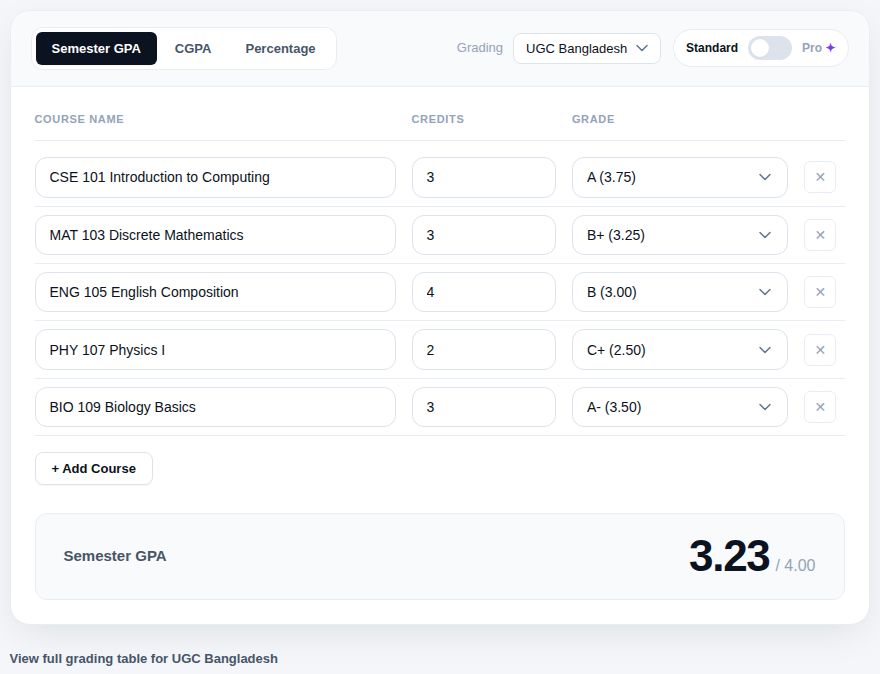
Real capture: five courses on the official CU scale — 3cr A (3.75) = 11.25, 3cr B+ (3.25) = 9.75, 4cr B (3.00) = 12.00, 2cr C+ (2.50) = 5.00, 3cr A- (3.50) = 10.50. Total 48.50 ÷ 15 = 3.23. CU’s official table matches the calculator’s scale exactly, so the result is your real CU GPA with no caveats.
Read more: Dhaka University Grading System 2026 — DU runs the same UGC scale with its own ordinances and worked examples.
The official CU grading table (marks → grade → points)
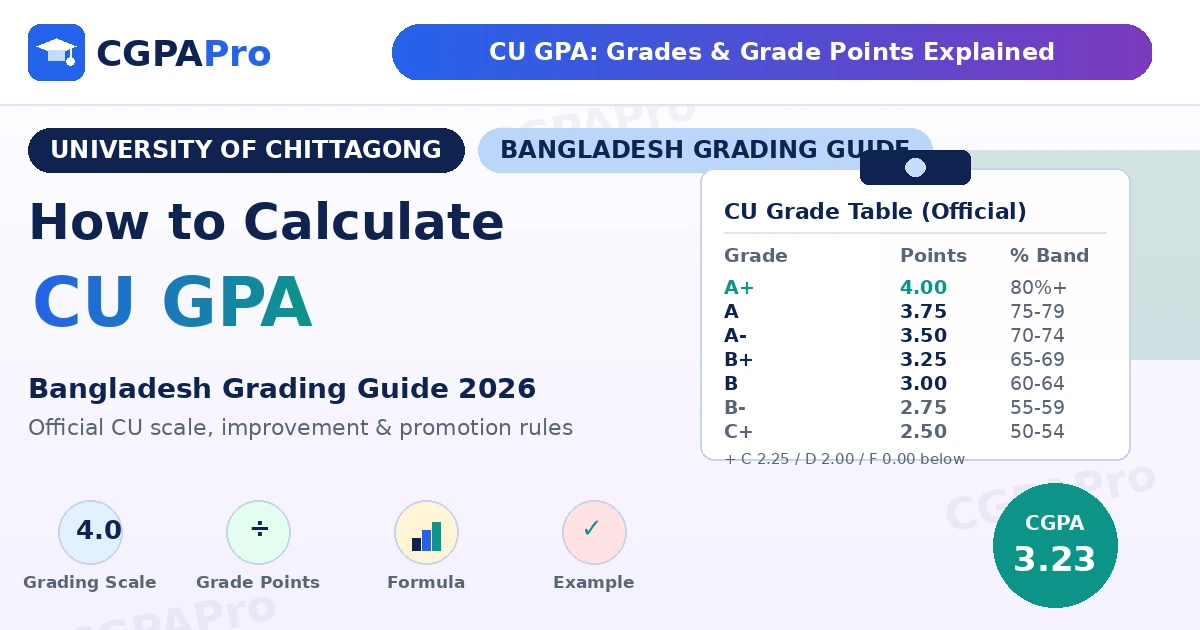
This is not a generic Bangladesh table. Every row below was verified against CU’s own examination documents: the official tabulation sheet instructions of the BSS (Honours) 2022 examination, the Faculty of Law LLB ordinance, the Department of Psychology ordinance, and the CSE B.Sc. Engineering ordinance. They all agree, and they all match the national UGC scale:
| Marks obtained | Letter grade | Grade point |
|---|---|---|
| 80% and above | A+ | 4.00 |
| 75% to less than 80% | A | 3.75 |
| 70% to less than 75% | A− | 3.50 |
| 65% to less than 70% | B+ | 3.25 |
| 60% to less than 65% | B | 3.00 |
| 55% to less than 60% | B− | 2.75 |
| 50% to less than 55% | C+ | 2.50 |
| 45% to less than 50% | C | 2.25 |
| 40% to less than 45% | D | 2.00 |
| Less than 40% | F | 0.00 |
| Incomplete / absent | X | — |
Three things about this table trip students up every year:
- D is the pass line, not F-plus-something. CU’s pass mark is 40% of the course marks (40/30/20/10 for 100/75/50/25-mark courses). A D (40–44%) passes; an F (below 40%) does not, and an F earns zero credit.
- There is no C−, D+, or B−with-a-different-value. Some private universities invent extra rungs. CU does not — the ten rungs above are the complete ladder, and the X grade covers incomplete or absent cases.
- Your transcript hides your marks on purpose. CU’s ordinances state that the academic transcript shows only the letter grade (LG), grade points (GP), points secured (PS), and finally the GPA/CGPA — never your numerical marks. If you are trying to reverse-engineer your 73% from the transcript alone, you can’t; the bands are deliberately the record.
If you are still working in percentages and want the reverse direction, see our percentage-to-CGPA guide for how the bands translate before you feed grades into any calculator.
Step-by-step: how a CU GPA is actually built
CU’s own ordinances describe the mechanics with two phrases you will see on every tabulation sheet: points secured (PS) and credit hours offered. The process is the same in every faculty:
- Find your percentage for each course from your marks (incourse + final, per your department’s split).
- Convert each percentage to a letter grade using the official table above. Note the boundaries are sharp: 74.9% is an A− (3.50), not an A. CU’s examiners report bands, so decimals rarely matter — the grade is what counts.
- Multiply each grade point by the course’s credit hours. That product is your points secured (PS) for the course. A 3-credit B (3.00) secures 9.00 points; a 4-credit A (3.75) secures 15.00.
- Add up all points secured across the courses of the year or semester.
- Divide by the total credit hours offered. The result is your GPA for that period.
One CU-specific detail worth knowing: the 2022 tabulation sheet instructions state that one credit equals 24 marks — so a 100-mark course is typically a 4-credit course. If your department’s credit split looks different from a friend’s in another faculty, this is why; always use your own syllabus’s credit hours.
The formula (yearly GPA and final CGPA)
CU’s ordinances state the formula in the same way across faculties:
GPA = Total Points Secured ÷ Total Credit Hours Offered
For the degree-level result, you do not average your yearly GPAs — that shortcut is mathematically wrong whenever credit hours differ between years. The correct form, used by CU’s examination branch, is:
CGPA = (Total PS of Year 1 + Year 2 + Year 3 + Year 4 + sessional + viva-voce) ÷ Total Credits of the Whole Programme
The sessional and viva-voce components deserve a note: under CU’s rules they do not enter your yearly GPA, but their letter grades, grade points and points secured do enter the final CGPA, summed across all years. Students who ignore the 25-mark sessional and viva-voce when estimating their final CGPA systematically underestimate themselves.
Finally, the reporting rule: CU rounds GPA and CGPA to two decimal places, rounding up when the third digit is 5 (so 2.215 becomes 2.22). Truncation stories you hear from other universities do not apply here.
Worked example 1: one semester, five courses
Take a typical first-year semester — five courses, ordinary credit hours, ordinary grades. This is the exact example captured in the calculator screenshot above:
| Course | Credits | Grade | Grade point | Points secured |
|---|---|---|---|---|
| CSE 101 | 3 | A | 3.75 | 3 × 3.75 = 11.25 |
| MAT 103 | 3 | B+ | 3.25 | 3 × 3.25 = 9.75 |
| ENG 105 | 4 | B | 3.00 | 4 × 3.00 = 12.00 |
| PHY 107 | 2 | C+ | 2.50 | 2 × 2.50 = 5.00 |
| BIO 109 | 3 | A− | 3.50 | 3 × 3.50 = 10.50 |
| Total | 15 | 48.50 |
GPA = 48.50 ÷ 15 = 3.2333… = 3.23.
Now do it once yourself with your own marks. If your hand result matches the calculator, you have the method; if not, re-check the credit hours first — they are the usual culprit.
Worked example 2: CGPA across two years (why “average of GPAs” is wrong)
Year 1: 28 credits offered, 85.00 points secured → GPA 3.04.
Year 2: 24 credits offered, 60.00 points secured → GPA 2.50.
The wrong way: (3.04 + 2.50) ÷ 2 = 2.77.
The CU way: CGPA = (85.00 + 60.00) ÷ (28 + 24) = 145 ÷ 52 = 2.7885… = 2.79.
Two hundredths of a point is the difference between a 2.77 and a 2.79 on your transcript — and scholarship cutoffs do not round in your favour. Always weight by credits, exactly as CU’s examination branch does.
GPA vs CGPA at CU — what each one means
Students use the two interchangeably, and CU’s own documents do not: the GPA is your performance in one examination year (or semester, in semester-system departments) — total points secured divided by that period’s credits offered. The CGPA is the cumulative version across the entire programme, including every year’s sessional and viva-voce. Employers and foreign universities ask for the CGPA; your promotion to the next class depends on the yearly GPA. If you want the full comparison across systems, our GPA vs CGPA vs SGPA guide lays out every variant.
The CU rules most guides never tell you
This is the part that separates a CU-specific guide from a generic Bangladesh calculator page. All of it comes from CU’s published ordinances:
- Improvement is allowed — but only with the immediate next batch. If you earn a C, D or F in a first, second or third-year course, you may re-appear for that course with the next batch to improve the grade. Miss that window and the original grade stands permanently. If you attempt the improvement and don’t better your grade, the previous grade remains valid — there is no downside risk to trying.
- An improved grade is marked “Improved” on your transcript — in a dedicated column. It still counts at full value toward your CGPA.
- No improvement in practical components. Moot court and mock trial, court attendance, field work, sessional and viva-voce cannot be improved. Apply to your department chairman at least four weeks before the next annual examination if you want a shot.
- Promotion needs 1.75. To move to the next higher class you must earn at least GPA 1.75 (excluding sessional and viva-voce) in that year’s examination; fall short and you are declared failed for the year. This is the floor most first-years have never heard of.
- 70% attendance to sit the exam. On average across your lectures. Documented marginal shortages down to 40% can be recommended by the academic committee with a non-collegiate fee — below that, no admit card.
- F earns zero credit and stays on the record. No credits are granted for any grade below D. The F contributes 0.00 points while its credits stay in the denominator — which is why one failed course drags a GPA down so hard.
If you are sitting on a C or D and wondering whether improvement is worth the effort, read our guide to how retaking a course affects your CGPA — the arithmetic of when a retake actually moves the needle is the same everywhere.
Read more: Rajshahi University Grading System 2026 — RU follows the same UGC template, with its own worked examples and rules.
Don’t confuse CU with CUET
A word of caution, because search engines mix them up constantly: the University of Chittagong (CU) is the public general university, and Chittagong University of Engineering & Technology (CUET) is a separate engineering university. They are different institutions with different ordinances — though both run the UGC 4.00 scale. If you are a CUET student, use our CUET grading system guide instead; the improvement and promotion rules there are CUET’s own.
Common mistakes CU students make
- Averaging yearly GPAs instead of weighting by credits. The second worked example shows the error. CU’s examination branch never does this.
- Counting sessional and viva-voce in the yearly GPA. They belong in the final CGPA only — adding them early inflates your estimate.
- Assuming 70% is an A. The boundary is “70% to less than 75%” for A− (3.50); an A needs a full 75%. One mark below the line costs 0.25 grade points on that course.
- Waiting too long to apply for improvement. The immediate-next-batch window is unforgiving, and the four-week application deadline to the chairman comes earlier than students expect.
- Reading the transcript for marks. CU transcripts deliberately show grades, grade points and points secured — not percentages. Argue from the bands, not from a remembered 73%.
Tips to raise your CU GPA
- Protect the high-credit courses. A 4-credit A (15.00 PS) moves your GPA four times as much as a 1-credit improvement. Allocate revision time by credit weight, not by how much you like the subject.
- Know your band edges. If you are sitting at 73–74% in incourse work, two or three marks in the final can lift you from A− (3.50) to A (3.75) — a 0.25 swing on every credit of that course.
- Use improvement strategically. Since a failed improvement attempt costs you nothing (the old grade stands), the rational move is to attempt improvement on any C, D or F course where you realistically expect to do better — but remember the next-batch-only window.
- Don’t sleep on sessional and viva-voce. They skip the yearly GPA but land in the CGPA. A B+ in viva-voce across four years is free CGPA most students leave on the table.
- Guard your attendance early. Losing exam eligibility over the 70% rule is the most avoidable academic disaster in the CU system.
Frequently asked questions
How is CGPA calculated at the University of Chittagong?
Add up the total points secured (grade point × credit hours for every course, plus all years’ sessional and viva-voce) and divide by the total credit hours of the whole programme. Never average the yearly GPAs — weight everything by credits, exactly as CU’s examination branch does.
What grade do I get with 73% at CU?
73% falls in the “70% to less than 75%” band, which is an A− worth 3.50 grade points. You need a full 75% for an A (3.75) — 74.9% is still an A−.
Can I improve a C grade at the University of Chittagong?
Yes. CU’s ordinances allow students who earn C, D or F in the first three years to re-appear for that course with the immediate next batch. If you don’t improve, your previous grade stands, and the improved grade is marked “Improved” on your transcript. Apply to your department chairman at least four weeks before the next annual exam.
What happens if I get an F in a course at CU?
You earn zero credit for the course — it contributes 0.00 points while its credit hours stay in the denominator, which pulls your GPA down sharply. The F remains on your academic record. You can improve it under the improvement rules, but no improvement is allowed in sessional, viva-voce, field work or moot components.
Is the CU grading system the same as Dhaka University’s?
The grade table is identical — both follow the national UGC Bangladesh scale (A+ 4.00 down to F 0.00 with the same percentage bands). The universities differ in their own ordinances: improvement windows, promotion floors and attendance rules are each university’s own. See our Dhaka University grading guide for DU’s version.
Why doesn’t my CU transcript show my marks?
CU’s ordinances specify that transcripts show only the letter grade, grade points, points secured, and the GPA/CGPA — never the numerical percentages. This is deliberate, so any appeal or verification has to work from the official bands in this article.
What is the minimum GPA to be promoted at CU?
You need at least GPA 1.75 (excluding sessional and viva-voce) in the year’s examination to be promoted to the next class. And you need at least 70% average attendance to be eligible to sit the examination at all.
Conclusion
The University of Chittagong’s grading system is the national UGC template with CU’s own teeth: sharp percentage bands, a credit-weighted CGPA that includes every year’s sessional and viva-voce, a 1.75 promotion floor, a 70% attendance bar, and an improvement window that only opens with the immediate next batch. Learn the bands, weight by credits, and use the improvement rules before the window closes — that is the entire game. Run your own numbers through the calculator, verify them against the worked examples above, and keep this table bookmarked for every result season.
Sources: University of Chittagong BSS (Honours) 2022 official tabulation sheet instructions; CU Faculty of Law LLB Ordinance; CU Department of Psychology ordinance; CU CSE B.Sc. Engineering Ordinance; UGC uniform grading circular via CIU academic policies.