How to Improve Your CGPA: Proven Strategies for 2026
Yes, you can raise your CGPA — but only if you know the exact number you need. Here is the formula nobody’s strategy guide shows you: Required future average = (Target CGPA × Total Credits − Current CGPA × Earned Credits) ÷ Remaining Credits. Plug in your numbers, and it tells you precisely what semester average you must earn from here on — or whether your target is mathematically impossible (anything above 4.00) and needs recalibrating.
The one-line strategy version: CGPA is a credit-weighted sum, not an average of your semester averages — so every point you earn has a price tag, and you should buy your CGPA gains where they are cheapest. An A in a 4-credit course moves your CGPA four times more than an A in a 1-credit lab, and retaking one failed 3-credit course to an A is worth +0.10 CGPA — double the return of retaking a C. This guide gives you the full arithmetic, three worked scenarios, and the study systems that actually feed those numbers.
Reverse-Engineer Your Target: The Formula
Most guides say “set a goal and figure out what grades you need.” Then they stop. Here is the actual math, built on the official definition of CGPA: total grade points earned ÷ total credit hours attempted (HEC Pakistan’s published grading guidelines lay out exactly this definition — see the HEC Draft Policy Guidelines for Uniform Semester Examination System).
Required future average = (Target CGPA × Total Credits − Current CGPA × Earned Credits) ÷ Remaining Credits
Where Total Credits is your full degree credit hours (typically 120), Earned Credits is what you have completed so far, and Remaining Credits is what is left. If the result is above 4.00, the target is impossible — more on that below.
Example 1: Achievable — 3.20 → 3.50
You have earned 60 credits at 3.20, with 60 left:
| Step | Calculation | Result |
|---|---|---|
| Total grade points needed | 3.50 × 120 | 420.00 |
| Grade points earned so far | 3.20 × 60 | 192.00 |
| Points still needed | 420.00 − 192.00 | 228.00 |
| Required future average | 228.00 ÷ 60 | 3.80 |
You need a 3.80 average across your remaining semesters — mostly A’s and A−’s. Ambitious but feasible.
Example 2: Impossible — 3.20 → 3.50, but with only 30 credits left
Same target, but you have earned 90 credits:
| Step | Calculation | Result |
|---|---|---|
| Total grade points needed | 3.50 × 120 | 420.00 |
| Grade points earned so far | 3.20 × 90 | 288.00 |
| Points still needed | 420.00 − 288.00 | 132.00 |
| Required future average | 132.00 ÷ 30 | 4.40 |
4.40 exceeds the 4.00 maximum — the target is impossible. Don’t waste a year chasing it. Recalibrate instead: target 3.35 → (3.35 × 120 − 288) ÷ 30 = 114 ÷ 30 = 3.80. Same ambition, but now it is a plan instead of a fantasy.
Example 3: The climb — 2.50 → 3.00
Earned 60 at 2.50, 60 remaining: (3.00 × 120 − 2.50 × 60) ÷ 60 = (360 − 150) ÷ 60 = 210 ÷ 60 = 3.50. You need a 3.50 average going forward — a mix of B+ and A− grades. That is a real, schedulable workload, not a vague “do better.”
One more check before you commit to any target: multiply your total grade points at graduation to see the ceiling. If even straight A’s in every remaining course fall short, pick a different target, plan retakes of your worst grades, or look into whether your university lets you take additional elective credits. Honest arithmetic up front beats a crushing surprise at graduation.
Calculator Shortcut: Model Your Comeback Semester
Doing the formula by hand is fine, but you will re-run it every semester — so use the calculator. Head to the CGPAPro homepage calculator, switch to Semester GPA mode, and enter your planned grades course by course. It does the credit-weighted arithmetic for you: total grade points ÷ total credit hours.
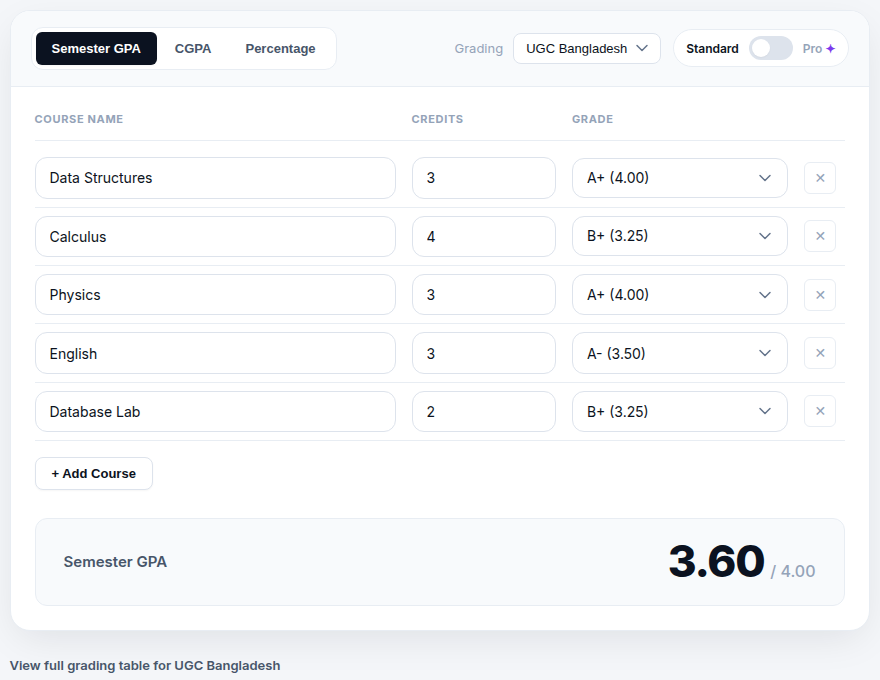
Screenshot: the CGPAPro homepage calculator in Semester GPA mode running a five-course comeback semester — Data Structures, 3 credits, A (4.00) → 12.00 grade points; Calculus, 4 credits, B+ (3.25) → 13.00; Physics, 3 credits, A (4.00) → 12.00; English, 3 credits, A− (3.50) → 10.50; Database Lab, 2 credits, B+ (3.25) → 6.50. Total 54.00 ÷ 15 credits = 3.60. Notice the 4-credit Calculus B+ (13.00 points) contributes more grade points than any 3-credit A — that is credit leverage in action.
Use it the same way before every semester: type in your target grades, and the result tells you whether your planned semester matches the required average the formula gave you. If the calculator says 3.40 and your formula said you need 3.80, you already know the plan is not good enough — fix it before the semester starts, not after.
10 Strategies That Actually Move the Number
Strategies 1–4 are math-first: they decide where your effort goes. Strategies 5–10 are the study systems that convert that effort into grades.
1. Run the formula before you do anything else
Every other strategy in this guide is downstream of one question: what average do you actually need? A student who needs 3.80 faces a completely different workload than one who needs 3.20. Run the formula from the previous section, write the required average on paper, and check it every semester — your earned credits and remaining credits change, and so does the number. This alone separates students who improve from students who “study hard” and wonder why nothing moves.
2. Spend your effort where the credits are
CGPA is credit-weighted: each course’s contribution is its grade points × its credits. So a one-step grade improvement (0.25 grade points) in a 4-credit course buys you 1.00 ÷ 120 = +0.0083 CGPA on a 120-credit degree. The same one-step improvement in a 1-credit lab buys 0.25 ÷ 120 = +0.0021 CGPA. That is exactly 4× leverage.
Practical version: if you have ten study hours to distribute this weekend, put most of them into the 4-credit core course, not the 1-credit lab. And a full letter-grade jump (1.00 grade point) in a 4-credit course is worth 4.00 ÷ 120 = +0.033 CGPA — nearly the entire semester-to-semester gain some students celebrate. Competitors all say “prioritize high-credit courses”; this is the arithmetic behind it.
3. Retake your F’s first, not your C’s
Under a grade-replacement policy, retaking a 3-credit F to an A adds (4.00 − 0.00) × 3 = 12.00 grade points = +0.10 CGPA. Retaking a 3-credit C to an A adds (4.00 − 2.00) × 3 = 6.00 points = +0.05 CGPA. The F-retake returns twice the CGPA per retaken credit of a C-retake — and it also erases the most damaging mark on your transcript.
The full retake playbook — replacement vs averaging policies, when a retake beats taking a new course, and the deadlines that matter — is in our dedicated guide. Read More: How Retaking a Course Affects Your CGPA.
Caveat: not every university replaces the old grade — some average the old and new attempt instead, and policies differ on whether retakes are capped. Check your handbook before planning retakes around these numbers.
4. Rank your courses by effort-per-grade-point
Look at your last two semesters and sort your courses by the grade you earned relative to the effort you gave. You will find a pattern: some subjects cost you three study hours per grade point and others cost you ten. For your remaining credits, attack the courses where your personal effort-per-grade-point is lowest — the subjects where one more hour of study has historically flipped a B to an A− for you.
This is deliberately personal. A friend’s “easy A” elective might be your grind. Your own grade distribution is the best dataset you have — use it instead of asking friends which courses are easy.
5. Review every exam paper you get back, line by line
Here is a habit nobody’s strategy list emphasizes enough: when midterms come back, don’t just glance at the score. Go through every lost mark and classify it — concept I never learned, silly arithmetic error, ran out of time, misread the question. Students who do this consistently find that 60–70% of their lost marks come from one or two repeatable causes, and fixing one cause (say, time management on 3-mark questions) lifts the next paper by half a grade or more. Also, if a mark sits near a grade cutoff, ask about re-evaluation — a 2-mark bump that crosses a grade boundary is worth the same as a 15-mark bump that doesn’t.
6. Go to office hours before midterms, not after
Everyone knows office hours exist; almost everyone goes after the exam, when grades are already locked. Go two weeks before the midterm with your attempted problem sets and one specific question (“I can solve these two types but not the third — where is my approach wrong?”). Professors flag exactly what gets tested, and a student who shows work in progress gets steering that a post-exam visitor never does. One clarifying conversation can be worth a full grade step in a 4-credit course — remember strategy 2’s arithmetic.
7. Test yourself instead of re-reading (spaced practice)
The evidence here is unusually consistent: retrieval practice — closing the book and writing out what you remember — outperforms re-reading and highlighting on delayed tests across dozens of studies. Pair it with spacing: three 45-minute sessions across a week beat one 4-hour cram session for the same material. A workable template: learn a topic in class on Monday, self-test from a blank page on Wednesday, self-test again on Sunday. Then review your errors using strategy 5’s classification. This is the engine that converts study hours into the grade steps your formula requires.
8. Bank your internals — they are the cheapest marks you will ever earn
Assignments, quizzes, lab reports, and class participation typically make up 20–40% of a course’s final mark, and they are graded when the pressure is lowest. Treat every internal as non-negotiable: submit everything, on time, complete. A student who banks 90% of internals needs only ~75% on the final to land an A−; a student who skips assignments needs ~90% on the final for the same grade. You are choosing which final-exam score you need — choose the easier one.
9. Show up — attendance is correlated with the grades you need
Multiple studies find that lecture attendance is one of the strongest behavioral predictors of course grades. You don’t need a lecture hall to tell you why: professors emphasize in class what ends up on exams, explain derivations the textbook skips, and occasionally hand out the kind of exam-hint that turns a B+ into an A−. If you need a 3.80 average (example 1), you cannot afford to miss the sessions where those hints get dropped.
10. Balance your semester load — never stack all the hard ones together
Credit leverage (strategy 2) is about within-semester priorities; load balancing is about across-semester survival. Three 4-credit core courses in one semester each demanding a B+ is a plan that fails in practice — there are only so many study hours in a week. Spread the heavyweight courses across semesters and pair each hard core with a lighter elective. The required average from your formula assumes consistent performance; an overloaded semester that crashes one course can cost you a full semester’s progress.
Retakes and Grade Replacement: The Math
Retakes deserve their own section because they are the single fastest way to move a stuck CGPA — you are buying back points in a course you have already seen once.
Under a replacement policy (the retaken grade replaces the old one), the ROI per 3-credit course is:
| Retake path | Grade points gained | CGPA gain (120 credits) |
|---|---|---|
| F (0.00) → A (4.00) | 12.00 | +0.10 |
| F (0.00) → B+ (3.25) | 9.75 | +0.081 |
| C (2.00) → A (4.00) | 6.00 | +0.05 |
Under an averaging policy (both attempts count), a C→A retake yields (4.00 − 2.00) × 3 ÷ (120 + 3) = 6 ÷ 123 = +0.049 — nearly the same magnitude as replacement, but it costs you 3 extra credits and the original C stays on the record.
The decision rule: retake F’s first (double the ROI of a C-retake), then consider C-retakes only if you have spare semesters and no better use for the credit hours — a strong new course is usually a better investment than retaking a C. Policies vary: replacement vs averaging, retake caps, and whether retakes appear on the transcript all differ by university. Read More: How Retaking a Course Affects Your CGPA (2026) — the full guide on policies, eligibility, and when a retake beats a new course.
Common Mistakes That Silently Kill CGPA Growth
Averaging your semester GPAs instead of credit-weighting
This is the most common arithmetic mistake students make. CGPA is total grade points ÷ total credits — it is not the average of your semester GPAs, unless every semester has identical credit hours. Example: Semester 1, 15 credits at 3.0 SGPA = 45 points; Semester 2, 18 credits at 4.0 SGPA = 72 points. The naive average is (3.0 + 4.0) ÷ 2 = 3.50. The true CGPA is (45 + 72) ÷ 33 = 117 ÷ 33 = 3.545.
With lopsided semesters the error grows: 12 credits at 2.5 + 6 credits at 4.0. Naive average: 3.25. True: (30 + 24) ÷ 18 = 54 ÷ 18 = 3.00 — off by a quarter of a grade point. Always weight by credits, or let the calculator do it. Read More: How to Calculate SGPA: Formula & Examples and CGPA vs GPA vs SGPA: What’s the Difference?.
Chasing “easy credits that don’t count”
Pass/fail courses, audited courses, and non-credit remedial classes do not enter your CGPA denominator — an A in a pass/fail course moves your CGPA by exactly zero. Worse, students sometimes load up on these thinking “easy credits” will dilute a bad semester, and they dilute nothing. Before counting any course toward your comeback plan, confirm it carries credit hours on your transcript.
Sitting exactly on a grade boundary
A 79.4% that becomes a B+ instead of an A− costs you the same as if you had scored 70% — the grade band is a cliff, not a slope. If your marks sit within a point or two of the next boundary, request re-evaluation or ask the instructor to review borderline cases; many universities have formal re-check procedures for exactly this. It is the cheapest grade-point gain available: no new studying, just a paperwork request.
Overloading to “catch up”
Taking 21 credits to graduate faster or dilute a bad semester backfires when one overloaded semester produces two C’s instead of the planned B+’s. The arithmetic: an extra 3-credit C at 2.00 in a semester where you needed a 3.50 average actively lowers your future-average requirement’s feasibility. Protect the average; don’t chase the credit count.
Grade Scale Reference
All the numbers in this article use the 4.00 scale below. Exact values vary by university — check your handbook; universities like GCWUF publish their official grade tables (GCWUF grading policy PDF) and they are worth confirming before you plan around them.
| Grade | Grade Points |
|---|---|
| A | 4.00 |
| A− | 3.50 |
| B+ | 3.25 |
| B | 3.00 |
| C+ | 2.50 |
| C | 2.00 |
| F | 0.00 |
Frequently Asked Questions
Can I raise my CGPA from 2.5 to 3.5 in final year?
No — not on a standard 120-credit degree with 90 credits earned and 30 remaining. The formula gives (3.50 × 120 − 2.50 × 90) ÷ 30 = (420 − 225) ÷ 30 = 6.50, which is above the 4.00 maximum. Even straight A’s in your entire final year cap you at (2.50 × 90 + 4.00 × 30) ÷ 120 = 345 ÷ 120 = 2.875. A realistic recalibrated target: 2.75 requires (2.75 × 120 − 225) ÷ 30 = 105 ÷ 30 = 3.50 — achievable with consistent B+/A− work. Aiming for 3.5 on a 2.5 base in one year is a fantasy; aiming for 2.75–2.85 is a plan.
Should I retake a C or take a new course?
Neither first — retake your F’s first. A 3-credit F→A retake is worth +0.10 CGPA, double a C→A retake’s +0.05. Between retaking a C and taking a new course, the new course usually wins: a fresh 3-credit A contributes the same 12 grade points without the retake’s policy complications, and it advances your degree instead of repeating it. Retake a C only if you have spare semesters, your policy is replacement-based, and you are confident of the A.
Does a W hurt my CGPA?
At most universities, a W (withdrawal) is excluded from GPA calculation — it carries no grade points and adds no credits to the denominator, so your CGPA does not move. An F, by contrast, counts as 0.00 grade points across the course’s full credit hours and drags you down hard (see the next question). That said, a transcript full of W’s raises questions with admissions committees and employers, and some universities cap withdrawals per degree — check your handbook before using withdrawals strategically.
How much does one F cost my CGPA?
On a 120-credit degree, one 3-credit F — versus the 3.33 average you otherwise earn — costs (3.33 × 3) ÷ 120 = 10 ÷ 120 = 0.083 CGPA. That is roughly a semester’s worth of careful improvement, gone in one course. The good news: retaking that F to a B+ recovers 9.75 ÷ 120 = 0.081 — nearly the entire loss. This is why F-retakes are strategy #3 in this guide.
Why can’t I just average my semester GPAs?
Because CGPA is credit-weighted: total grade points ÷ total credits. Averaging semester GPAs gives every semester equal weight, which is only correct if every semester has the same credit hours. Example: 12 credits at 2.5 SGPA plus 6 credits at 4.0 SGPA. Naive average: (2.5 + 4.0) ÷ 2 = 3.25. True CGPA: (30 + 24) ÷ 18 = 54 ÷ 18 = 3.00. The naive method overstates your CGPA by 0.25 — enough to make an “impossible” target look achievable, which is exactly how students plan semesters around phantom numbers.
Is my target even possible? The reality-check formula
Run this: Required future average = (Target CGPA × Total Credits − Current CGPA × Earned Credits) ÷ Remaining Credits. If the answer is above 4.00, your target is mathematically impossible — no amount of studying changes it. Three honest options: (1) lower the target until the required average drops to something you can actually earn (like example 2’s 3.50 → 3.35 recalibration); (2) add credits — retakes and extra electives increase your remaining credits and dilute old damage; (3) combine both. The formula is the reality check; the recalibration is the strategy. Also see our guide on whether a 3.5 CGPA is good for jobs, scholarships and study abroad to sanity-check whether your target is even the right one.
Improving your CGPA is an arithmetic problem wearing a motivation costume. Run the formula, find your cheapest grade points — high-credit courses and F-retakes — and build your semesters around them. Students who plan with numbers don’t just study harder; they study where it counts.