2nd class upper CGPA in Malaysia most commonly means a final CGPA between 3.00 and 3.66 — but at universities like MMU the band is narrower, 3.33 to 3.66. The exact band is set by your university, and this is the single most confusing thing about Malaysian degree classification: there is no one national table, and the websites that pretend there is are the reason students keep getting wrong answers.
This guide fixes that. You will find the verified classification tables from MMU, UPTM, UTM, UTAR/TAR UMT, UM and UUM, a side-by-side comparison showing exactly where “Second Class Upper” (the 2:1) starts at each one, a worked CGPA calculation you can copy, and the real-world reasons the 2:1 band matters — Malaysian jobs, UK master’s applications, scholarships, JPA, and PTPTN. If you are mid-degree and wondering whether you are safely inside the 2:1 band or sitting in the danger zone, start with the calculator below.
Find Your Class in 60 Seconds
Before reading the tables, plug your grades into the CGPA calculator and get your number first. Then match it against your own university’s band in the comparison table below — not the generic internet table.
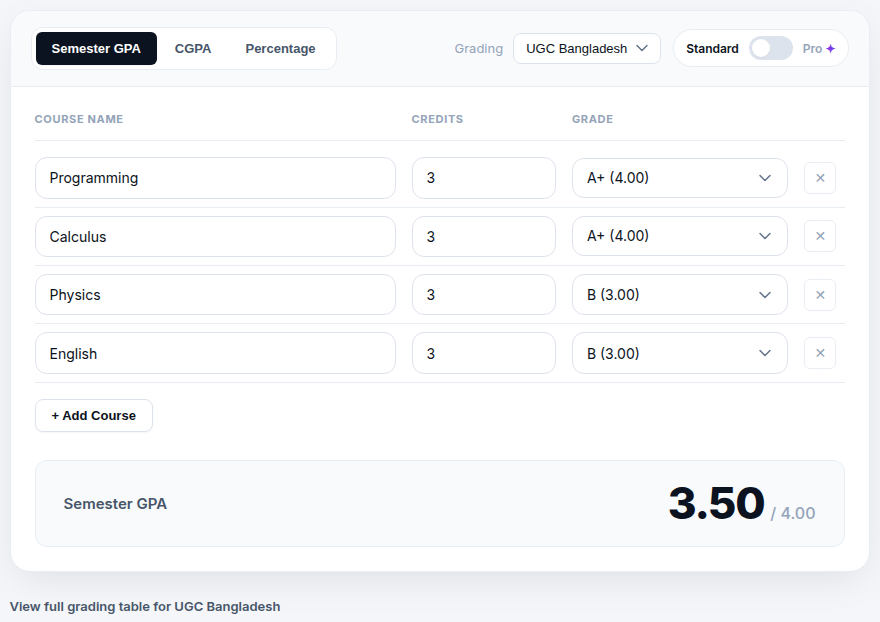
Screenshot: the homepage Semester GPA calculator (UGC Bangladesh scale selected as the generic 4.0 scale). Two courses at A/A+ (4.00) and two at B (3.00), 3 credits each — result 3.50/4.00. The grade-select matched A+ because A and A+ carry identical 4.00 grade points on this scale, so the result is the same arithmetic your Malaysian university uses on any 4.0 scale.
Got your number? Good. Now the important part: which band does it fall in? That depends on your university.
The Three Ladders: Why Every Table You Find Disagrees
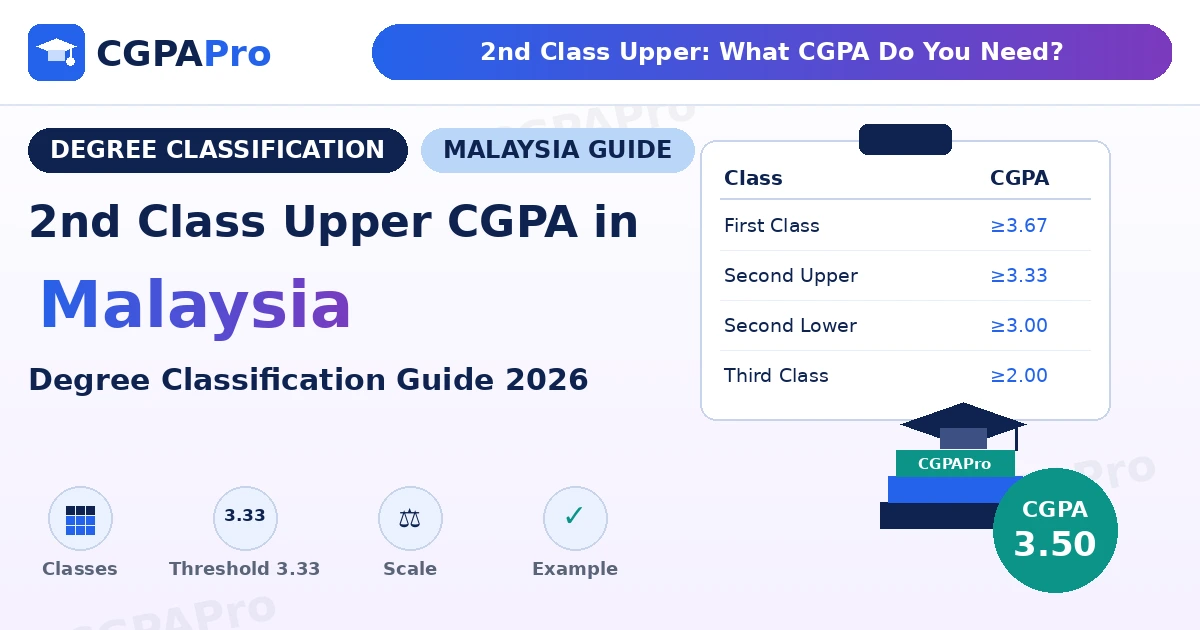
Malaysian universities inherited degree classification from the British system — First Class, Second Class Upper (2:1), Second Class Lower (2:2), Third Class — but each university sets its own CGPA cut-offs on the 4.0 scale. Three competing ladders circulate, and I have verified each one against a real source:
| Class | Ladder A: “3.33 split” (e.g. MMU) | Ladder B: “3.00 split” (e.g. UPTM) | Ladder C: “2.50 split” (older/generic) |
|---|---|---|---|
| First Class | 3.67 – 4.00 | 3.67 – 4.00 | 3.67 – 4.00 |
| Second Class Upper (2:1) | 3.33 – 3.66 | 3.00 – 3.66 | 3.00 – 3.66 |
| Second Class Lower (2:2) | 2.67 – 3.32 | 2.20 – 2.99 | 2.50 – 2.99 |
| Third Class | 2.00 – 2.66 | 2.00 – 2.19 | 2.00 – 2.49 |
Notice the trap: a CGPA of 3.21 is Second Class Upper at UPTM but Second Class Lower at MMU. This is exactly the confusion one real MMU student posted about online — their CGPA was 3.21, some websites told them 3.00–3.50 was “second upper,” but MMU’s own handbook says second upper starts at 3.33. The handbook wins. Always.
Per-University Classification Tables (Verified)
Here are the bands I could verify against official documents. Where a table comes from a secondary source instead, I say so — and you should confirm it in your current program handbook before putting a class on your resume.
MMU — Multimedia University (official: Academic Handbook 2021/2022)
| Class | CGPA |
|---|---|
| First Class | 3.67 – 4.00 |
| Second Class (Upper Division) | 3.33 – 3.66 |
| Second Class (Lower Division) | 2.67 – 3.32 |
| Third Class | 2.00 – 2.66 |
MMU follows the narrower ladder: at MMU, 2nd class upper CGPA starts at 3.33, not 3.00. A CGPA of 3.30 is Second Class Lower here. If you are an MMU student, 3.33 is your magic number, not 3.00.
UPTM — Universiti Poly-Tech Malaysia (official: Academic Regulations, 2023 Amendment)
| Class | CGPA |
|---|---|
| First Class | 3.67 – 4.00 |
| Second Class (Upper Division) | 3.00 – 3.66 |
| Second Class (Lower Division) | 2.20 – 2.99 |
| Third Class | 2.00 – 2.19 |
UPTM is the generous 2:1: the upper-second band runs a full 0.66 points wide, from 3.00 to 3.66. The same 3.21 that is Second Lower at MMU is comfortably Second Upper at UPTM.
UTM — Universiti Teknologi Malaysia (reported; confirm in your handbook)
| Class | CGPA |
|---|---|
| First Class | 3.70 – 4.00 |
| Second Class Upper | 3.00 – 3.69 |
| Second Class Lower | 2.50 – 2.99 |
UTM is unusual in setting the first-class bar at 3.70 rather than 3.67 — consistently reported by UTM students and alumni, though I could not verify the classification section of the current regulations PDF directly, so treat this as reported. See our full UTM grading system guide for its full grade-point table.
UTAR legacy ladder (reported; UTAR is now TAR UMT)
| Class | CGPA |
|---|---|
| First Class | 3.50 – 4.00 |
| Second Class (Upper) | 3.00 – 3.499 |
| Second Class (Lower) | 2.20 – 2.9999 |
| Third Class | 2.00 – 2.1999 |
Note the catch: UTAR’s first class started at just 3.50, which is why UTAR first-class graduates used to collide with PTPTN’s own benchmark (more on that below). TAR UMT’s current handbook uses different nomenclature entirely — Honours with Distinction (3.75–4.00), Honours with Merit (2.75–3.7499), Honours (2.00–2.7499). Our UTAR grading guide covers the full grade table.
UM — Universiti Malaya (official: Bachelor’s Degree Regulations 2024)
UM does not use “First/Second Class” wording for its honours award at all. Instead, the Bachelor’s Degree Pass With Honours (With Distinction) requires a final CGPA of 3.70 or above, plus: no grade F in any course, no repeated or upgraded courses, and completion within the minimum study duration. So at UM, a failed-then-repeated course can cost you the distinction even if your CGPA recovers. Details in our UM grading system guide.
UUM and the branch campuses
A real UUM completion letter records a graduate with CGPA 3.41 classified as Second Class Upper — concrete proof that 3.41 sits inside the 2:1 band at a public university. The UK branch campuses in Malaysia (e.g. Nottingham Malaysia) classify on the British percentage scale instead: 70%+ First, 60–70% Upper Second — their CGPA equivalents depend on the campus conversion policy, so ask the registry, not Google. Monash Malaysia’s bands are covered in our Monash grading guide.
How CGPA Is Calculated (Step by Step)
Degree classification is awarded on your final CGPA at graduation — the cumulative grade point average across every course you took. If you are still confused about how CGPA differs from GPA and SGPA, read our CGPA vs GPA vs SGPA explainer first. The formula:
CGPA = total grade points earned ÷ total credit hours attempted
And each course’s grade points = grade point of your letter grade × the course’s credit hours. Step by step:
- Convert each grade to grade points. On the common 4.0 scale: A+/A = 4.00, A− = 3.67, B+ = 3.33, B = 3.00, B− = 2.67, C+ = 2.33, C = 2.00, C− = 1.67, D+ = 1.33, D = 1.00, F = 0.00. (Your university’s exact mapping may differ slightly — check its handbook; our UiTM guide and UPM guide list theirs.)
- Multiply grade points by credit hours for each course. A 3-credit B gives 9.00 grade points; a 4-credit A− gives 14.68.
- Add up all grade points and add up all credit hours.
- Divide. That is your CGPA. Compare it with your university’s band from the tables above.
Worked Example: Hand-Computing to Exactly 3.50
Let us do one semester by hand, with the exact courses from the screenshot above. Four 3-credit courses on a standard 4.0 scale:
| Course | Credits | Grade | Grade points | Weighted |
|---|---|---|---|---|
| Programming | 3 | A (4.00) | 4.00 | 3 × 4.00 = 12.00 |
| Calculus | 3 | A (4.00) | 4.00 | 3 × 4.00 = 12.00 |
| Physics | 3 | B (3.00) | 3.00 | 3 × 3.00 = 9.00 |
| English | 3 | B (3.00) | 3.00 | 3 × 3.00 = 9.00 |
| Total | 12 | 42.00 |
GPA = 42.00 ÷ 12 = 3.50. Two A-level grades and two B-level grades average out to exactly the midpoint — and 3.50 is safely inside the 2:1 band at every university in the tables above, and within touching distance of first class nowhere (that starts at 3.67 or 3.70).
Now scale that up to your whole degree. Your CGPA is the same calculation over every course across every semester — or equivalently, a credit-weighted average of your semester GPAs. This is why final-year students feel trapped: with 100+ credits already banked, one great semester barely moves the needle. Which brings us to the most practical question of this guide.
Why the 2:1 Band Is the Magic Number
Second Class Upper is not just a label on your scroll. In Malaysia it is a gatekeeper number, because employers, universities and government bodies all picked round CGPA values that happen to sit at or inside the 2:1 band.
Malaysian jobs: the 3.00 line
Scroll Malaysian graduate job ads and you will keep seeing the same phrase: “minimum CGPA 3.00 / Second Class Upper or equivalent.” One real listing — Carlsberg Malaysia’s apprenticeship posting — wrote exactly that. At UPTM-style universities, 3.00 is the bottom of the 2:1 band, so the two requirements are the same thing. But at MMU, a CGPA of 3.00 is Second Class Lower — and an employer who wrote “Second Class Upper or equivalent” could reasonably reject you even though you cleared the 3.00 number. When an ad uses both phrases, the class requirement is the stricter one. This is why the distinction between the 3.00 split and the 3.33 split is not academic trivia; it can decide shortlists.
Master’s abroad: the 2:1 equivalence
Most UK postgraduate courses require a 2:1 or equivalent. The University of Sheffield’s official Malaysia entry requirements translate this as: First Class = 3.5/4.0, 2:1 = 3.0/4.0, 2:2 = 2.5/4.0. Malaysia’s International Scholarship (MIS) likewise sets a strict 3.00 CGPA minimum — applications at 2.99 are auto-filtered out. So for overseas study, the 3.00 line is genuinely the line that matters, regardless of what your university calls the band.
JPA scholarships: the reported 3.75 line
Students have long reported that JPA (the Public Service Department) treats first class as 3.75 where the degree itself does not dictate — the “JPA standard” that kept surfacing in student discussions. This is a reported figure, not something I could verify against a JPA document, so if you are on a JPA track, read your actual offer letter: it is the only number that binds.
PTPTN: the first-class loan exemption (2026 rules)
Second class upper does not convert your PTPTN loan — only First Class Honours does. And the rules tightened under Budget 2026: the exemption now applies only to graduates from low and middle-income families (B40/M40) with First Class Honours from public universities; private-institution graduates no longer qualify. What counts as first class is your degree’s own definition — generally CGPA 3.67 or higher — and you must apply within 12 months of your convocation, having finished full-time and on schedule with no overlapping sponsorship. An older student-reported figure of 3.75 as a flat PTPTN benchmark appears to be historical; today PTPTN follows the degree’s first-class definition. The actionable point for a 2:1 student: PTPTN exemption is a first-class game, and if you are close, every decimal matters.
Common Mistakes Students Make With Classification
1. Trusting the first table Google shows you. The top results for this query include an article that says Second Class Upper is 3.00–3.4999 in one paragraph and 2.00–2.80 in another — both on the same page. Always verify against your university’s academic regulations, not a random site.
2. Assuming 3.00 = 2:1 everywhere. At MMU the 2:1 starts at 3.33. A 3.10 is a comfortable 2:1 at UTM and UPTM, and a 2:2 at MMU. Your university’s handbook is the only table that counts.
3. Rounding up in your head. A CGPA of 3.329 is not 3.33. Universities do not round your CGPA up into the next class — the published cut-off is a hard floor. If your transcript says 3.329 at MMU, you are in Second Class Lower, full stop.
4. Confusing the percentage band with the CGPA band. The UK-style “60–70% = 2:1” is a marks band used by branch campuses. It does not mean CGPA 3.00 = 60%. Do not convert between them with a rule of thumb; use your university’s official mapping. (Our CGPA-to-percentage guide explains the proper conversion.)
5. Thinking a retake erases history. Some students assume retaking a low-grade course replaces it in the classification math. At many Malaysian universities the repeated attempt’s grade counts, but policies differ — and at UM, any repeated course disqualifies you from the Honours (With Distinction) award even if your CGPA recovers to 3.70. See how retaking a course affects your CGPA before you decide.
Tips for Crossing Into (or Staying Inside) the 2:1 Band
If you are a final-year student watching your CGPA hover near a band boundary, this is the math that matters. Remember the real student whose CGPA dropped from 3.3 to 3.1 entering final year — he wanted to know when he could relax and when he had to push. Here is how to answer that for yourself.
1. Know your personal floor. Write down your university’s exact 2:1 cut-off (3.00 or 3.33) and your current CGPA with completed credits. The formula for what you need next:
Required GPA = (Target CGPA × total credits by graduation − current CGPA × completed credits) ÷ remaining credits
Example: you have 90 credits at 3.25, need 3.33 over 120 credits. (3.33 × 120 − 3.25 × 90) ÷ 30 = (399.6 − 292.5) ÷ 30 = 3.57. You need a 3.57 average across your remaining 30 credits — achievable, but it means mostly A−/B+ grades, no coasting.
2. Weight follows credits. A 4-credit core course moves your CGPA roughly twice as much as a 2-credit elective. If you are defending a band, your effort should follow the credit weighting, not your interest in the subject.
3. B+ is the most underrated grade in Malaysia. At 3.33, a B+ is exactly the MMU 2:1 threshold grade — every B+ you earn is a second-upper grade. Students chasing A’s often ignore that a wall of B+’s already secures the band at MMU-style universities.
4. Do not “rileks” in the semester you need least. The lazy-semester strategy only works if you have buffer above your floor. If you are at 3.05 at UPTM with the floor at 3.00, one bad semester can drop you into Second Lower permanently — there is no grade inflation rescue at the end. Build buffer first, coast later.
Frequently Asked Questions
What CGPA is 2nd class upper in Malaysia?
There is no single answer: it is 3.33–3.66 at MMU, 3.00–3.66 at UPTM, 3.00–3.69 at UTM (reported), and 3.00–3.499 at legacy UTAR. Check your own university’s academic regulations — the handbook’s table is the only one that decides your class.
My CGPA is 3.21 at MMU. Is that second class upper?
No. At MMU, Second Class Upper starts at 3.33, so 3.21 falls in Second Class Lower (2.67–3.32). At UPTM the same 3.21 would be Second Class Upper. This is the exact real-world confusion students post about: the answer genuinely differs by university.
Is second class upper good for jobs in Malaysia?
Yes — it is the standard graduate-employer threshold. Many job ads ask for “minimum CGPA 3.00 / Second Class Upper or equivalent.” A 2:1 keeps you eligible for the large majority of graduate postings; below it, options narrow sharply, especially at GLCs and multinationals.
Can I do a master’s in the UK with a second class upper from Malaysia?
Usually yes. Most UK universities accept a 2:1 or equivalent, and the University of Sheffield officially equates a Malaysian 2:1 with 3.0/4.0. Competitive courses and top universities may demand first-class equivalent, so check each course’s page.
Does second class upper convert my PTPTN loan into a scholarship?
No. PTPTN repayment exemption requires First Class Honours (generally CGPA 3.67+, per your degree’s definition). Under the 2026 rules it is further limited to B40/M40 graduates of public universities — private-institution graduates no longer qualify. Apply within 12 months of convocation.
My university awards first class at 3.50. Will employers and JPA accept that?
Employers generally accept whatever your transcript states. JPA is stricter: students report JPA applying its own 3.75 first-class benchmark where the degree does not dictate. Always confirm against the specific sponsor’s letter, not the university’s table.
Is a CGPA of 3.329 the same as 3.33 for classification?
No. Classification cut-offs are hard floors; universities do not round you up into the next class. 3.329 at MMU is Second Class Lower. If you are near a boundary, that hundredth of a point is worth real effort in your final semester.
The Bottom Line
“2nd class upper CGPA” in Malaysia is a question with a university-specific answer — 3.33–3.66 at MMU, 3.00–3.66 at UPTM, 3.00–3.69 at UTM, and different again elsewhere. The generic tables floating around the internet are not just incomplete; the top-ranking one contradicts itself within a single page. Your move is simple: compute your CGPA with the calculator above, open your university’s academic regulations, and match your number to their table. If you land at 3.00 or above, you are inside the 2:1 band at most Malaysian universities — the band that keeps graduate jobs, UK master’s programs and scholarships on the table. If you are below your university’s line, the target-GPA formula above tells you exactly what the remaining semesters must produce. No guessing, no generic tables — just your number against your university’s rule.