Quick answer: Yes, a failed subject counts toward your CGPA. In most university systems — Pakistan, Bangladesh, Malaysia, and the US — an F (or E) is recorded as 0 grade points while its credit hours stay in the denominator. One F in a 15-credit semester can drag a 3.13 GPA down to 2.50. Some systems (like IIT’s new curriculum) exclude failed courses from the CGPA until you clear them, but they still hit your SGPA — and the F stays on your grade card permanently either way.
This guide shows you exactly how the math works, how each country’s universities treat failed subjects and backlogs differently, what happens when you retake, and how to recover your CGPA — with real worked examples you can check against the calculator below.
The Formula: Where the F Actually Goes
Every CGPA system is built on the same skeleton:
GPA = Σ (grade point × credit hours) ÷ Σ (credit hours attempted)
A failed subject contributes 0 × credits to the top of that fraction — but the question that decides everything is whether its credits stay in the bottom of the fraction. There are two families of rules:
Family 1 — The failed credits stay in. Pakistan (HEC), Bangladesh (UGC), Malaysia, and most US-style systems: the F’s credits remain in the denominator forever (until a successful retake replaces them under your university’s policy). This is the common case.
Family 2 — The failed credits drop out (of CGPA, not SGPA). Under IIT’s new curriculum rules, E and F grades are “not counted in the calculation of the CGPA; however, these are counted in the calculation of the SGPA.” So your semester GPA takes the hit, but your cumulative average ignores the failed course until you clear it. The grade itself still sits on your grade card permanently.
Which family you are in changes your numbers dramatically — and most students calculate it the wrong way.
Worked Example: One F in a 5-Course Semester
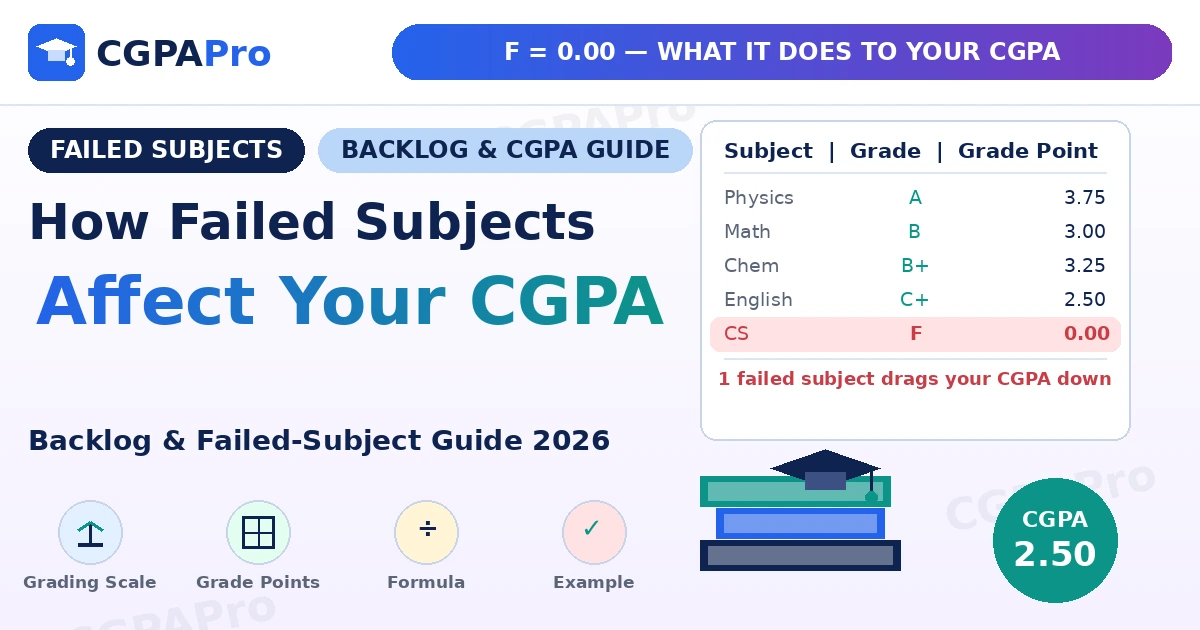
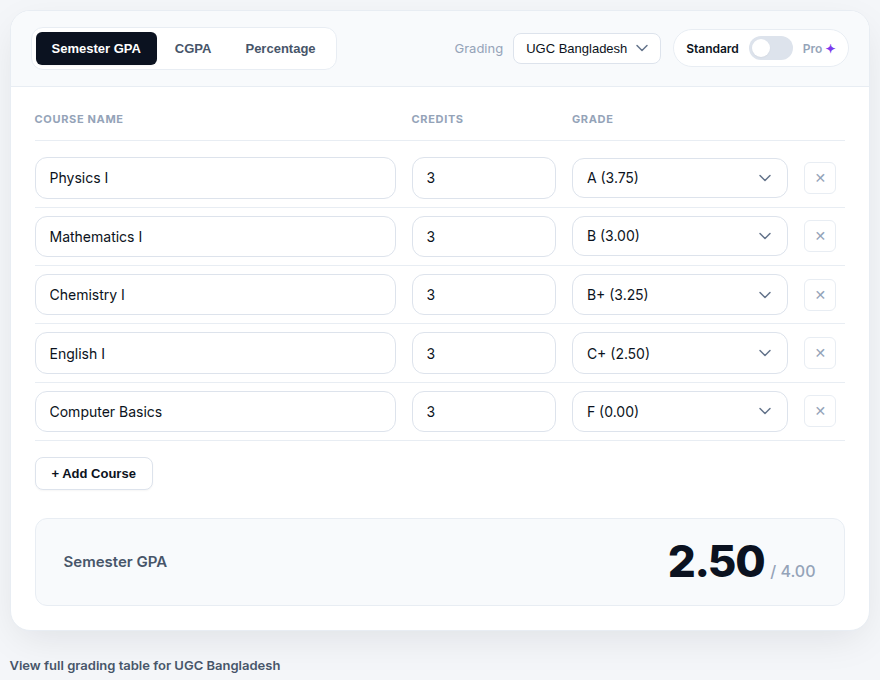
Take a typical 15-credit semester (5 courses, 3 credits each) on the standard 4.0 scale used by Bangladesh’s UGC:
| Course | Grade | Grade Point | Credits | Points (GP × Cr) |
|---|---|---|---|---|
| Physics I | A | 3.75 | 3 | 11.25 |
| Mathematics I | B | 3.00 | 3 | 9.00 |
| Chemistry I | B+ | 3.25 | 3 | 9.75 |
| English I | C+ | 2.50 | 3 | 7.50 |
| Computer Basics | F | 0.00 | 3 | 0.00 |
| Total | 15 | 37.50 |
GPA = 37.50 ÷ 15 = 2.50
Now watch what happens if you remove the failed course from the math entirely:
Without the F: 37.50 ÷ 12 = 3.13
One failed 3-credit course cost 0.63 GPA points — the difference between a respectable transcript and academic probation territory. That is the real price of an F: it is not just the missing 11.25 points you would have earned with an A — it is the dead weight of 3 credits contributing nothing while still dividing the total.
You can verify this yourself on the free calculator below — enter the five grades above and you should see 2.50.
How Pakistan Counts Failed Subjects (HEC Rules)
Pakistan’s Higher Education Commission rules are the most clearly documented of the four countries, and they are strict:
- An F grade means you must repeat the course. It is not optional — “If a student gets F grade, s/he will be required to repeat the course.”
- Both attempts stay on your transcript, but “only the better grade shall be used in the calculation of CGPA.” So the 0 still sits in your old semester GPA, but your CGPA uses the new grade once you pass.
- Undergraduates may also repeat courses they passed with a D to improve the grade (universities may cap this at about 6 courses in a 4-year program); MS/MPhil students may repeat a C (cap of about 3).
- Pass/fail electives are excluded from GPA entirely. You can take up to 9 credit hours of elective courses on a pass/fail basis, and those grades “will not be considered in calculating the GPA or CGPA” — a legitimate way to protect your average on risky electives (ask your department which courses qualify).
The biggest trap in the HEC rulebook is the withdrawal rule: a student who withdraws after the 6th week is automatically awarded an F, which counts in the GPA. A “W” (withdrawn) before the deadline has no grade point and its credits do not count toward the semester — but once that deadline passes, withdrawing is no escape from the zero.
How India Handles Failures and Backlogs
India’s term is “backlogs” (or “arrears” in some universities) — any subject you failed and must clear later. The math follows the UGC’s CBCS model:
- An F is shown on the grade card with 0 grade points, and “credits are not allotted to the learner in such cases.” The course contributes nothing to the numerator.
- The standard UGC scale is: O=10, A+=9, A=8, B+=7, B=6, C=5, P=4, F=0. Your SGPA is Σ(C×G) ÷ total credits of the semester, and the failed course’s credits are included in that denominator.
- At universities like Anna University and VIT, an uncleared course appears as N (No grade / re-registration required) — you must re-register, attend classes, and clear it. VIT’s relative-grading system adds a twist: if your class performs well, the passing floor rises, which is why students ask “can I get an F with good marks?”
- IIT’s exception matters: under the new curriculum FAQ, E and F grades “stay permanently on the grade card” but are excluded from CGPA (counted only in SGPA). An E additionally makes you eligible for a summer-semester repeat (undergraduates only).
Practical backlog rules (varies by university — check your handbook):
- Most universities cap how many active backlogs you can carry into the next semester or the final year.
- You cannot graduate until every backlog is cleared, no matter how high your CGPA is.
- Supplementary/remedial exams let you clear a backlog without re-attending classes at many universities; others require full re-registration.
- Backlogs can delay placements and internships — many recruiters ask for “no active backlogs.”
How Bangladesh and Malaysia Count Them
Bangladesh (UGC scale): F = 0.00 on the standard A+ 4.00 → F 0.00 scale, and failed credits count in the semester GPA denominator like any other course — Family 1. There is no national grade-forgiveness rule, so each university’s own repeat policy (BRACU, IUB, NSU, DU differ) decides what happens after a retake. See our BRACU, IUB, NSU, and Dhaka University grading guides for the per-university rules.
Malaysia: also Family 1. A typical semester math looks like this (from a real student walkthrough on the lowyat forums):
Semester 2: P (6 cr, A=4.00), Q (3 cr, B=3.00), R (3 cr, E=0.00, failed), S (2 cr, B=3.00)
(6×4.00) + (3×3.00) + (3×0.00) + (2×3.00) = 39 grade points ÷ 14 credits = 2.79 GPA
CGPA after two semesters = (32 + 39) ÷ (11 + 14) = 2.84 — note this is NOT the average of the two semester GPAs.
When the student repeats subject R in semester 3 and gets an A, that semester’s GPA jumps to 3.25. The general Malaysian GPA/CGPA mechanics are covered in our 2nd Class Upper, UiTM, and UTAR guides.
W vs WF vs I: The Withdrawal Alphabet That Saves (or Sinks) You
These three transcript codes look similar but behave completely differently:
| Code | Meaning | Counts in GPA? | Credits count? |
|---|---|---|---|
| W | Withdrew before the deadline | No | No — invisible to the math |
| WF | Withdrew while failing (after deadline) | Yes — treated as F (0.0) | Yes |
| I | Incomplete (medical/approved) | No (for now) | No |
The WF is the cruelest surprise in the book: it looks like a withdrawal, but it is calculated exactly like a failure. And remember HEC’s 6th-week rule — withdraw late in a Pakistani university and the system writes the F for you. The honest hierarchy of outcomes, from best to worst:
W (early withdrawal) > I (incomplete, then finish) > retake-and-replace > carrying the F
If you are failing a course and the withdrawal deadline has not passed, withdrawing is almost always mathematically better than taking the F — but check your university’s lifetime limit on W grades first.
What Happens After a Retake: Replacement vs Averaging
There are three policies in the wild, and you must know which one your university uses:
- Replacement (Pakistan HEC, many others): the new grade replaces the F in the CGPA. Both attempts stay on the transcript, but the math only sees the better one. Retaking an F here is the single highest-ROI move in your degree — going from 0.00 to 3.00 in a 3-credit course adds 9 grade points.
- Averaging: both grades count (the F and the new grade are averaged). Still worth it, but the F never fully leaves the math.
- Exclude-and-clear (IIT style): the cleared course simply joins the CGPA with its new grade; the old F was never in the CGPA to begin with.
Worked recovery under replacement rules, continuing our example (current: 37.50 points / 15 credits = 2.50 GPA):
You retake Computer Basics, earn a B (3.00). New points: 37.50 + 9.00 = 46.50. The F’s 3 credits stay in the denominator (replacement swaps the 0 for the 9, not the credits): 46.50 ÷ 15 = 3.10 GPA.
One retake recovered 0.60 points — nearly the entire loss. For the full decision framework (when a retake is actually worth your time and money vs. protecting other courses), see our dedicated guide: How Retaking a Course Affects Your CGPA.
Recovery Math: Can You Still Hit Your Target?
Students always ask whether one bad semester ruins everything. The honest answer is arithmetic. Suppose you want a 3.50 CGPA after finishing 18 credits at 2.50 (45 points), and you have 15 credits left:
Needed: (3.50 × 33 − 45) ÷ 15 = (115.50 − 45) ÷ 15 = 70.50 ÷ 15 = 4.70 — impossible on a 4.0 scale.
That is the moment to reset the target, not the effort. The realistic ceiling with straight 4.0s from here:
(45 + 60) ÷ 33 = 105 ÷ 33 = 3.18
Rules of thumb that save students from fantasy planning:
- One F needs one A to average back to 2.0 — every F requires an equal-credit A to pull a 2.0 back up (the math checks out).
- Future credits dilute the damage. The F is a fixed 0 in your numerator; every new credit you earn at 3.5+ shrinks its share. Volume is the cure.
- Protect the denominator. A W before the deadline removes the course from the math entirely; an F keeps dividing you.
For the complete playbook on raising the number from here, see How to Improve Your CGPA.
5 Mistakes Students Make With Failed Subjects
- Averaging semester GPAs. CGPA is total grade points ÷ total credits — never the average of SGPAs. The lowyat example above proves it: (2.91 + 2.79) ÷ 2 = 2.85, but the true CGPA is 2.84. Small gap, wrong method — and it compounds.
- Thinking a retake erases the transcript. Replacement policies fix the CGPA, not the record. IIT’s FAQ says E/F grades “stay permanently on the grade card”; HEC records both attempts. Employers and grad schools who read transcripts will see the F — which is why you should be ready to explain it.
- Treating W and WF as the same thing. A timely W is invisible to your GPA. A WF is an F wearing a disguise. Know your deadline.
- Ignoring credit weight. An F in a 4-credit lab course does 33% more damage than an F in a 3-credit theory course. When choosing which backlog to clear first, clear the heavy one.
- Using a flat “minus 0.5” estimate. Some students guess each F costs “about half a point.” The real cost depends on your total credits — in our example it was 0.63, but in a 120-credit degree with 105 earned credits, one 3-credit F costs only about 0.07 CGPA points. Run the actual numbers.
FAQ: Failed Subjects, Backlogs & CGPA
Does a failed subject count in CGPA or only SGPA?
It depends on your system. In Pakistan, Bangladesh, Malaysia, and US-style systems, the F counts in both (0 points, credits included). Under IIT’s new curriculum, E/F grades count in SGPA but are excluded from CGPA until cleared. When in doubt, assume it counts in both — that is the common case.
Will the F stay on my transcript even after I retake and pass?
Yes. Both IIT’s and HEC’s official rules keep the original F on the permanent record; only the CGPA math is repaired. Some universities let you petition to annotate or, rarely, expunge old grades — ask your registrar, but plan on it staying.
What is a backlog (arrear)?
An Indian-universities term for any subject you failed and must clear later. Backlogs sit on your grade card (often as N/no-grade at places like VIT/Anna University), must all be cleared before you graduate, and most universities limit how many active backlogs you can carry.
Is it better to get a W than an F?
Almost always, yes — a timely W does not touch your GPA or your credits. But watch two traps: the WF-after-deadline (counts as an F) and lifetime W limits at some universities.
How many backlogs can I have?
There is no universal number — each university sets its own cap for promotion to the next year and for degree completion. Check your program handbook; carrying too many can block registration for the next semester.
Can I still get a scholarship or job with an F on my record?
A single cleared F rarely disqualifies you by itself. Most scholarships and employers look at the final CGPA and the transcript trend. What hurts is a pattern — multiple Fs, or active backlogs at application time. Graduate programs that read full transcripts (like WES-evaluated applications) will see every attempt, so the recovery story matters. See our guides on whether 3.0 CGPA is good and WES conversion for how evaluators read your record.
Can I convert my percentage to CGPA if I have backlogs?
Yes — conversion uses your final awarded marks/CGPA after clearing. Until backlogs are cleared, most universities will not issue a final consolidated marksheet, so convert only after your record is complete. See how to convert percentage to CGPA.
The Bottom Line
An F is a 0 in your numerator with its credits still dividing your total — usually. The three numbers that define your situation are: (1) your system’s denominator rule, (2) your retake policy (replacement vs averaging), and (3) your withdrawal deadline. Get those three from your handbook, run the worked examples in this guide with your own grades, and you will know exactly where you stand — and exactly how many good credits it takes to climb back. Start with the calculator above, then read how retaking affects CGPA to plan your next move.
Sources: IIT New Curriculum Academic FAQ; HEC Draft Policy Guidelines for the Uniform Semester Examination System (Pakistan); HEC Uniform Semester System Policy (pass/fail courses, withdrawal rules); SPU CBCS Notification (UGC model); College Board ACES grade-mapping FAQ; NTU Academic Rules (Pakistan).