Quick answer: The common formula is GPA (4.0) = (CGPA ÷ 10) × 4 — so 8.0 becomes 3.2. But that formula systematically undervalues Indian grades. A grade-table conversion of the same record gives 3.40, and a WES course-by-course evaluation often lands higher still. And for most US applications, you should not convert at all — report your CGPA on its 10-point scale and let the university convert it.
If you studied at an IIT, a VTU-affiliated college, Anna University, or anywhere else on India’s 10-point CGPA scale, you have probably typed “10 point cgpa to 4 point gpa” into Google at 2 AM before a grad-school deadline. You found five websites with the same one-line formula, punched in your number, and walked away with an answer that felt slightly off.
It felt off because it probably is. This guide shows you the four real conversion methods — the formula everyone quotes, the grade-table method that actually flatters your record, what WES does with your transcripts, and the percentage route with the official university formulas most websites get wrong — plus the one trap (the VTU trap) that can cost you half a grade point. Every method comes with worked numbers, not theory.
Try it first: convert your grades with a real 10-point calculator
Before the theory, let’s ground this in your actual record. Our VTU CGPA calculator uses the exact UGC 10-point scale (O = 10 down to F = 0) that VTU, Anna University, and most Indian CBCS universities use. Enter your courses exactly as they appear on your marks card:
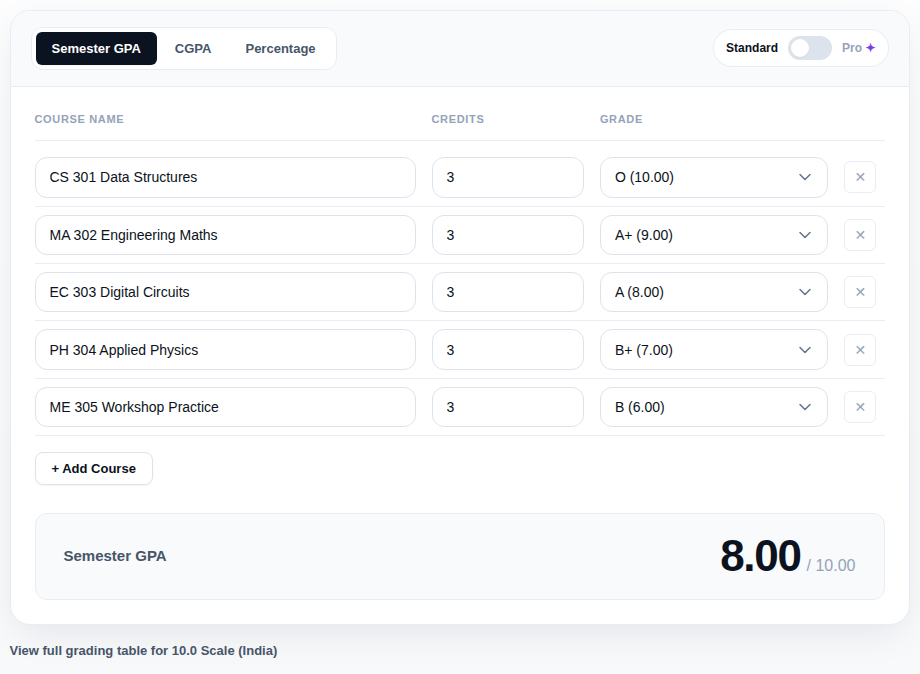
Screenshot: a five-course VTU semester on the 10-point scale. O (10) × 3cr + A+ (9) × 3cr + A (8) × 3cr + B+ (7) × 3cr + B (6) × 3cr = 120 ÷ 15 = CGPA 8.00. Real capture from cgpacalculatorpro.com.
That 8.00 is the number every conversion method in this guide starts from. Note it well — the next section shows how three honest methods turn it into three different answers, and only one of them is what US admissions offices actually compute.
Method 1: The linear formula (a benchmark, nothing more)
GPA = (CGPA ÷ 10) × 4
For our worked example: 8.0 ÷ 10 × 4 = 3.20.
This is the formula every top-ranking article repeats — and it is the least honest of the four. A US 4.0 scale is not a straight proportion of a 10-point scale. American grading is built from letter grades (A = 4.0, A− = 3.7, B+ = 3.3, B = 3.0…), each with its own band width. Indian grading bands are coarse: an “A” spans a whole band of marks and the letter steps are far apart. When you divide by 10 and multiply by 4, you silently pretend both systems slice achievement the same way. They don’t.
Where the formula is still useful: as a personal sanity check. If a website, a friend, or your own estimate says your 8.5 is “about 3.6 on 4.0”, the formula tells you that is optimistic. Use it to catch inflated claims, never to fill in an application field.
Method 2: The grade-table conversion (your best honest estimate)
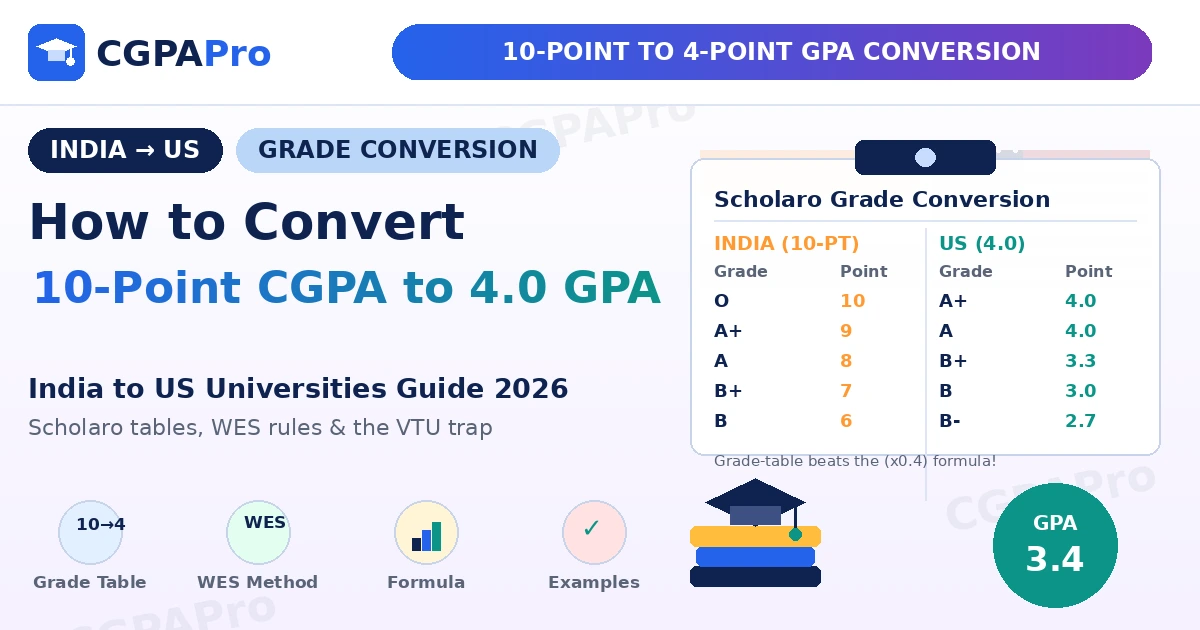
This is the method nobody in the top search results shows you, and it is the one that treats your record fairly. Instead of converting the average, you convert each grade to its US equivalent and then average — the way Scholaro’s India grading-system tables map the UGC 10-point scale to the US 4.0 scale:
| Indian grade | Points (10-pt) | US equivalent | US points |
|---|---|---|---|
| O (Outstanding) | 10 | A+ | 4.0 |
| A+ (Excellent) | 9 | A | 4.0 |
| A (Very Good) | 8 | B+ | 3.3 |
| B+ (Good) | 7 | B | 3.0 |
| B (Above Average) | 6 | B− | 2.7 |
| C (Average) | 5 | C | 2.0 |
| P (Pass) | 4 | C | 2.0 |
| F (Fail) | 0 | F | 0.0 |
Now run our 8.00 worked example through this table, course by course (all 3-credit courses):
- Data Structures — O → A+ → 4.0 × 3 = 12.0
- Engineering Maths — A+ → A → 4.0 × 3 = 12.0
- Digital Circuits — A → B+ → 3.3 × 3 = 9.9
- Applied Physics — B+ → B → 3.0 × 3 = 9.0
- Workshop Practice — B → B− → 2.7 × 3 = 8.1
Total = 51.0 ÷ 15 = 3.40.
Same record, two honest methods: the formula says 3.20, the grade table says 3.40. That 0.20 gap is the difference between being filtered out and being shortlisted at schools with a 3.3 cutoff — and it exists because the grade-table method respects how Indian bands actually map to US letters. Notice the mechanism: your top grades (O, A+) map to the very top of the US scale (A+, A), while the formula smears them down proportionally.
Method 3: WES course-by-course evaluation (the admissions-safe one)
World Education Services (WES) does not do what the formula does. It never multiplies your overall CGPA by 0.4. A WES course-by-course evaluation converts every course on your marks card individually — each course becomes a US letter grade plus US semester credits — and only then computes a 4.0 GPA. That is why students report WES GPAs that diverge from the formula: in one widely-discussed thread, a 71% aggregate came back as 3.76 while the formula would have called it roughly 3.1.
The mechanics matter here because they mirror the grade-table method above, just executed by an agency admissions offices trust. WES’s free iGPA calculator gives you a rough estimate, but the official evaluation report (around $160 for course-by-course) is what schools that require it actually read.
When does this matter for you? Many US universities — including competitive programs — explicitly ask international applicants not to self-convert. Their admissions teams know the Indian system; they run your marks card through their own conversion or accept a WES report. If you self-convert and also submit a WES report later, the two numbers can mismatch, and a mismatch is the one thing that makes an admissions reader reach for the reject pile. Rule of thumb: if the application form accepts your original scale, leave your CGPA on 10. Only if a form field forces a 4.0 value should you enter a converted number — and then label it as an estimate.
Read more: our WES CGPA conversion guide 2026 walks through course-by-course vs document-by-document reports, costs, processing times, and which US and Canadian universities require one.
Method 4: The percentage route (and the VTU trap)
Many students go CGPA → percentage → 4.0 GPA. This route has two official-university tripwires, and the second one is the nastiest trap in this whole guide.
Tripwire 1: the CGPA→percentage formula is university-specific. There is no single Indian conversion. The official formulas:
| University / system | Official CGPA → percentage formula | Example |
|---|---|---|
| VTU | % = (CGPA − 0.75) × 10 | 8.0 → 72.5% (not 80%) |
| Anna University | % = (CGPA × 10) − 7.5 | 8.5 → 77.5% |
| Mumbai University | % = 7.25 × CGPA + 11 | 8.0 → 69.0% |
| AKTU | % = CGPA × 9.5 | 8.0 → 76.0% |
| IITs / NITs | % = CGPA × 10 (convention) | 8.0 → 80.0% |
A VTU student who multiplies by 10 instead of using the official formula inflates their percentage by 7.5 points — and the same error in reverse deflates the record of students who use the wrong university’s formula. If you need the full country-wise breakdown, see our CGPA-to-percentage guide.
Tripwire 2: the VTU trap. Take our worked example — VTU CGPA 8.00. Official percentage: (8.0 − 0.75) × 10 = 72.5%. Now convert that percentage to a 4.0 GPA the naïve way: 72.5 ÷ 100 × 4 = 2.90. Compare with the direct formula: 8.0 ÷ 10 × 4 = 3.20. Same student, 0.30 GPA apart — and the 2.90 is simply wrong, produced by chaining two unrelated formulas. The lesson: never chain conversions. Convert once, from the source scale, with one method — or don’t convert at all.
There is a deeper reason the percentage route punishes Indian students. On Scholaro’s “Most Common” India grading scale, 60–100% is First Division, and First Division maps to a US A. An Anna University student at CGPA 7.5 converts to 67.5% — First Class, a US “A” student. Run that same 7.5 through the linear formula and you get 3.0 — a US “B”. Nobody at a US admissions desk looks at a First Class Indian degree and sees a B student; the formula does, and the formula is what you typed into that converter at 2 AM.
Which method should you actually use?
- Applying to a US university and the form accepts your scale? Report your CGPA on the 10-point scale. Do not convert. This is the correct answer for most MS applications.
- A form field forces a 4.0 number? Use the grade-table method (3.40 for our example) and label it an estimate. It is the fairest self-conversion available.
- The university requires a credential evaluation? Order a WES course-by-course report (~$160) and report exactly what it says — never your own formula.
- Estimating your competitiveness for shortlisting? Use the linear formula as a floor (3.20) and the grade-table as your honest number (3.40). The truth is between them, usually closer to the top.
- On your resume or LinkedIn? Write “CGPA 8.0/10.0” — recruiters who hire from Indian universities read the 10-point scale natively.
Read more: how your specific institute computes its numbers — our IIT grading system guide covers CPI vs SPI and what counts as a good CPI, and the Anna University guide covers its official conversion rules.
Quick reference table (linear benchmark — read the warning first)
Use this table only as a rough benchmark. Every value below is the formula (CGPA ÷ 10 × 4); as you now know, the grade-table method typically reads 0.1–0.2 higher for strong records:
| CGPA (10-pt) | Formula GPA (4.0) | Rough US standing |
|---|---|---|
| 10.0 | 4.0 | A+ (summa-level) |
| 9.5 | 3.8 | A |
| 9.0 | 3.6 | A− |
| 8.5 | 3.4 | B+ |
| 8.0 | 3.2 | B+ |
| 7.5 | 3.0 | B |
| 7.0 | 2.8 | B− |
| 6.5 | 2.6 | B−/C+ |
| 6.0 | 2.4 | C+ |
GPA vs CGPA vs SGPA — the thirty-second version
Indian universities run on three related numbers. SGPA (or SPI/CPI at IITs) is one semester; CGPA is the credit-weighted average across all semesters; GPA in the American sense is the same idea as CGPA but on a 4.0 scale with plus/minus letters. When US schools say “GPA”, they mean a cumulative number on 4.0 — which is why “convert my CGPA to GPA” really means “re-express my cumulative average on the American letter scale”. Full explainer: CGPA vs GPA vs SGPA.
Common mistakes students make
- Multiplying by 0.4 and calling it a day. The formula is a floor, not a conversion. For a strong record it undersells you by 0.1–0.3.
- Chaining CGPA → % → GPA. The VTU trap above: 8.0 → 72.5% → 2.9. Each conversion step leaks accuracy; convert once or not at all.
- Using someone else’s university formula. VTU’s (CGPA − 0.75) × 10 is not Anna’s (CGPA × 10 − 7.5). Your marks card states which formula your university uses — check it.
- Self-converting on the application. Most US MS programs want your original CGPA. A self-converted number that later disagrees with a WES report creates a discrepancy flag.
- Confusing CGPI with CGPA. Mumbai University and some others report CGPI (Cumulative Grade Performance Index) — a different scale with its own formula (7.25 × CGPI + 11). Treat it as its own thing.
- Ignoring backlogs in course-by-course math. Cleared backlogs still appear on your transcript; WES evaluates each attempt under its own policy, so a “cleared” backlog can still affect the converted GPA. Our retake guide covers how repeated courses affect your numbers.
Tips that actually help your application
- Lead with the scale: write “CGPA 8.0/10.0 (First Class with Distinction)” — the denominator and the class tell a US reader more than any converted decimal.
- Add rank if you have it: “top 5% of class” survives every conversion debate.
- Get the WES evaluation early if any school on your list requires it — processing takes weeks, and deadlines don’t wait.
- Keep your marks cards consistent: whatever scale you report must match what your university sends. One mismatch = one flag.
- Use our calculators to sanity-check your record first: IIT Bombay, VTU, and Anna University calculators all run on the correct 10-point scales.
Frequently asked questions
What is 8.5 CGPA in 4.0 GPA?
The linear formula gives 3.4 (8.5 ÷ 10 × 4). The grade-table method for a typical 8.5 record lands around 3.4–3.6, and a WES evaluation often comes back higher still for rigorous institutes like the IITs. Treat 3.4 as your floor.
Do US universities accept self-converted GPAs?
Most top programs ask you not to convert — they want your CGPA on its original 10-point scale and convert it themselves. Some universities require an official WES course-by-course evaluation instead. Always read the application instructions before entering any converted number.
Is WES evaluation required for MS in the US?
It depends on the school. Most US MS programs do their own conversion and don’t require WES; a minority do. Canadian universities require WES far more often. Our WES conversion guide has the full breakdown.
What is VTU’s official CGPA-to-percentage formula?
% = (CGPA − 0.75) × 10. So a VTU CGPA of 8.0 is officially 72.5%, not 80%. Using ×10 inflates your percentage by 7.5 points — recruiters and grad schools notice.
What does 75% from an Indian university equal on a 4.0 scale?
75% is First Class (the 60%+ First Division band), which Scholaro’s most-common India scale maps to a US A. A linear conversion would wrongly call it a B-range 3.0 — another reason to avoid chained conversions.
How do backlogs affect my converted GPA?
Cleared backlogs remain on your transcript. In a WES course-by-course evaluation each attempt is treated under WES’s policy, so backlogs can weigh on the converted number even after you’ve cleared the subject. Report attempts honestly — undisclosed attempts are worse than the grades themselves.
Can I write the converted GPA on my resume?
You can, but write the original alongside it — “CGPA 8.0/10.0 (≈3.4 on 4.0 scale)”. A bare converted number with no scale invites verification questions you don’t want.
The bottom line
The formula everyone quotes — (CGPA ÷ 10) × 4 — is a floor, not a conversion. Your real options are: report your CGPA on its original scale (correct for most US applications), use the Scholaro grade-table method for an honest estimate (our 8.00 example: 3.40, not 3.20), or get a WES course-by-course evaluation when a school requires one. And never chain CGPA → percentage → GPA: VTU’s 8.0 official 72.5% becomes a false 2.9 the moment you do.
Start from your actual record — run it through our VTU calculator or the IIT calculator — then pick the method that matches your situation, not the one that flatters you most. Admissions offices have seen every conversion trick; the one thing they respect is the original number, reported exactly as your university issued it.