Here is the single strangest line in Bahria University’s grading table: the entire D grade lives between 50% and 53%. Three percentage points. At most Pakistani universities, D sprawls across 50–59. At Bahria, score a 55% and you don’t have a D — you have a D+ (1.33). Score a 52% and you have a D (1.00). Miss 50% by a hair and it’s an F. Bahria’s bands are tighter than almost anywhere else in the country, and students who plan with generic HEC tables consistently misread where they stand.
The second thing that separates Bahria: the rules around your grades matter as much as the table. Two consecutive probations followed by one more below-minimum semester and you are dropped. A repeat wipes the old grade out of your CGPA math entirely (only the highest attempt counts). And less than 75% attendance means you are barred from the final exam and awarded an F — regardless of how good your internal marks were. This guide covers the official table, the formula, the worked numbers, and every one of those rules, all sourced from Bahria University’s own Student Handbook.
Quick answer: Bahria University uses absolute grading on a 4.00 scale: A = 85–100 (4.00), A− = 80–84.99 (3.67), B+ = 75–79.99 (3.33), B = 71–74.99 (3.00), B− = 68–70.99 (2.67), C+ = 64–67.99 (2.33), C = 60–63.99 (2.00), C− = 57–59.99 (1.67), D+ = 53–56.99 (1.33), D = 50–52.99 (1.00), F = below 50 (0.00). Semester GPA and CGPA are credit-weighted: Σ (credit hours × grade points) ÷ Σ credit hours. Undergraduates need a 2.00 CGPA to stay enrolled and graduate; postgraduates need 2.50 (PhD: 3.00).
Try it: calculate your semester GPA
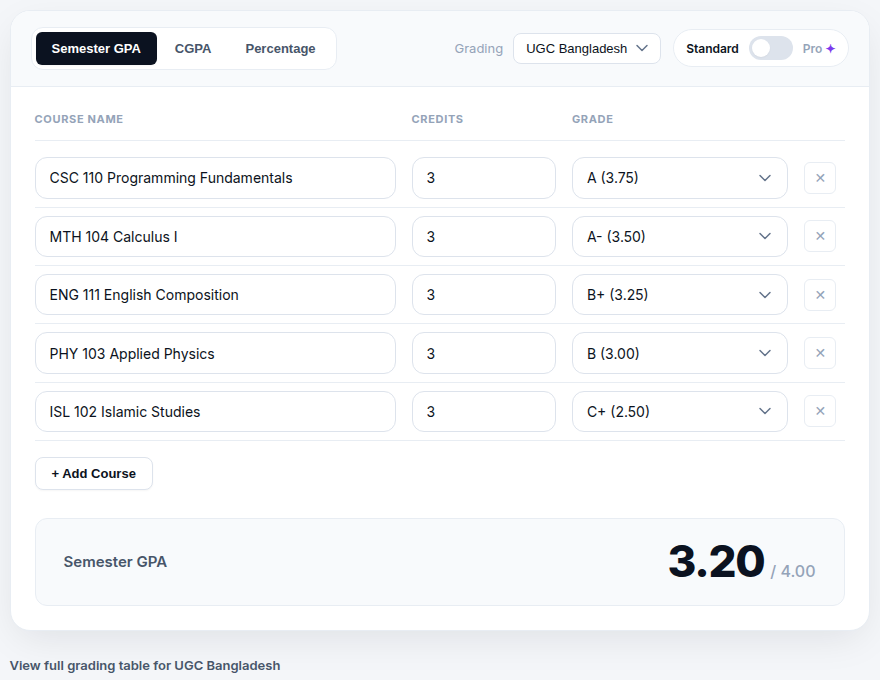
Before the tables, get a feel for the math. Enter your courses — name, credit hours, letter grade — and the calculator runs the credit-weighted formula for you. One honest heads-up first: Bahria doesn’t have a dedicated calculator page on this site yet, so the screenshot below shows our general calculator, which runs a generic scale (see the “UGC Bangladesh” selector at the top). The same five courses give 3.20 there and 3.27 on Bahria’s official scale — the worked example right after the screenshot shows the official math, and the 0.07 gap between them is one of the most useful things this article will teach you.
Bahria University’s official grading table (Fall 2018 → present)
This is the table from §5.3.1 of Bahria University’s Student Handbook, confirmed by the “Grading System: FALL 2018 and onward” table printed in official Bahria LMS course outlines (Islamabad and Karachi campuses, uploads through February 2025). Grading is absolute: your letter is fixed by the percentage you score against these published cut-offs, not by where you rank in your class. There is no A+ at Bahria — A (4.00) is the top.
| Grade | Percentage band | Grade points | What it means |
|---|---|---|---|
| A | 85 – 100 | 4.00 | Outstanding — the ceiling of the scale; there is no A+ above it |
| A− | 80 – 84.99 | 3.67 | Excellent |
| B+ | 75 – 79.99 | 3.33 | Very good |
| B | 71 – 74.99 | 3.00 | Good — the honest middle of a Bahria transcript |
| B− | 68 – 70.99 | 2.67 | Above average |
| C+ | 64 – 67.99 | 2.33 | Average |
| C | 60 – 63.99 | 2.00 | Satisfactory |
| C− | 57 – 59.99 | 1.67 | Weak — still passes, but it drags |
| D+ | 53 – 56.99 | 1.33 | Very weak — earns credit, barely |
| D | 50 – 52.99 | 1.00 | Minimum pass — a three-point-wide band |
| F | Below 50 | 0.00 | Fail — no credit, must be cleared |
| W | — | — | Withdrawn — carries no grade point, excluded from GPA/CGPA |
| I | — | — | Incomplete — teacher discretion with Director Campus approval; becomes F if not cleared before the following semester’s finals |
Three things jump out. First, the plus/minus bands are narrow and staggered oddly: B starts at 71 (not 70), C+ at 64 (not 65), C− at 57. A 70.5% is a B− here, not a B — one mark swings the grade. Second, the D-band is a sliver: at 50–52.99%, D (1.00) is the minimum passing grade, but there is almost no room inside it. Third, notice what the table does not contain: no A+, and no E grade — below 50 is simply F.
Postgraduate scale (MBA, MS, MPhil, PhD)
Per §5.3.2 of the Handbook, postgraduate programs use the same scale with two changes: F is reckoned below 60% marks (not 50%), and there are no C−, D+ or D grades at all. C (2.00) is the lowest passing grade for a postgraduate course — the minimum pass mark for PG courses is 60% (§5.4). If you are an MS student, that safety net of D grades your undergraduate friends talk about does not exist for you.
A warning about old tables
Some Bahria engineering course handouts still floating around print an older scale: A at 87–100 (4.0), B+ at 80–86 (3.5), B at 72–79 (3.0), C+ at 66–71 (2.5), C at 60–65 (2.0), D at 50–59 (1.5). That was the pre-Fall-2018 table. If a course outline contradicts the table above, the Fall-2018-onward table governs — but confirm with your HoD, because §5.3.3 allows Bahria to review grading rules every three years.
How to calculate your GPA, step by step
Bahria’s official formula (§5.3.3) is one line: GPA = Σ (credit hours × grade points) ÷ Σ credit hours. In plain steps:
- Convert each letter grade to grade points using the official table above — not a generic one.
- Multiply each course’s grade points by its credit hours. This gives the course’s quality points.
- Add up all quality points.
- Add up all credit hours for graded courses (skip W grades and any Pass/Fail electives — they don’t count).
- Divide total quality points by total credit hours.
Your CGPA is the same formula stretched across your whole degree: every graded course from admission to your last exam, credit-weighted. Bahria recomputes it every semester, and it is the CGPA — not the semester GPA — that the probation rules watch.
Read more: Air University Grading System 2026: GPA & CGPA Guide — another major Pakistani university, but with relative grading and a very different probation ladder. Comparing the two tables side by side is the fastest way to see why “the HEC scale” is a myth.
Worked example: a first-year semester, fully calculated
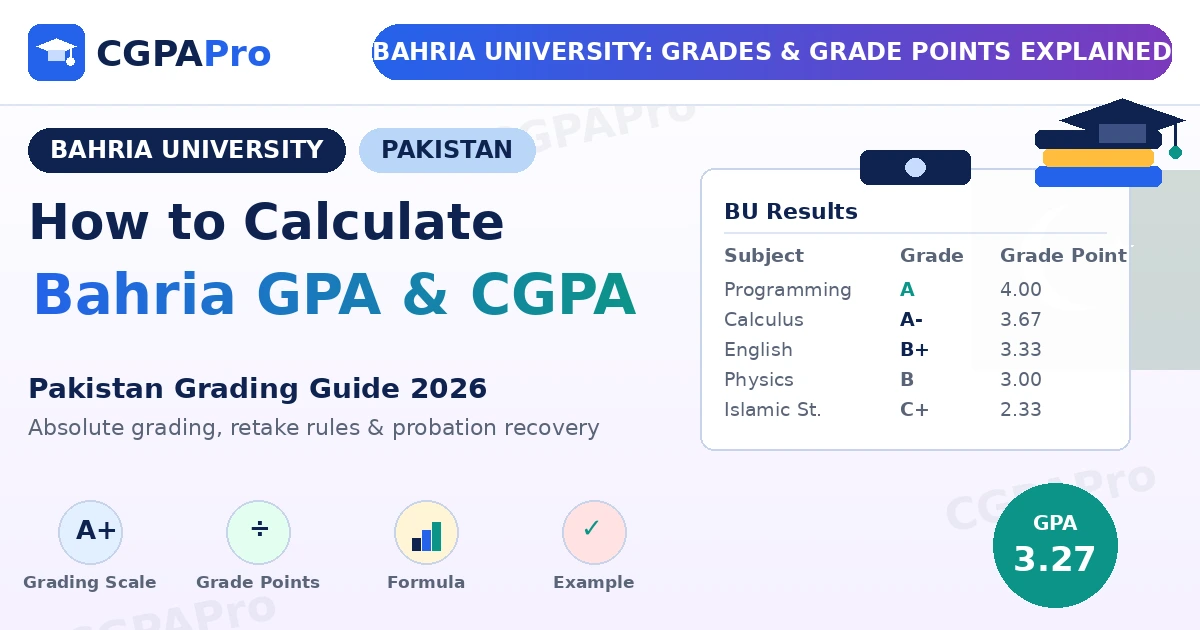
Take five typical first-year courses, each 3 credit hours, with the grades shown. Every grade point below is Bahria’s official value:
| Course | Credits | Grade | Grade points | Quality points |
|---|---|---|---|---|
| CSC 110 Programming Fundamentals | 3 | A | 4.00 | 3 × 4.00 = 12.00 |
| MTH 104 Calculus I | 3 | A− | 3.67 | 3 × 3.67 = 11.01 |
| ENG 111 English Composition | 3 | B+ | 3.33 | 3 × 3.33 = 9.99 |
| PHY 103 Applied Physics | 3 | B | 3.00 | 3 × 3.00 = 9.00 |
| ISL 102 Islamic Studies | 3 | C+ | 2.33 | 3 × 2.33 = 6.99 |
| Total | 15 | 48.99 |
Semester GPA = 48.99 ÷ 15 = 3.266 → 3.27
Check the arithmetic: 12.00 + 11.01 = 23.01; + 9.99 = 33.00; + 9.00 = 42.00; + 6.99 = 48.99. And 48.99 ÷ 15 = 3.266, which rounds to 3.27.
Now the comparison that matters. Run the same five letters through the generic scale in the calculator screenshot above (A 3.75, A− 3.50, B+ 3.25, B 3.00, C+ 2.50) and you get 11.25 + 10.50 + 9.75 + 9.00 + 7.50 = 48.00 ÷ 15 = 3.20. The official Bahria math says 3.27. The 0.07 difference comes entirely from the rounded plus/minus values (3.50 vs 3.67, 3.25 vs 3.33, 2.50 vs 2.33). Two students with identical transcripts can report different GPAs depending on which scale their tool used — and only the official one is real.
The CGPA continuation works the same way. Suppose this student carried a 3.10 CGPA over 30 completed credits before this semester: new CGPA = (3.10 × 30 + 3.266 × 15) ÷ 45 = (93.00 + 48.99) ÷ 45 = 141.99 ÷ 45 = 3.16. Notice how 30 old credits anchor the average: one good semester barely moves it. That’s exactly why the probation rules below exist — and why digging out of a hole takes planning, not just hoping.
GPA vs CGPA at Bahria: which one the university watches
Students mix these up constantly, so here is the clean version:
- Semester GPA — one semester only. Useful for tracking, and it decides the Rector’s Honours List each semester.
- CGPA — everything, credit-weighted, from day one. This is what the probation rule (§5.5) checks, what graduation requires (2.00), and what honours and medals are awarded on.
The one exception: in your very first semester, there is no CGPA yet, so the probation rule looks at your first-semester GPA instead. From the second semester on, it’s CGPA all the way down.
The two-probation rule (read this before you need it)
Bahria’s probation machinery (§5.5) is simpler than most universities’ — and harsher at the end. There is no “chance” status, no third warning. The whole thing fits in four lines:
| Programme | Minimum CGPA |
|---|---|
| Associate Degree, BBA, BEE, BS (undergraduate) | 2.00 |
| MBA, MS, MPhil | 2.50 |
| PhD | 3.00 |
- Any semester below the minimum → Probation. Your HoD issues a formal warning letter, and you sign a copy for the record.
- Still below the minimum next semester → second consecutive Probation, another letter.
- Still below the minimum in the semester immediately after those two probations → you are dropped from the programme.
The escape hatch: if at any point your CGPA reaches the minimum — summer session counts — you are taken out of the probation regime and your probation count resets to zero for the rest of your degree. One strong semester genuinely wipes the slate.
A note on sources: Bahria’s older public “Academic Rules” page describes a legacy probation/chance/drop scheme with 1.5/2.0 tiers. The current Student Handbook’s §5.5 (the two-probation rule above) supersedes it — quote the Handbook, not the old page.
Read more: Dean’s List & Academic Probation: CGPA Thresholds 2026 — how probation works across Pakistani universities, and the recovery math for each system.
Probation-recovery math: what it actually takes to climb back
Suppose you’re an undergraduate sitting at CGPA 1.90 over 30 completed credits — one probation used, one semester to fix it. What semester GPA do you need over a 15-credit semester to hit 2.00?
Current quality points: 1.90 × 30 = 57.00. Target: 2.00 × 45 = 90.00. You need 33.00 more points from 15 credits → 33.00 ÷ 15 = 2.20 semester GPA. Check: (57.00 + 33.00) ÷ 45 = 90.00 ÷ 45 = 2.00 exactly.
A 2.20 average means, for example, straight C+ (2.33) grades with one C (2.00) — achievable, but it leaves zero slack. Two lessons: first, recover on credit volume — more credits at a modest average beat fewer credits at a heroic one. Second, this is where the repeat rule becomes your best friend: repeating a C (2.00) course and lifting it to a B (3.00) injects a full extra grade point per credit into the CGPA math, because only the highest attempt counts.
Repeating a course: Bahria’s most generous rule
From §1.17 of the Handbook, and this is the part students consistently underestimate:
- You may repeat any course graded C+ or below — that includes C+, C, C−, D+, D and F. Apply to your HoD on the prescribed form; the HoD’s approval is required, and the course needs a minimum class strength of ten plus an available teacher.
- Every attempt stays on your transcript, but only the HIGHEST grade counts toward your CGPA. The old grade’s points are fully replaced in the math — not averaged.
- You cannot hurt yourself by repeating. If the new grade is lower, the old (higher) one still stands in the CGPA.
- Timing: the older rules page says a repeat must happen within one year of the result declaration; the current Handbook frames the window as the programme’s maximum duration. Plan for the tighter of the two — repeat in the next available semester.
The strategy writes itself: a D+ (1.33) in a 3-credit core course is the single highest-leverage repeat in the system. Lifting it to a B (3.00) adds (3.00 − 1.33) × 3 = 5.01 quality points to your CGPA numerator — on a 45-credit base, that’s +0.11 CGPA from one course. And because the repeat wipes the old grade from the math, there is no averaging penalty like at some other universities.
Read more: How Retaking a Course Affects Your CGPA (2026) — grade-replacement rules at Pakistani universities, worked examples, and when a retake is actually worth the fee.
Honours, medals and the Rector’s Honours List
Bahria awards Latin honours on the final CGPA. A word of caution first: the exact bands were revised between handbook editions. The older public rules page lists Summa 3.95–4.00, Magna 3.80–3.94, Cum Laude 3.60–3.79 with a 3.50 Rector’s list; the newer Handbook (§5.6–§5.9) sets Summa Cum Laude at 3.90+, Magna Cum Laude 3.80–3.90, Cum Laude 3.60–3.80, with a Rector’s Honours List each semester at 3.90+. Use the newer bands, and confirm against the handbook for your intake year.
Honours also carry eligibility conditions, and they’re strict: complete the degree within the regular duration, carry a full semester load, no withdrawn or repeated courses, no credit transfer or migration, and a clean disciplinary record. One repeat — the same repeat that saves your CGPA — forfeits honours eligibility. And gold and silver medals go to the first- and second-highest CGPAs of each graduating batch.
Five mistakes Bahria students keep making
- Planning with the wrong scale. Scholaro’s Bahria page prints rounded values (A− 3.70, B+ 3.30, C+ 2.30, C− 1.70) and has no D+ row at all — plus wrong percentage bands (it puts C at 58–61, but officially C starts at 60; it puts C+ at 61–65, but officially C+ starts at 64). A student scoring 63% would read “C+” on Scholaro and get a C (2.00) officially. A 55% is D+ (1.33) officially; Scholaro’s table would have you count 1.00. On a 15-credit semester that single misread costs 0.33 × 3 ÷ 15 ≈ 0.07 GPA points.
- Treating D as “safe”. D (1.00) passes the course — and parks you halfway to probation. A semester of D and C− grades passes everything and still lands you under 2.00.
- Ignoring the 75% attendance line. Below 75% of contact hours and you are barred from the final exam and awarded an F — even with strong internal marks. No appeal fixes it after the fact.
- Averaging instead of weighting. Adding your grade points and dividing by the number of courses is wrong; a 3-credit B (9.00 points) and a 1-credit A (4.00) average to (3.00 + 4.00) ÷ 2 = 3.50, but the correct credit-weighted GPA is 13.00 ÷ 4 = 3.25. Labs and 1-credit courses barely move the needle; core courses decide everything.
- Forgetting that postgraduates play a different game. At 60% an MS student fails outright (no C−/D+/D safety net), while an undergraduate at 60% holds a C. If you moved from a BS to an MS at Bahria, your margin for error just shrank by ten percentage points.
Seven tips that actually move your Bahria CGPA
- Learn the band edges, not just the letters. B starts at 71, not 70. C+ starts at 64, not 65. C− starts at 57. One mark at a boundary is worth a third of a grade point — and boundaries are where exams are won.
- Attack the final. The standard theory-course weightage is assignments/project 20, quizzes 10, mid-term 20, final 50. Half your course grade is one exam. For labs it’s lab journals 30, quizzes/assignments 10, project 10, mid 20, final 30 — labs are won in coursework, not the final.
- Use the 9-credit Pass/Fail shield. Undergraduates may take up to 9 credit hours of electives on a Pass/Fail basis — excluded from GPA entirely. The choice is made at registration and cannot be changed, so decide before the semester starts, not after a bad midterm.
- Repeat strategically, not emotionally. Only the highest attempt counts, so target high-credit, low-grade courses first: a D+ → B jump in a 3-credit course is worth more than polishing a B+ into an A− in a 2-credit one.
- Know the freeze option. You can freeze a semester (illness, circumstances beyond your control) — at most two at a time, fee non-refundable once classes start, and you must resume the next semester or be struck off. It beats a semester of Fs.
- Track with the official scale only. Any tool using rounded 3.70/3.30 values or missing the D+ row will mislead you by up to 0.07 GPA per semester — always verify against §5.3.1.
- Summer counts toward recovery. Probation recovery explicitly includes the summer session, and it resets your probation count to zero. A focused summer of repeats is the fastest legal way out of probation.
Two more Pakistan guides in the same series: IBA Karachi’s grading system (where an A starts at 93% and the survival lines are 2.0/2.2/2.5), FAST-NU’s grading system, and COMSATS’ grading system — all with official tables and worked examples.
Frequently asked questions
If I repeat a course at Bahria University, which grade counts?
Only the highest of your attempts is used in the CGPA calculation — the old grade is not averaged in. Every attempt stays visible on your transcript, but the math uses the best one. You may repeat any course graded C+ or below, with HoD approval on the prescribed form. If the new grade is lower, the old one still stands, so a repeat can’t hurt your CGPA.
What is the minimum passing grade at Bahria University?
For undergraduates, D — 50% marks, 1.00 grade point. Anything below 50% is an F (0.00) and earns no credit. For MBA/MS/MPhil/PhD students the floor is higher: 60%, with no C−, D+ or D grades — C (2.00) is the lowest passing grade.
Does Bahria University use absolute or relative grading?
Absolute. Your letter grade is set by fixed published percentage cut-offs (§5.3.1), not by your rank in the class. An 85% is an A whether you’re first or fiftieth in the section. There is no curve to save you — and no curve to hurt you.
What CGPA do I need to graduate from Bahria University?
Undergraduates (AD/BBA/BEE/BS) need a minimum 2.00 CGPA plus the prescribed credit hours, completed within the maximum programme duration (6 years for a 4-year programme). MBA/MS/MPhil need 2.50; PhD needs 3.00. Fall below the minimum in any semester and you’re on probation; fail to recover in the semester after two consecutive probations and you’re dropped.
Can I repeat a course I got a C+ in?
Yes. C+ is the highest grade Bahria allows you to repeat — the rule is “C+ or below.” A C+ (2.33) in a 3-credit course lifted to a B (3.00) adds about 0.04–0.05 to a 45-credit CGPA, so prioritize repeats where the grade-point jump per credit is largest (D+ and D courses first).
Does attendance really affect my grade at Bahria?
Yes — brutally. You must attend at least 75% of contact hours; fall short and you are barred from the final examination and awarded an F for the course, no matter how good your quizzes and assignments were. This is the single most common “unfair F” story on campus, and it’s written into the rules.
What CGPA earns honours at Bahria University?
Per the current Handbook: Cum Laude 3.60–3.80, Magna Cum Laude 3.80–3.90, Summa Cum Laude 3.90+, plus a Rector’s Honours List each semester at 3.90+. But eligibility requires finishing in the regular duration with a full load, no withdrawn or repeated courses, no credit transfer/migration, and a clean disciplinary record — and older Bahria pages list slightly different bands (3.95/3.80/3.60), so confirm against the handbook for your intake year.
The bottom line
Bahria University’s system rewards precision: absolute bands with odd edges (71, 64, 57), a D grade squeezed into three percentage points, no A+ to chase, and a probation rule with exactly two warnings before the drop. Calculate with the official table — A 4.00, A− 3.67, B+ 3.33, B 3.00, B− 2.67, C+ 2.33, C 2.00, C− 1.67, D+ 1.33, D 1.00 — weight every course by its credit hours, and remember that the repeat rule is the most powerful tool in the Handbook: only your best attempt counts. Guard the 75% attendance line, know your band edges, and never trust a calculator that can’t show you Bahria’s own numbers.
Sources: Bahria University Student Handbook §1.16, §1.17, §5.3–§5.5 (official PDF); Bahria University Academic Rules; official LMS marks-distribution documents (“Grading System: FALL 2018 and onward”). Grading rules may be reviewed periodically (§5.3.3) — confirm against the handbook for your intake year.