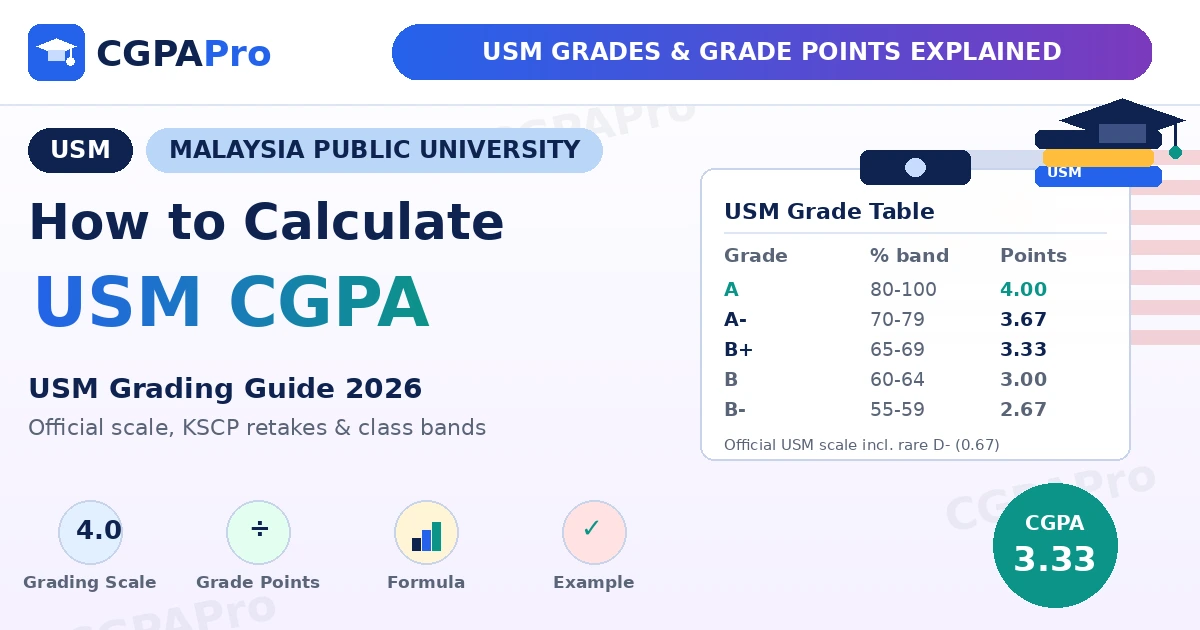
Universiti Sains Malaysia (USM) runs on a 4.00 CGPA scale — but the table most online “USM CGPA calculators” use is wrong. USM’s official scale (published in the university’s own IMCC factsheet) uses A− = 3.67, B+ = 3.33 and B− = 2.67, not the rounded 3.70 / 3.30 / 2.70 you see on calculator sites. It also includes a grade almost no other Malaysian public university has: D− (0.67). This guide gives you the verified official table with percentage bands, shows exactly how USM computes your PNG and PNGK, and covers the things students actually argue about on the USM forums — KSCP retakes, the 3.67-vs-3.75 first-class confusion, the Dean’s Certificate, and which grades don’t touch your CGPA at all.
Quick answers: graduation needs a CGPA of 2.00; the Dean’s Certificate needs a semester GPA of 3.50 or above every semester; and USM’s own 2012 Registrar letter maps 3.67–4.00 to First Class for administrative purposes — not 3.75.
https://blog.cgpacalculatorpro.com/wp-content/uploads/2026/10/usm-calculator.png
Try the USM CGPA calculator
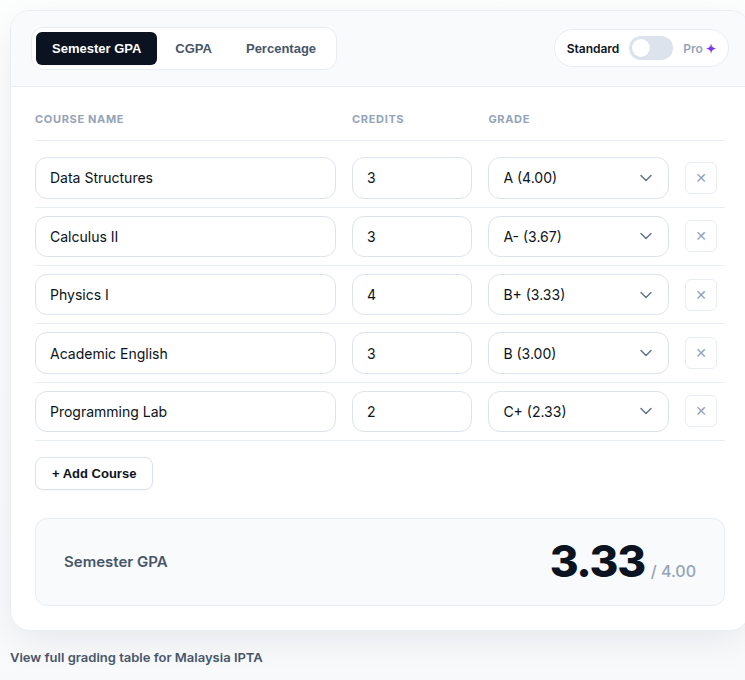
The fastest way to check your standing is to run your actual courses through the calculator. Add each course with its credit units and the grade you expect — the calculator uses USM’s official grade points.
The official USM grade table (verified)
This is the table from USM’s own International Mobility & Collaboration Centre (IMCC) factsheet — the university’s official statement of its CGPA grading system. Every grade point in the CGPAPro USM calculator matches these values.
| Grade | Percentage band | Grade point |
|---|---|---|
| A | 80–100 | 4.00 |
| A− | 70–79 | 3.67 |
| B+ | 65–69 | 3.33 |
| B | 60–64 | 3.00 |
| B− | 55–59 | 2.67 |
| C+ | 50–54 | 2.33 |
| C | 45–49 | 2.00 |
| C− | 40–44 | 1.67 |
| D+ | 35–39 | 1.33 |
| D | 30–34 | 1.00 |
| D− | 25–29 | 0.67 |
| F | below 25 | 0.00 |
Two things in this table surprise most USM students. First, the D− grade (0.67) — USM is nearly alone among Malaysian public universities in having both D+ and D−. Most IPTA scales stop at D. Second, the A− band starts at 70%, not 75% — so a 72% final mark is an A− at USM. (One honesty note: the factsheet prints the F band as “20–24”; anything below that is also an F, but USM’s document doesn’t spell out the exact floor, so don’t quote one.)
PNG and PNGK: USM’s two numbers
USM doesn’t use the words “GPA” and “CGPA” on its official documents. It uses PNG (Purata Nilai Gred — the semester average, i.e. GPA) and PNGK (Purata Nilai Gred Kumulatif — the cumulative average, i.e. CGPA). Same maths, Malay names. When a lecturer says “jaga PNG”, they mean your semester GPA; “PNGK” is the number on your transcript and the one employers ask about.
The formula
PNG (one semester) = Σ (grade point × credit units) ÷ Σ (credit units that semester)
PNGK (cumulative) = Σ (grade point × credit units, all semesters) ÷ Σ (all credit units)
Credit units are the weight. A 4-unit course moves your PNG twice as much as a 2-unit course with the same grade — which is why students who “protect” heavy courses do better than students who spread effort evenly.
Worked example: a 5-course semester → 3.33
Here is the exact example from the calculator screenshot above, worked by hand so you can check every number:
| Course | Units | Grade | Point | Units × Point |
|---|---|---|---|---|
| Data Structures | 3 | A | 4.00 | 12.00 |
| Calculus II | 3 | A− | 3.67 | 11.01 |
| Physics I | 4 | B+ | 3.33 | 13.32 |
| Academic English | 3 | B | 3.00 | 9.00 |
| Programming Lab | 2 | C+ | 2.33 | 4.66 |
| Total | 15 | 49.99 |
PNG = 49.99 ÷ 15 = 3.33. Your PNGK is the same calculation extended across every semester you’ve completed — never the average of your semester PNGs (more on that trap below).
Your USM calculator may be lying to you
Here’s the uncomfortable bit: a lot of websites that offer a “USM CGPA calculator” use the wrong grade points. The most common wrong scale you’ll see is A− = 3.70, B+ = 3.30, B− = 2.70, C+ = 2.30, C− = 1.70 — the rounded private-university style scale. USM’s official scale is 3.67 / 3.33 / 2.67 / 2.33 / 1.67.
Does 0.03–0.04 per grade matter? Take the worked example above and recompute it on the wrong scale: A− becomes 3.70 (11.10), B+ becomes 3.30 (13.20), C+ becomes 2.30 (4.60). New total: 12.00 + 11.10 + 13.20 + 9.00 + 4.60 = 49.90 ÷ 15 = 3.33 — same this time, because the errors partly cancelled. But change the mix: three A− grades and two B+ grades across 15 units gives 3.50 on the official scale and 3.53 on the wrong one. That 0.03 is the difference between missing and hitting the Dean’s Certificate line of 3.50. Use the official points — or a calculator that does.
USM vs other Malaysian public universities
The grade points are the same across Malaysia’s public universities (A 4.00, A− 3.67, B+ 3.33 …), but the tables aren’t identical:
| Feature | USM | UM / UTM / UPM |
|---|---|---|
| D+ grade | Yes (1.33) | Yes (most) |
| D− grade | Yes (0.67) — rare | No (most stop at D) |
| A− percentage band | 70–79 | Varies (UM: 75–79) |
| First-class admin band | 3.67–4.00 (2012 Registrar letter) | Varies by university |
| Dean’s award name | Dean’s Certificate | Dean’s List (most) |
If you’re comparing your USM results with friends at UM or UTM, remember the bands can differ even when the points match. Read their guides too: UiTM, UTM, and UPM.
The 3.67 vs 3.75 first-class myth — settled
Ask around USM and you’ll hear two numbers for “first class”: 3.67 and 3.75. The 3.75 figure usually comes from PTPTN briefing staff — but they’re quoting other universities’ standards. USM’s own position comes from a 2012 USM Registrar letter that maps CGPA bands for administrative purposes:
- 3.67–4.00 = First Class
- 3.00–3.66 = Second Class Upper
- 2.00–2.99 = Second Class Lower
Two caveats. First, USM does not award degree classes the way UK universities do — this mapping exists for administrative and employer-reference purposes. Second, if a scholarship body (like PTPTN) sets its own 3.75 line for an exemption, their rule wins for their money regardless of what USM’s letter says. Always check the specific body’s requirement. For the full Malaysian classification picture, see our 2nd Class Upper in Malaysia guide.
Recovery math: “I got 3.55 in semester 1 — can I still finish first class?”
Yes, with room to spare. Say semester 1 was 15 units at 3.55 (53.25 points). You have 7 semesters × 15 units = 105 units left, 120 total. First class needs PNGK ≥ 3.67, i.e. 440.40 total points. You need 440.40 − 53.25 = 387.15 from 105 units = 3.69 average across the remaining semesters. Hard but doable — roughly A− average with a few As. The general formula:
Required future average = (target PNGK × total units − earned points) ÷ remaining units
Dean’s Certificate: 3.50 every semester
USM calls it the Dean’s Certificate (Sijil Dekan), not the Dean’s List — and the rule, confirmed in USM’s programme handbooks, is a semester GPA (PNG) of 3.50 or above, every semester. Note it’s the semester PNG that counts, not your cumulative PNGK: a 3.80 semester with a 3.40 PNGK still earns the certificate for that semester. Miss one semester and you simply don’t get it that semester — it doesn’t cancel previous ones. Our Dean’s List & probation guide compares USM’s 3.50 with every other Malaysian university’s threshold.
Retakes, repeats and KSCP — the rules that actually matter
Latest grade counts, not the best one
The single most argued-about rule on the USM student forums: after a retake, does USM use your best result or your latest? USM’s programme handbooks say the latest grade is used in the GPA computation. Both attempts stay on your transcript; only the latest counts toward the average. The confusion comes from KSCP (below), where your coursework marks from the best previous attempt are carried forward — students conflate “best coursework carried” with “best grade counts”. They are different things.
KSCP: the long-vacation second chance
KSCP (Kursus Semasa Cuti Panjang — courses during the long vacation) is USM’s official repeat mechanism, and no competitor guide explains it properly. The verified mechanics:
- Maximum 3 courses / 10 units per KSCP session.
- Only courses you have previously attempted — you can’t take new courses in KSCP.
- Your coursework marks are carried over from your best previous attempt — you don’t re-sit the coursework, only the final assessment.
- The probation escape hatch: if your KSCP GPA is 2.00 or above, your academic status flips back to Active even if the previous semester left you on probation. Below 2.00, you stay on probation.
For postgraduates the handbook is explicit: courses graded B or below may be repeated in Semester I/II or KSCP — but F*/X grades from a normal semester may not be repeated in KSCP. Undergraduates: check your school’s handbook for the equivalent restriction.
The D− trap: why USM’s rarest grade is dangerous
Because USM has D− (0.67) where most universities bottom out at D (1.00), a bad semester hurts more at USM than the same marks would elsewhere. The recovery arithmetic: one 3-unit D− contributes 2.01 points. To neutralise it back to a 3.00 average on those 3 units you need 9.00 points from another 3 units — that’s an A− (3.67) plus change, effectively a full A (4.00) in a matching course just to cancel one D−.
Warning-recovery math: if your PNGK has slipped to 1.85 after 30 units (55.50 points) and you need 2.00 to be safe, with 15 units next semester you need (2.00 × 45 − 55.50) ÷ 15 = 2.30 — a B/B− average semester. Very achievable. But note the honest limit: USM’s published pages don’t spell out a full undergraduate probation-to-dismissal ladder the way UiTM or UPM do. The confirmed safety line is 2.00 — treat anything below it as “fix this semester”.
Graduation requirements
- Undergraduate: minimum CGPA (PNGK) of 2.00, plus a minimum grade of C in the compulsory university courses. (This is the widely cited requirement; USM states it through its academic management pages rather than one public regulations PDF, so confirm against your school’s handbook.)
- Postgraduate (coursework): minimum CGPA of 3.00 — stated directly in the official postgraduate handbook. Master’s students must also pass each course with at least a C+; doctoral students need at least a B per course.
- Postgraduate termination lines (official): Fail & Out if you earn zero credits in a semester, and termination if your CGPA sits at 0.00–0.99 after two semesters.
Grades that don’t touch your CGPA
Not every letter on your USM record moves the needle. Excluded from GPA/CGPA computation:
- DK (dikecualikan — exempted/credited courses)
- TL (incomplete)
- P / F for dissertations and theses
- Courses coded Y and Z
- Audit (non-credit) courses
Strategic note: an audit enrolment lets you preview a hard course without CGPA risk — but it also doesn’t help your PNGK. Use audits for exploration, not rescue.
One rule for clinical programmes
Students in Medicine, Dentistry, Nursing and Pharmaceutical Sciences face a stricter floor: a minimum of B− in every core course. A C+ that would be a comfortable pass in Engineering or Management is a fail-and-repeat in these schools. If you’re in a health-sciences programme, plan your study time around the B− line, not the C line.
Postgraduate students: your floors are higher
USM’s postgraduate scale uses the same grade points, but the pass floors move up: C+ minimum per course for master’s, B minimum for PhD. A C that keeps an undergraduate comfortably enrolled will force a master’s student into a repeat. Postgraduates also graduate on a 3.00 CGPA line (not 2.00), and the handbook’s F&O and 0.00–0.99 termination rules bite faster than anything in the undergraduate system. If you’re doing a taught master’s at USM, read the repeat rule twice: B-or-below courses may be repeated, but F*/X grades from a normal semester can’t be rescued in KSCP.
Common mistakes USM students make
- Averaging semester PNGs. (3.55 + 3.20) ÷ 2 = 3.375 is wrong unless both semesters had identical units. Always weight by credit units — see the formula above.
- Using the wrong grade points. A− is 3.67 at USM, not 3.70. Every “3.70” calculator is quietly mis-scoring your minus grades.
- Assuming the best retake grade counts. USM uses the latest grade. Retaking a C+ and scoring a C makes things worse, not better.
- Forgetting the compulsory-course C floor. A 2.00 PNGK with a D in a compulsory university course still blocks graduation.
- Treating 3.75 as the first-class line. USM’s Registrar letter says 3.67. Chasing 3.75 because a PTPTN briefer said so wastes effort you could spend elsewhere.
Tips to protect your PNGK at USM
- Weight your effort by units. A 4-unit B+ (13.32 points) beats a 2-unit A (8.00 points). Study time should follow the points, not the panic.
- Use KSCP surgically. Three courses, ten units, best coursework carried — it’s designed for targeted repair of C-range grades, not for re-taking your whole semester.
- Know your school’s B−/C lines. Clinical programmes live on a different floor from everyone else.
- Track PNG and PNGK separately. The Dean’s Certificate runs on semester PNG; graduation runs on PNGK. Optimise for the one that’s currently binding.
- Check the A− band. At USM, 70% is already A− territory — if you’re sitting at 68–69% before finals, a small push buys a full 0.34 grade-point jump (B+ 3.33 → A− 3.67).
USM grading FAQ
Is first class at USM 3.67 or 3.75?
3.67, per USM’s 2012 Registrar letter (3.67–4.00 = First Class for administrative purposes). The 3.75 figure comes from other universities’ standards quoted by PTPTN briefing staff. Note USM doesn’t award UK-style degree classes; the mapping is administrative.
Does USM count the best or the latest grade after a retake?
The latest grade is used in the GPA computation; both attempts remain on the transcript. In KSCP, your coursework marks from the best previous attempt are carried forward — that’s where the “best” confusion comes from.
I got 3.55 in semester 1 — can I still graduate with first class?
Yes. With 15 units at 3.55 and 105 units remaining, you need roughly a 3.69 average across the rest — about A− average with some As. Use the target formula in the recovery-math section.
Can I just average my semester PNGs to get my PNGK?
No — unless every semester had exactly the same number of credit units. Always recompute from total points ÷ total units.
I got a C−. Should I retake it?
At USM a C− is a conditional pass and it is retake-eligible (including via KSCP). The decision rule: retake if the course is heavy (3–4 units) and you’re confident of at least a B, because the latest grade replaces it. Don’t retake a 1-unit C− at the risk of scoring lower — the latest grade counts even if it’s worse.
What is KSCP and who can use it?
KSCP (Kursus Semasa Cuti Panjang) is USM’s long-vacation repeat session: max 3 previously-attempted courses / 10 units, with your best previous coursework marks carried forward. Hit a 2.00 KSCP GPA and probation flips back to Active status.
What CGPA do I need to graduate from USM?
Undergraduates need a PNGK of 2.00 plus at least a C in compulsory university courses. Taught postgraduates need a CGPA of 3.00, with C+ (master’s) or B (PhD) minimums per course.
The bottom line
USM’s grading system looks like every other Malaysian public university’s until you read the fine print: the rare D− (0.67), the 70%-starts-A− band, the latest-grade retake rule, the KSCP escape hatch, and the 3.67 first-class line that half the campus misquotes as 3.75. Get those five right and the rest is arithmetic — arithmetic the USM CGPA calculator will do for you with the official points.
Sources: USM IMCC Information Sheet (official factsheet, Aug 2018); USM Postgraduate Student Handbook v2025 (cpr.usm.my); USM Bachelor of Accounting (Hons) programme handbook; USM 2012 Registrar letter on CGPA bands (via gpacalc.app USM profile, source-checked 2026-09-26). Undergraduate probation/dismissal ladders and clinical B− floors are cited from secondary sources — confirm against your school’s current handbook.