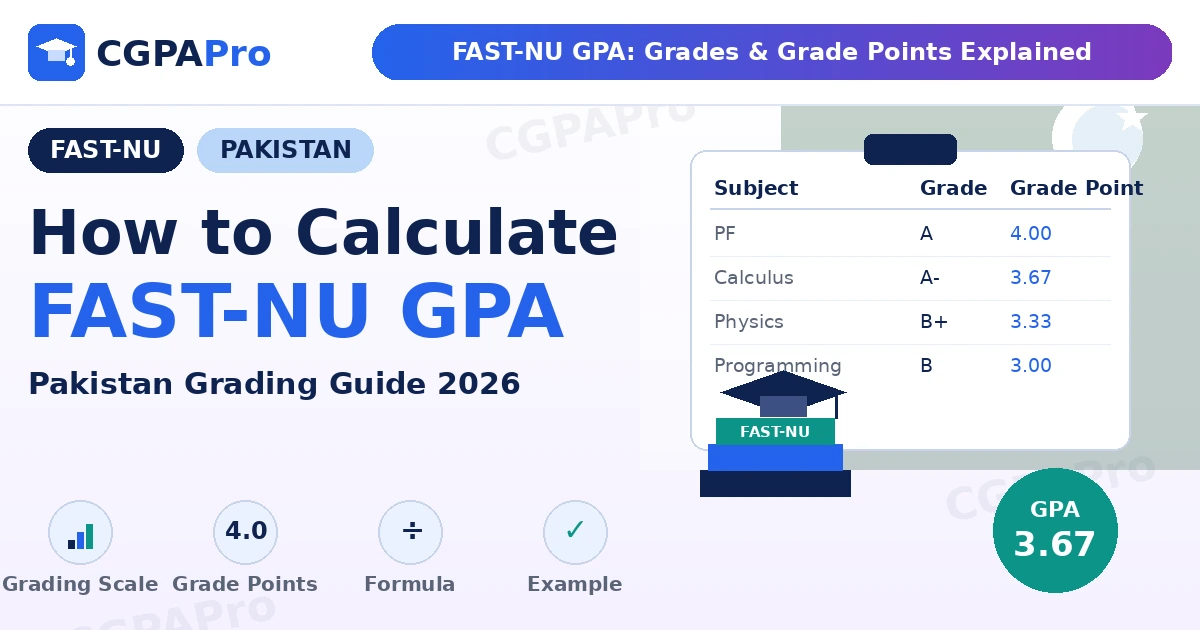
If you study at FAST-NU (the National University of Computer and Emerging Sciences), one number follows you from your first semester to your degree: your CGPA. It decides whether you get an academic warning, whether you make the Dean’s List, and whether you graduate at all. The rules behind it are published in the university’s own Undergraduate Academic Rules and Regulations 2026 — but almost nobody reads the handbook, and the grading advice floating around student groups and calculator sites is often wrong.
This guide fixes that. It walks through the official FAST-NU grading system for 2026: the complete grade table with interpretations, the SGPA and CGPA formulas exactly as the university defines them, the repeat-course rules (including the traps almost no student knows about), the warning-and-dismissal ladder, summer semester mechanics, and the honors thresholds. Every rule is cited to its section of the official handbook, and the numbers are worked out by hand so you can follow along.
The Quick Answer
FAST-NU grades every course with a letter from A+ down to F on a 4.00 scale. Your SGPA is the credit-weighted average of one semester; your CGPA is the credit-weighted average of every semester combined. The minimum CGPA to avoid an academic warning is 2.00 — fall below it at the end of a semester and you get a warning; stay below it for three consecutive semesters and your admission is automatically closed. The lowest passing grade is D, and A+ and A both carry 4.00 grade points — the plus is distinction only, not extra marks.
Use the FAST-NU GPA/CGPA calculator to plug in your grades and see where you stand — then read on for the full rules, because the details here are where students actually get hurt.
How to Calculate Your FAST-NU GPA Online
1. Open the FAST-NU GPA calculator.
2. Add each course: type the course name, its credit hours, and the letter grade you received (or the grade you expect).
3. The calculator converts every grade to its official FAST-NU grade point, multiplies by the credit hours, and totals everything.
4. Click calculate — your semester GPA appears instantly. Add further semesters to build your cumulative CGPA.
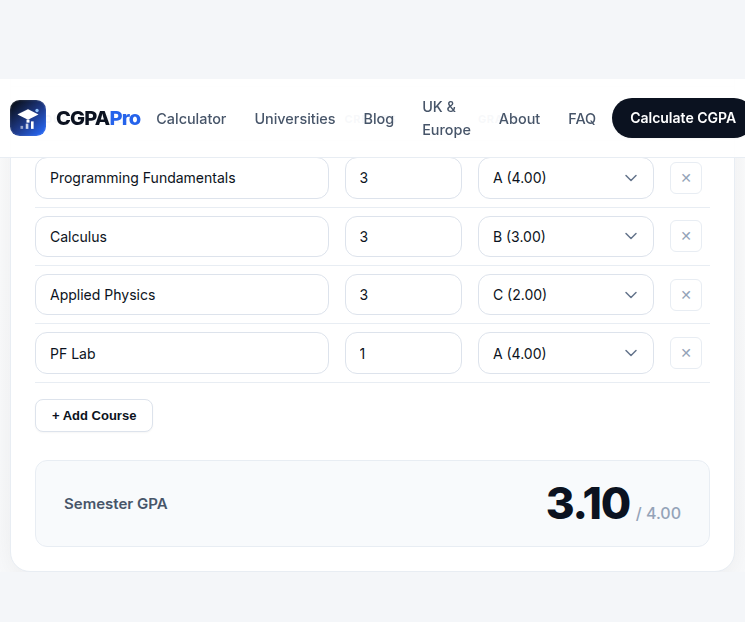
Caption: the live FAST-NU calculator above, filled with a worked example — 3-credit A, B, and C plus a 1-credit A, giving Semester GPA 3.10 / 4.00. Honest note: as of October 2026 the calculator uses a rounded generic scale (A− 3.70, B+ 3.30, B− 2.70, C+ 2.30, C− 1.70, D+ 1.30, plus a D− 0.70 row) and does not list A+, whereas FAST-NU’s official handbook uses A− 3.67 / B+ 3.33 / B− 2.67 / C+ 2.33 / C− 1.67 / D+ 1.33, includes A+ at 4.00, and has no D−. The example above uses only whole-number grades (A, B, C), which are identical in both scales, so its 3.10 result is correct under either table. A data fix for the calculator has been flagged for the next site update — for B+/A− boundary grades, trust the official table in this guide.
The Official FAST-NU Grading Table
FAST-NU uses a 12-letter undergraduate scale. Here it is exactly as published in §2.3 of the Undergraduate Academic Rules and Regulations 2026, with the official interpretation of each letter from §2.2:
| Grade | Grade Point | Official interpretation |
|---|---|---|
| A+ | 4.00 | Outstanding |
| A | 4.00 | Excellent |
| A− | 3.67 | Excellent |
| B+ | 3.33 | Good |
| B | 3.00 | Good |
| B− | 2.67 | Good |
| C+ | 2.33 | Adequate |
| C | 2.00 | Adequate |
| C− | 1.67 | Pass — you may repeat the course |
| D+ | 1.33 | Pass — you may repeat the course |
| D | 1.00 | Pass — you may repeat the course |
| F | 0.00 | Fail |
Three things about this table matter more than the rest. First: A+ and A are both worth 4.00. The handbook treats them as distinct letters — A+ is “Outstanding” and A is “Excellent” — but they carry the same grade points. Students who obsess over converting an A into an A+ are chasing distinction, not GPA. The points are already maxed.
Second: the bottom three passing grades — C−, D+, and D — are the only grades the handbook explicitly marks as “Pass, the student may repeat the course.” That phrasing is an invitation, not a requirement: FAST-NU lets you repeat any course to improve your CGPA, but the handbook singles out these three as the grades where repeating is expected to be considered. More on that in the repeat-rules section, because repeating has traps.
Third: the point gaps are uneven. A− (3.67) to A (4.00) is a 0.33 jump, while B− (2.67) to B (3.00) is also 0.33, but C− (1.67) to C (2.00) is 0.33 too — the gaps are consistent thirds except at the top, where A+ collapses into A’s value. The grades students most often miscalculate are the ones that don’t exist in some online calculators: several FAST-NU GPA tools on the web simply drop A+ and D+ from their scales, which silently corrupts the result for anyone holding those grades. Always check the tool’s grade list against the table above.
Grade Symbols That Aren’t Grades
Your transcript can carry letters that have nothing to do with your GPA. The handbook defines them in §2.2, §2.8, and §2.10, and each has a real consequence:
- W (Withdrawn): stays on your transcript but is excluded from CGPA. A withdrawal does not move your average — but it does stay visible, so treat it as a record, not an eraser.
- I (Incomplete): temporary. If it is not converted to an earned grade within the time the competent authority fixes, it automatically becomes an F. Never let an I sit unresolved.
- FA: fail due to shortage of attendance. Fail the attendance requirement and you don’t even get to sit the final exam — you are assigned an FA in the course (§1.22). A handful of missed lectures can turn into a zero-point grade.
- S / U (Satisfactory / Unsatisfactory): used for courses like PhD thesis work — no grade points, no GPA effect.
How Marks Become Grades: The 50/50 Split
Before the letter grades, there are marks. §5.2 of the handbook sets the normal assessment split: semester work contributes 50% (midterms, assignments, quizzes, case studies, projects) and the final examination contributes the remaining 50%. Deviations from this split are allowed only with the approval of the Dean of the Faculty — so for most courses, the split you plan around is half-and-half.
This has a practical consequence students underestimate: the final exam is only half the grade. A strong sessional record — quizzes, assignments, the midterm — is worth exactly as much as the final. Students who “start studying for the final in the last two weeks” are trying to earn 100% of their grade with 50% of the assessment. The handbook also requires transparency: all instruments of evaluation must be shared with you after marking, and final-exam answer books are shown to students in a scheduled paper-viewing session (§5.16–5.17). If a mark looks wrong, you have a formal rechecking route: apply on the prescribed form with the fee within seven days of the result announcement, and the fee is refunded if your marks increase (§5.20–5.25).
FAST-NU SGPA and CGPA Formulas
The handbook defines exactly two averages in §2.1: the Semester Grade Point Average (SGPA), covering the courses of one semester, and the Cumulative Grade Point Average (CGPA), covering every course you have completed so far. The formulas (§2.4–2.6):
SGPA (one semester):
SGPA = (P1×C1 + P2×C2 + P3×C3 + P4×C4) ÷ C
where P is the grade point of each course, C is its credit hours, and C in the denominator is the total credits attempted in the semester.
CGPA (all semesters):
CGPA = total grade points from all semesters ÷ total credit hours from all semesters
In plain words: every course’s grade point is multiplied by its credit hours, everything is added up, and the sum is divided by the total credit hours. A 4-credit course moves your GPA roughly twice as much as a 2-credit course — at FAST-NU, where core CS and engineering courses carry 3–4 credits, your major subjects dominate the average. If you want the deeper mechanics of semester averaging, our SGPA formula guide walks through the same weighted-average logic with more examples.
Worked Example: A Real FAST-NU Semester
Here is a first-semester BS Computer Science load worked through exactly the way the handbook prescribes. Watch the arithmetic — this is the method the calculator above automates.
| Course | Credits | Grade | Points | Grade pts × credits |
|---|---|---|---|---|
| Programming Fundamentals | 3 | B+ | 3.33 | 9.99 |
| Calculus | 3 | C+ | 2.33 | 6.99 |
| Applied Physics | 3 | B | 3.00 | 9.00 |
| English Composition | 2 | A | 4.00 | 8.00 |
| Islamic Studies / Ethics | 2 | A− | 3.67 | 7.34 |
| PF Lab | 1 | A | 4.00 | 4.00 |
| Physics Lab | 1 | B+ | 3.33 | 3.33 |
Total grade points: 9.99 + 6.99 + 9.00 + 8.00 + 7.34 + 4.00 + 3.33 = 48.65. Total credits: 15. SGPA = 48.65 ÷ 15 = 3.24.
Notice two things. First, the labs: 1-credit courses barely move the needle — both labs together contribute 7.33 of 48.65 points. Second, Calculus at C+ is the anchor: at 3 credits and 2.33 points it contributes only 6.99, nearly 3 points less than Programming Fundamentals at the same credit weight. When students ask “which course should I focus on,” the answer is always the high-credit course with the lowest current standing.
GPA vs CGPA: The Myth That Costs Students Real Points
One of the most repeated — and most wrong — pieces of advice about FAST-NU is that your CGPA is the average of your semester GPAs. Several calculator sites teach exactly this: add your SGPAs, divide by the number of semesters. That is not how the handbook defines it. §2.6 defines CGPA as the weighted average over all courses taken — credit hours included. Averaging SGPAs ignores the fact that semesters carry different credit loads, and it gives the wrong number.
Proof with real numbers. Take the semester above (SGPA 3.24 over 15 credits) plus a second semester: SGPA 2.40 over 18 credits (48.60 points ÷ 18). The “average of SGPAs” method gives (3.24 + 2.40) ÷ 2 = 2.82. The handbook’s method gives (48.65 + 43.20) ÷ 33 = 91.85 ÷ 33 = 2.78. That 0.04 gap is the difference the wrong method hides — and it grows when credit loads differ more. Always compute CGPA from total points over total credits, never from averaged SGPAs.
The Repeat Rules: FAST-NU’s Sharpest Edges
This is the section of the handbook every FAST-NU student should read twice. The repeat rules (§5.8–5.11, §2.7) are generous on the surface and dangerous underneath.
You may repeat any course to improve your CGPA (§5.9). Not just failed courses — any course. And a failed or missed course from a previous semester must be repeated the next semester it is offered; you are not allowed to skip registering for it (§5.8).
Now the traps.
Trap 1: the most recent grade counts — even if it is worse. §2.7 is unambiguous: in CGPA calculation for repeated courses, only the most recent grade points are used, even if they are less than the earlier attempts. There is no best-grade logic. If you repeat a B (3.00) hoping for an A and land a C+ (2.33), your CGPA now uses the 2.33. On a 3-credit course, that swap costs you 2.01 grade points — real damage, bought with a semester of extra work.
Trap 2: repeating a course whose post-requisite you already passed requires a written undertaking — and failing the repeat flips your post-requisite grades to F. §5.10: if you repeat a course and you have already passed its post-requisite course(s), you must sign a written undertaking that if you fail the repeated course, the grades in all post-requisite courses are changed to F. Read that again. Repeating Data Structures after passing Algorithms, then failing the repeat, turns your Algorithms grade into an F too. This is the single most dangerous rule in the handbook, and it is the one almost no student knows exists.
Trap 3: taking a new course “in lieu of” a failed one does not erase the F. §5.11: if you repeat the failed course itself, the new grade is used for CGPA — but if you take a new course in place of the failed one, both grades count in the CGPA. The numbers: repeat the failed 3-credit course and earn a C (2.00) → the CGPA sees 6.00 points over 3 credits for that slot. Take a new 3-credit course instead and earn a B (3.00) → the CGPA sees 0.00 + 9.00 = 9.00 points over 6 credits, an effective 1.50. The “easy substitute” strategy is mathematically worse than facing the failed course again.
Practical checklist before you repeat anything: (1) check whether you have passed a post-requisite — if yes, weigh §5.10 very carefully; (2) repeat the same course, never a substitute, when clearing an F; (3) be honest about whether your new grade will actually beat the old one, because the new one counts regardless.
Academic Warning: The Countdown Nobody Explains
The warning system (§5.4–5.7) is a countdown with a reset button — and most students only learn the countdown half.
- Warning trigger: CGPA below 2.00 at the end of any semester, including the summer semester → academic warning, and your warning count goes up by one (§5.5).
- The reset: if your CGPA reaches 2.00 or above after the first or second warning, the warning count resets to zero (§5.7). Recovering fully wipes the slate — a warning is not a permanent mark.
- The end of the line: CGPA below 2.00 for three consecutive semesters → warning count becomes three → your admission is automatically closed (§5.6). No hearing, no appeal described — automatic.
- Students on warning register under stricter registration rules (see §4 of the handbook), and the minimum CGPA for graduation is 2.00 (§1.25) — warning territory and graduation-ineligibility territory are the same line.
Here is what the reset means in numbers. Suppose you finish first year at CGPA 1.85 over 15 credits (warning 1). Next semester you take 16 credits. To hit CGPA 2.00: (1.85 × 15 + 16x) ÷ 31 ≥ 2.00 → 27.75 + 16x ≥ 62 → x ≥ 2.14. An SGPA of 2.14 next semester — roughly a C+ average — resets your warning count to zero. That is the concrete target. But note the trap inside the reset: it only applies after the first or second warning. There is no reset after the third, because after the third consecutive sub-2.00 semester there is no fourth semester.
Summer Semester: Not the Safety Net You Think
Summer at FAST-NU is an 8-week semester (§6), and its rules surprise students every year:
- It exists for four categories: students on Academic Warning I/II, graduating students, students who need credits to register FYP-I in the Fall, and students who need a pre-requisite for Fall courses (§6.1).
- Only repeat courses are allowed — no new courses (§6.2). You can only repeat courses you previously registered for and received a letter grade in (§6.3). Maximum 2 courses (with their labs) (§6.6).
- The warning count moves in summer (§6.12). A bad summer semester counts as one of your three consecutive sub-2.00 semesters. Summer is not consequence-free practice — it is a real semester for warning purposes.
- 80% attendance is mandatory (§6.7), courses need at least 10 registered students or they are dropped (§6.11), contact hours are doubled to fit the 8-week window (§6.4), and — a detail that stings — no financial assistance, scholarship, or fee concession is available in summer (§6.10), and summer courses cannot be dropped with a refund (§6.9).
Honors: Dean’s List, Rector’s List, and Graduation Distinctions
FAST-NU’s honor system (§7) rewards two different things: single-semester excellence and whole-degree excellence.
Dean’s List of Honors: SGPA of 3.50 to 3.99 in a semester, with the regular course load prescribed in your study plan (§7.6–7.8). Your name goes on the campus list and the university website, and you get a recognition certificate. Note it is the semester GPA that counts, not the CGPA — one outstanding semester earns it even if your cumulative average is lower.
Rector’s List of Honors: SGPA of 4.00 with at least 30 credit hours (§7.3) — a perfect semester after you have real credit weight behind you. Same certificate-and-website recognition, higher prestige tier.
Graduation distinctions printed on your degree (§7.2): Summa cum laude at CGPA 3.90+, Magna cum laude at 3.75–3.89, Cum laude at 3.60–3.74. And the graduation medals — the Agha Hasan Abedi Gold, Mahboob ul Haq Silver, and Akhlaque Hussain Bronze for the top three position holders of each program at each campus — require a minimum CGPA of 3.00, and you are ineligible if you failed, repeated, or withdrew from any course that semester, or took a non-standard credit load (§7.10–7.11). A single W can cost a medal.
Common Mistakes FAST-NU Students Make
1. Averaging SGPAs instead of credit-weighting. As shown above, this gives the wrong CGPA whenever semesters carry different credit loads. Use total points ÷ total credits.
2. Repeating a course to “improve” without checking the post-requisite undertaking. §5.10 can convert one failed repeat into multiple Fs. Check your post-requisites first.
3. Substituting a new course for a failed one. Both grades count (§5.11). Repeat the failed course itself.
4. Treating summer as consequence-free. The warning count moves in summer (§6.12), only repeats are allowed, and there is no financial aid.
5. Ignoring the attendance line. Miss the attendance requirement and you are barred from the final exam and assigned an FA — a zero-point grade for a course you might otherwise have passed (§1.22).
6. Letting an Incomplete sit. An I that is not converted in time becomes an F automatically (§2.9). Chase it down before the deadline.
7. Chasing A+ over A. Both are 4.00 (§2.3). The effort difference between A and A+ buys distinction, not grade points — spend that effort where points are actually available.
Tips for Protecting (and Raising) Your FAST-NU CGPA
- Weight your effort by credit hours. A 4-credit core course at B+ versus A is a 2.68-point swing; a 1-credit lab at the same grades is a 0.67 swing. Study time should follow the math.
- Guard the 50% sessional. With half the grade decided before the final exam (§5.2), consistent quiz and assignment performance is the cheapest GPA insurance you have.
- Use the warning-reset math. After a warning, compute the exact SGPA you need next semester to reach CGPA 2.00 and reset the count (§5.7) — a concrete number beats vague anxiety.
- Repeat strategically, not emotionally. Repeating a D (1.00) you can realistically lift to a B (3.00) is worth 6 points on a 3-credit course. Repeating a B+ you might only nudge to an A− is worth 1.02 points and carries the most-recent-grade risk (§2.7).
- Show up to paper viewing. The handbook guarantees you see your marked final exam (§5.17) and a seven-day rechecking window with a refundable fee (§5.20–5.25). Boundary grades are worth challenging.
Frequently Asked Questions
What CGPA do I need to graduate from FAST-NU?
A minimum CGPA of 2.00 (§1.25). The degree also requires completing all core and elective courses in your study plan within the maximum duration — 6 years, extendable by one year with approval (§1.23).
Is an A+ worth more than an A at FAST-NU?
No — not in grade points. Both carry 4.00 (§2.3). A+ is interpreted as “Outstanding” versus A’s “Excellent” (§2.2), so it is a distinction on your transcript, not extra GPA.
Can I repeat a course I passed with a C− or D?
Yes. The handbook explicitly marks C−, D+, and D as “Pass, the student may repeat the course” (§2.2), and §5.9 allows repeating any course to improve CGPA. Just remember the most-recent-grade rule (§2.7) and the post-requisite undertaking (§5.10) before you decide.
If I repeat a course and get a lower grade, which one counts?
The new, lower grade. Only the most recent attempt’s grade points are used in the CGPA, even if they are less than the earlier attempt (§2.7). Repeating is not risk-free.
Does a W (withdrawn) course affect my CGPA?
No. A W appears on your transcript but is excluded from the CGPA calculation (§2.8). It is still a visible record, though — and withdrawing from courses you need can delay graduation.
What SGPA do I need for the Dean’s List?
An SGPA of 3.50 to 3.99 for the semester, with the regular course load from your study plan (§7.6–7.8). A perfect 4.00 semester (with at least 30 credit hours) puts you on the Rector’s List instead (§7.3).
How many warnings before my admission is closed?
A CGPA below 2.00 at the end of a semester gives you one warning (§5.5). Three consecutive semesters below 2.00 — and summer counts (§6.12) — and your admission is automatically closed (§5.6). But if you recover to 2.00+ after the first or second warning, the count resets to zero (§5.7).
Conclusion
FAST-NU’s grading system rewards students who read the fine print. The headline rules are simple — a 4.00 scale, credit-weighted averages, 2.00 to stay safe — but the rules that actually change outcomes hide in the repeat and warning sections: the most-recent-grade trap, the post-requisite undertaking, the substitute-course trap, and the warning-count reset that rewards a genuine recovery. Know these, run your numbers with the FAST-NU GPA calculator, and check every boundary grade at paper viewing. Your CGPA is too important to leave to rumors — and now you have the handbook’s version.
For comparison with other Pakistani universities, see our COMSATS grading guide and NUST grading guide.