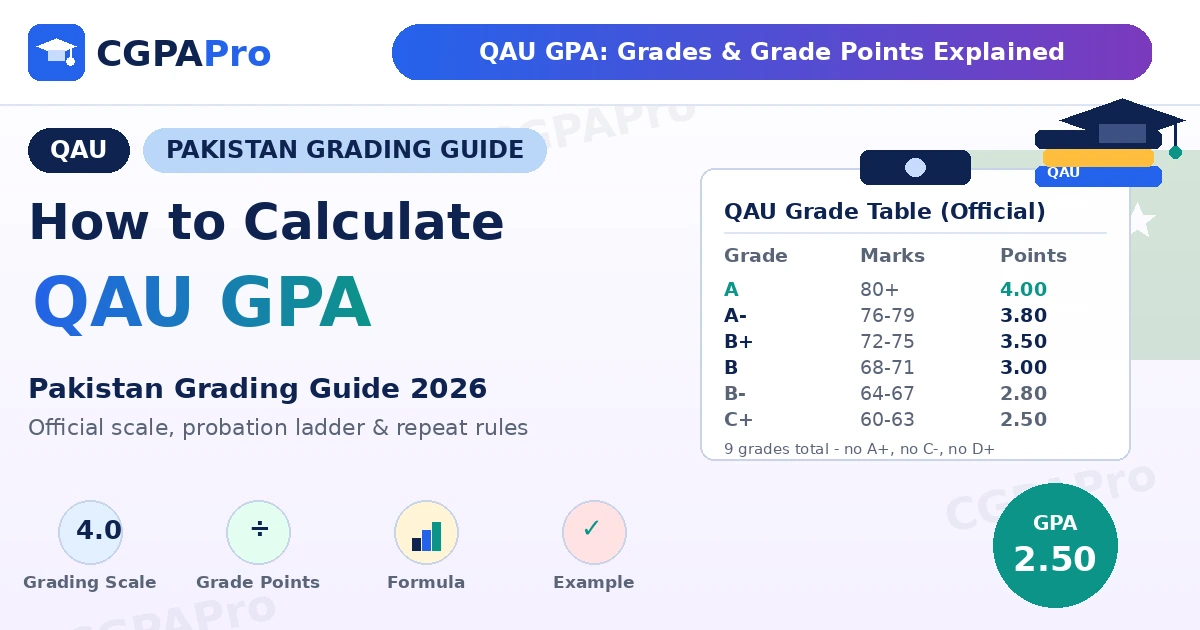
Quaid-i-Azam University Islamabad grades on a fixed 4.00 scale — but its grade table has quirks that trip up nearly every new student. There is no A+: the ceiling is a plain A at 80% and above. There is also no C− and no D+ — just nine grades, A through F. And the grade points aren’t the rounded numbers most generic calculators assume: at QAU, A− is 3.80, B+ is 3.50, and B− is 2.80. Run your marks through one of the popular “HEC scale” calculators floating around online and you’ll get a number that has nothing to do with what appears on your QAU transcript. This guide gives you the official table from QAU’s own published regulations, shows exactly how QAU computes your GPA and CGPA, and answers the questions students actually argue about — the 79.5% rounding rule, the probation ladder, how many courses you can repeat, and whether your percentage shows on the transcript.
Quick answers: you need 50% (a D) to pass a course; GPA = total quality points ÷ total credit hours; CGPA below 1.0 gets you dropped from the rolls, 1.0–2.0 puts you on probation (with only three chances to recover); and students may repeat up to four courses over the whole degree to improve grades.
Try the QAU GPA calculator
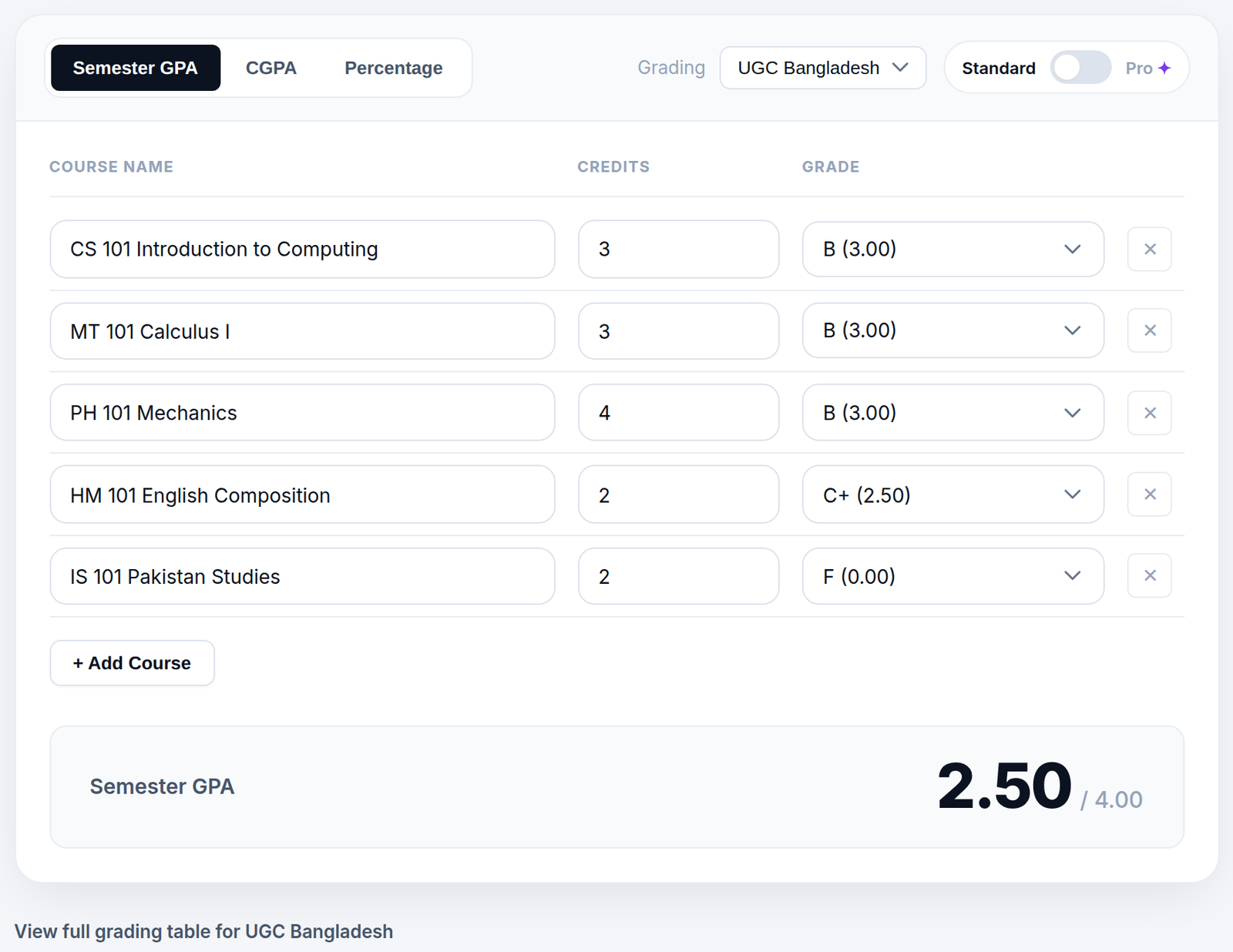
The fastest way to check your standing is to run your actual courses through a calculator. Add each course with its credit hours and the grade you expect, and it does the weighted maths for you. Here’s a real example — five first-semester-style courses:
The official QAU grade table (verified)
This is the grade table from QAU’s Calendar 2012 — the university’s official published regulations for BS programmes (section 7.4.4.2, “Marks, Grade Points, Letter Grades”), available on QAU’s own website at qau.edu.pk. Read it once and notice what’s missing: there is no A+, no C− and no D+. Nine grades, full stop.
| Marks | Grade | Grade point | Means |
|---|---|---|---|
| 80 and above | A | 4.00 | Outstanding / Excellent |
| 76–79 | A− | 3.80 | Very good |
| 72–75 | B+ | 3.50 | Very good |
| 68–71 | B | 3.00 | Good |
| 64–67 | B− | 2.80 | Good |
| 60–63 | C+ | 2.50 | Satisfactory |
| 55–59 | C | 2.00 | Satisfactory |
| 50–54 | D | 1.00 | Weak |
| 0–49 | F | 0.00 | Fail |
Three things to lock in. First, the pass line is 50 marks: anything from 50–54 is a D (“Weak” in QAU’s own words), and 49 or below is an F. Second, the top grade A at 4.00 starts at 80, not 85 and not 90 — the regulations attach a written description to each grade, and A is split descriptively into “Outstanding” (above 85%) and “Excellent” (80–85%), but both halves are still grade A at 4.00. There is no extra credit for crossing 85. Third, the odd-numbered grade points (3.80, 3.50, 2.80) are the QAU signature — if a calculator gives you A− = 3.67 or B+ = 3.33, it’s using someone else’s table, not QAU’s.
One more clause worth knowing: QAU says letter grades are used only for individual courses, never for semester GPA or CGPA — your GPA/CGPA is always a number, never a letter. And the percentage of marks is never reported on transcripts; the transcript shows grade points, not your 73% or 81%.
How your marks become a grade
Every course at QAU carries 100 marks, built from three components:
- Continuous assessment (home assignments, term papers, quizzes, class presentations, lab work) — roughly 20–25%
- Mid-semester examination — 25–30%
- Terminal examination — 50%
For laboratory courses or courses with extensive field work, the split is 50% terminal exam and 50% continuous evaluation. The mid-semester exam is held around the 8th week of classes.
Here’s the rule that changes real outcomes: a fractional mark is rounded to the nearest whole number before the letter grade is assigned. A 79.5 doesn’t mean A− — it rounds to 80, which is an A. A 54.5 rounds to 55, turning a D into a C. The boundaries are hard lines, but your raw marks get rounded up to them first. (Yes, that makes 79.5 the most valuable half-mark of your semester.)
Also note the practical gates: you need 80% attendance in a course to be allowed into the terminal exam (the chairperson can relax 10% of it for recognised extracurricular participation), and all assignments and term papers must be submitted before teaching ends.
GPA and CGPA: the formula
QAU’s own regulation states the semester GPA formula directly:
GPA = Σ (credit hours of each course registered × grade point earned in each course) ÷ Σ (credit hours registered in the semester)
In plain words: convert each grade to its grade point, multiply by that course’s credit hours (that’s your “quality points”), add them all up, and divide by your total credit hours for the semester. Credit hours are the weight — a 4-credit course moves your GPA twice as much as a 2-credit course with the same grade.
CGPA uses the same formula stretched across all completed semesters — total quality points over total credit hours. The standard load is 15–18 credit hours per regular semester (up to 21 with the dean’s approval).
Worked example 1: a 5-course semester → 2.50
The same five courses from the calculator screenshot above, worked by hand — check every number:
| Course | Units | Grade | Point | Units × Point |
|---|---|---|---|---|
| CS 101 Introduction to Computing | 3 | B | 3.00 | 9.00 |
| MT 101 Calculus I | 3 | B | 3.00 | 9.00 |
| PH 101 Mechanics | 4 | B | 3.00 | 12.00 |
| HM 101 English Composition | 2 | C+ | 2.50 | 5.00 |
| IS 101 Pakistan Studies | 2 | F | 0.00 | 0.00 |
| Total | 14 | 35.00 |
GPA = 35.00 ÷ 14 = 2.50 — matching the screenshot exactly.
Notice what the F does: it contributes zero points but its 2 credit hours still sit in the denominator. That’s why a failed course is so expensive — and why repeating it (covered below) matters so much.
Worked example 2: QAU’s signature grades in action → 3.58
The first example used only grades where every calculator agrees. Now let’s use the grades where QAU’s table is unique — A−, B+ and B− at their official values — and work them by hand:
| Course | Units | Grade | Point | Units × Point |
|---|---|---|---|---|
| Introduction to Economics | 3 | A | 4.00 | 12.00 |
| Calculus II | 3 | A− | 3.80 | 11.40 |
| General Physics II | 4 | B+ | 3.50 | 14.00 |
| English Comprehension | 2 | B− | 2.80 | 5.60 |
| Total | 12 | 43.00 |
GPA = 43.00 ÷ 12 = 3.58.
Run those same letters through a generic calculator that assumes A− = 3.67 and B+ = 3.33 and you’d get roughly 3.46 — a 0.12 gap from nothing but the wrong table. That gap is the entire story of why you must always calculate with QAU’s own numbers.
GPA vs CGPA — and the averaging trap
Your GPA is one semester. Your CGPA is everything you’ve completed, credit-weighted from semester one. The trap: never just average your semester GPAs. Take a student with semester 1 at 3.00 (16 credits, 48.00 points) and semester 2 at 3.60 (18 credits, 64.80 points). The naive average is (3.00 + 3.60) ÷ 2 = 3.30. The real CGPA is (48.00 + 64.80) ÷ 34 = 112.80 ÷ 34 = 3.32. Different numbers, because semester 2 carried more weight. The more uneven your credit loads, the bigger the error.
Note that at QAU the same discipline applies in reverse when you need to recover. Suppose your first semester was 18 credits at a GPA of 1.80 (32.40 quality points) — probation territory, as we’ll see. To lift your CGPA back to the 2.0 line after semester 2 (another 18 credits), you need 72.00 total points, so 39.60 from 18 credits — a 2.20 average across semester 2. The formula generalises: required future average = (target CGPA × total credits − earned points) ÷ remaining credits.
Your QAU calculator may be lying to you
Here’s the uncomfortable bit: several websites offering a “QAU GPA calculator” use a grade table that isn’t QAU’s. Two specific cases to watch for:
- The invented C−. One popular QAU calculator page lists “C− = 1.70 for 55 marks” alongside B+ = 3.40 and C+ = 2.40. QAU has no C− grade at all — 55–59 is a plain C at 2.00 — and the official values are B+ 3.50 and C+ 2.50. Its own worked example uses the wrong numbers, so every result it produces is off.
- The generic “HEC scale”. Another calculator claims an “HEC-approved” scale — A+ at 4.0, A 3.7, A− 3.3, B+ 3.0, B 2.7, B− 2.3, C+ 2.0, C 1.7, D 1.0. Not one of those bands matches QAU’s official table. A student at 78% would be told they have an A− at 3.3 by that scale; at QAU they have an A− at 3.80.
The rule is simple: if a calculator doesn’t show you a grade table that matches the official one above — A 4.00, A− 3.80, B+ 3.50, B 3.00, B− 2.80, C+ 2.50, C 2.00, D 1.00, F 0 — don’t trust its number. Our HEC vs UGC grading scale comparison explains how Pakistan’s generic scales differ from university-specific ones like QAU’s.
The probation ladder — what happens below 2.0
QAU’s promotion rules are written as a ladder, and every rung is verified in the official regulations:
- CGPA below 1.0 at the end of any semester → dropped from the university rolls. (For first-semester students, the first semester’s GPA is what counts.) This is automatic — there is no probation rung below 1.0.
- CGPA 1.0–2.0 → probation. You’re warned and you stay, but you’re on the ladder.
- Three chances on probation, total, across the whole degree. If you still haven’t reached a 2.0 CGPA by the fourth reckoning, you cease to be a student of the university.
Beyond probation, two more clocks run on your degree: you must finish the BS within 12 regular semesters (6 years), and you may not take more than three attempts to clear any single course. A failed compulsory course must be repeated whenever the department next offers it.
If you’re on probation right now, the recovery maths from the GPA section above is your plan: compute the exact semester average you need, course by course, rather than guessing. For how QAU compares with other Pakistani universities’ probation lines, see our guides to Punjab University’s grading system and GIKI’s grading system.
Summer sessions and improving your grades
QAU’s regulations give you two distinct routes to fix a bad semester:
- Failed or withdrawn courses: you can re-register for them in the summer session (48 contact hours, intensive), on the chairperson’s recommendation. Up to two courses per summer.
- Improvement repeats: if you earned a D or C (below 60%) in a course, you may repeat it to improve your CGPA — but this is capped at four courses across your entire degree. Choose the repeats with the biggest credit-hour × grade-point upside, because you only get four.
Note the asymmetry that confuses students: there is no “four chances” limit on re-taking failed courses the way some calculator sites claim — the “four” in the regulations is the improvement-repeat cap, while probation gives you three chances. Mix those two up (as one competitor site does) and you’ll plan your recovery around the wrong number.
Two more practical notes: no special examinations are allowed for summer courses — you sit the mid and terminal exams like everyone else — and 80% attendance still applies.
Honor board, transcripts and the fine print
A few verified details that rarely make it into calculator pages:
- Honor board: students with a CGPA of 3.8 or better have their names displayed on the dean’s-office honor board.
- Transcripts show grade points, not percentages. Your 73% or 81% never appears — this is exactly why converting QAU marks to a generic “percentage → GPA” table (a common forum question) is a dead end.
- Grade grievances: if you believe a grade is wrong, you must approach your chairperson/director within 3 working days of the result being displayed. A departmental committee then hears both sides and decides within 5 days. Miss the window and the grade stands.
- Attendance: below 80% in a course and you can’t sit the terminal exam — with no make-up exam for summer courses.
- No percentage shortcut: because QAU uses absolute mark bands (not a curve), your grade depends only on your own marks, not on how the class performed.
One qualification worth making: the calendar also covers MSc, MBA and MPA programmes under separate admission and examination regulations, and several secondary sources claim a simplified scale for those programmes (A ≥ 80%, B 60–79.9%, C 50–59.9%, F below 50). We couldn’t verify that from a primary QAU document, so treat it as unconfirmed — check your programme handbook rather than trusting any website on this, including this one.
Common mistakes QAU students make
- Using a generic HEC/UGC table. The single biggest error: calculating with A− = 3.67 or B+ = 3.33 instead of QAU’s 3.80 / 3.50. Every grade shifts.
- Assuming 85% is the A line. A starts at 80. The “Outstanding / Excellent” split is descriptive only — 80–85% and 85%+ are both A at 4.00.
- Forgetting the rounding rule. 79.5 is an A, not an A−. Know where your fractional marks land.
- Averaging semester GPAs. Always weight by credit hours, as shown above.
- Thinking an F disappears. The failed course’s credits stay in the denominator until you repeat it — and a repeat is one of only four improvement slots.
- Sleeping on the grievance window. Three working days, then it’s final.
Tips for a strong QAU CGPA
- Weight your effort by credits. A 4-credit course at B+ (14.00 points) contributes more than two 2-credit courses combined. Protect your high-credit courses first.
- Target the rounding boundaries. If you’re sitting at 78.6, half a mark of effort is worth a full grade-point jump per credit — the highest-leverage studying you’ll ever do.
- Guard the 50 line, not the 60 line. At QAU, 50–54 still passes (a D). Many students panic at 55 and waste repeats — a D only becomes worth repeating if you have spare slots under the four-course improvement cap.
- Never burn an improvement repeat on a low-credit course when a 4-credit C is dragging you down instead. Run the quality-points maths first.
- Keep attendance above 80% from week one. Losing exam eligibility over attendance is the most avoidable CGPA disaster there is.
FAQ — real student questions
What are the passing marks at QAU?
50%. Marks of 50–54 earn a D (grade point 1.00), which is a pass; 49 or below is an F. That said, a D still drags your GPA hard, and courses below 60% (D or C) are the only ones you’re allowed to repeat for improvement.
Is there an A+ grade at QAU?
No. QAU’s scale tops out at A (80% and above, 4.00 grade points). There is also no C− and no D+ — nine grades total: A, A−, B+, B, B−, C+, C, D, F.
I scored 79.5 — is that an A−?
It’s an A. QAU rounds fractional marks to the nearest whole number before assigning the grade, so 79.5 becomes 80 — the bottom of the A band. This is one of the most valuable rules in the regulations.
What happens if my CGPA falls below 2.0?
You go on probation. You get three probation chances across your entire degree; if you still haven’t reached 2.0 by the fourth reckoning, you cease to be a student. Below 1.0 at the end of any semester, you’re dropped from the rolls immediately — no probation rung in between.
How many courses can I repeat to improve my CGPA?
Four, across your entire degree — and only courses where you earned a D or C (below 60%). Failed courses are a separate matter: you must repeat those whenever offered. You may take up to two courses in a summer session.
Does QAU show my percentage on the transcript?
No. QAU transcripts report grade points only — your percentages are never shown. That’s also why generic “convert my percentage to GPA” tables don’t apply to QAU: your GPA comes from the official grade-point bands above, nothing else.
Is a 3.0 CGPA from QAU good for jobs or MS abroad?
It’s the implied baseline — QAU’s own probation ladder treats 2.0 as the stay-or-go line, so 3.0 keeps you comfortably clear and meets most local job filters. For MS abroad, universities convert your transcript themselves, so report your official CGPA exactly as QAU awards it. Our guide on whether a 3.0 CGPA is good breaks down job, scholarship and abroad thresholds in detail.
Conclusion
QAU’s grading system rewards students who read the fine print: A− is 3.80 not 3.67, fractions round up to the grade boundary, and the probation ladder gives you exactly three chances — no more. Calculate with the official table, weight everything by credit hours, spend your four improvement repeats where the maths says they’ll move the needle, and keep attendance above 80%. Do that and there’ll be no surprises on your transcript — because at QAU, the numbers are printed in the regulations for anyone who bothers to look.
Sources: Quaid-i-Azam University Calendar 2012, Regulation Relating to BS Programmes (sections 2, 5–8, 7.4), qau.edu.pk; cross-verified against gpawise.com’s QAU grading page, which cites QAU’s BS Program Rules verified July 2026.