Short answer: a 3.50 CGPA in Pakistan and a 3.50 CGPA in Bangladesh are not the same achievement. On Pakistan’s HEC scale, 3.50 sits in the A− grade-point range — roughly the 80–84% marks band. On Bangladesh’s UGC scale, 3.50 is exactly an A−, worth 70–74% marks. Same number, about a ten-mark gap in what it took to earn it. If you are comparing yourself with a friend across the border, applying abroad, or converting either number for a job, this guide shows you both official scales side by side, with real worked examples nobody else bothers to do.
Both countries use a 4.0 scale, which is exactly why the confusion survives. “4.0 scale” describes the ceiling, not the staircase. Pakistan’s Higher Education Commission (HEC) and Bangladesh’s University Grants Commission (UGC) built very different staircases: different numbers of grades, different percentage bands, a different value for a D, and — the detail that surprises everyone — an A+ that officially exists in one country and not the other. Let’s walk up both, step by step.
Step 1: Calculate your CGPA correctly first
Before comparing systems, you need a clean, credit-weighted number — not the rough average in your head. The CGPAPro calculator on the homepage handles this: add each course with its credits and letter grade, and it does the weighted math. The homepage calculator runs the UGC Bangladesh scale (A+ 4.00 through F 0.00), which makes it perfect for the worked example below.
Take a student with five 3-credit courses and these grades — A, A−, B+, B, C+. Every one of these letter grades exists on both the HEC and UGC scales, which is what makes this example useful:
- Course 1 — 3 credits — A → 3.75 (UGC) / 4.00 (HEC)
- Course 2 — 3 credits — A− → 3.50 (UGC) / 3.67 (HEC)
- Course 3 — 3 credits — B+ → 3.25 (UGC) / 3.33 (HEC)
- Course 4 — 3 credits — B → 3.00 (UGC) / 3.00 (HEC)
- Course 5 — 3 credits — C+ → 2.50 (UGC) / 2.33 (HEC)
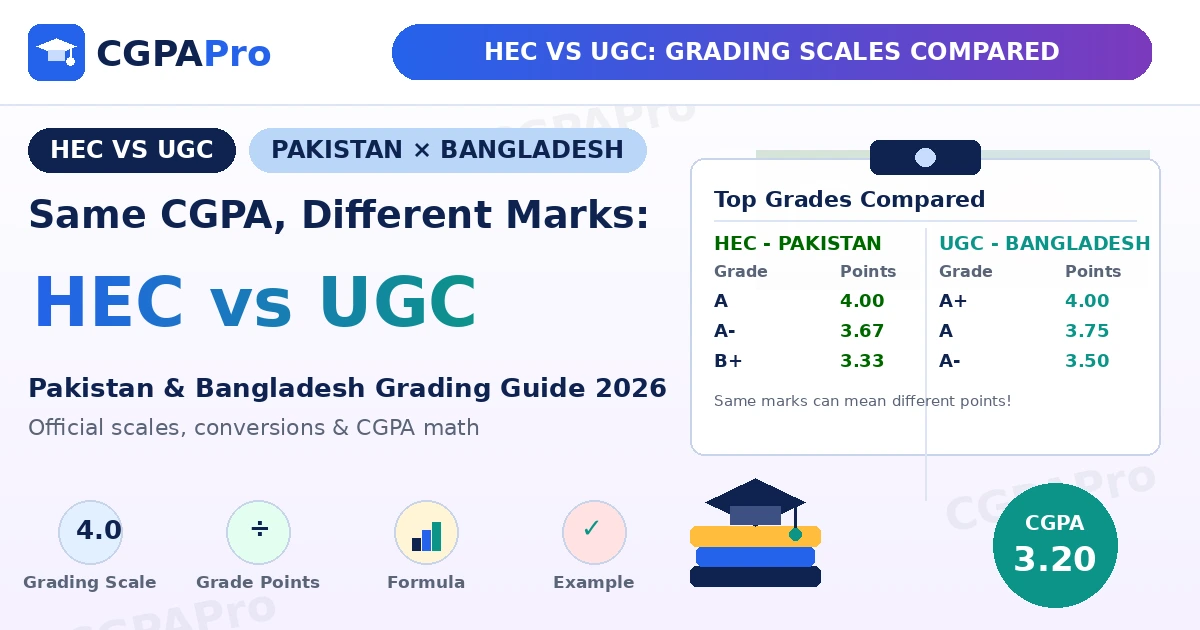
On the UGC scale: (3.75 + 3.50 + 3.25 + 3.00 + 2.50) ÷ 5 = 16.00 ÷ 5 = 3.20. On the HEC scale, the identical transcript gives (4.00 + 3.67 + 3.33 + 3.00 + 2.33) ÷ 5 = 16.33 ÷ 5 = 3.27. Same grades, same credits — a 0.07 gap created by nothing but the scale. Keep this pair of numbers in mind; the featured comparison below builds on them.
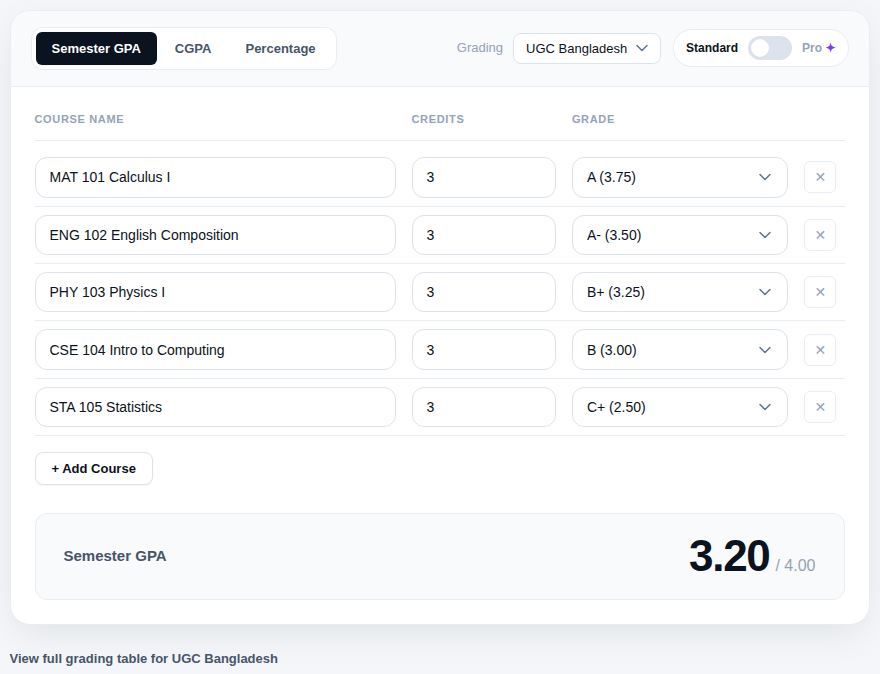
Screenshot: the exact 5-course scenario above, calculated on the CGPAPro homepage calculator (UGC Bangladesh scale). Result: 3.20. The same grades on Pakistan’s HEC scale work out to 3.27 — calculated by hand in the example above. (Real capture from cgpacalculatorpro.com, October 2026.)
The formula behind both systems is identical — only the grade-point values change: GPA = Σ (credits × grade points) ÷ Σ credits. If the mechanics are fuzzy, our SGPA formula guide walks through them with more examples.
Pakistan: the official HEC scale
Pakistan’s Higher Education Commission publishes an official “fractionalized” grading policy as part of its uniform semester-system guidelines. It is the baseline nearly every HEC-recognized university builds on — though, as we’ll see, universities implement it in two slightly different ways.
| Grade | Grade-point range (official) | Percentage band |
|---|---|---|
| A | 3.67 – 4.00 | 85 and above |
| A− | 3.34 – 3.66 | 80 – 84 |
| B+ | 3.01 – 3.33 | 75 – 79 |
| B | 2.67 – 3.00 | 71 – 74 |
| B− | 2.34 – 2.66 | 68 – 70 |
| C+ | 2.01 – 2.33 | 64 – 67 |
| C | 1.67 – 2.00 | 61 – 63 |
| C− | 1.31 – 1.66 | 58 – 60 |
| D+ | 1.01 – 1.30 | 54 – 57 |
| D | 0.10 – 1.00 | 50 – 53 |
| F | 0.00 | Below 50 |
Three things about this table catch every student off guard. First, there is no A+ in the official HEC scale — the top grade is a plain A, and it starts at 85%, the highest top-grade threshold in South Asia. (Several universities, like UET Lahore, add an A+ of their own — but that is a university decision, not HEC’s.) Second, the grade points are ranges, not single values. In practice, almost every Pakistani university publishes fixed midpoints instead: A 4.00, A− 3.67, B+ 3.33, B 3.00, B− 2.67, C+ 2.33, C 2.00, C− 1.67, D+ 1.33, D 1.00, F 0.00. We verified this fixed version line by line in our guides to COMSATS, FAST-NU, NUST, Air University, Bahria University, and Punjab University — it is the de-facto standard, and it is what this article uses for all HEC calculations.
Third, HEC has an official rule for converting a CGPA back to a percentage, and it is not “multiply by 25.” HEC’s policy states that a CGPA takes the minimum percentage of its band — so a 3.00 CGPA converts to 71% (the bottom of the 71–74 band), not 75%. The ×25 shortcut overstates your marks, and it is one of the most common mistakes on Pakistani CVs. Our percentage-to-CGPA guide exposes this shortcut with the official tables.
The other HEC house rules: minimum 2.00 CGPA to graduate and stay in good standing (fall below it and you enter the probation ladder), and anything below 50% is an F — no partial credit.
Bangladesh: the official UGC scale
Bangladesh’s University Grants Commission prescribes a uniform 10-grade scale used by the public universities — Dhaka University, Jahangirnagar, Rajshahi, Chittagong, BUET, RUET, CUET, KUET, SUST, and the rest. We verified this scale against official ordinances in our BUET, Dhaka University, Jahangirnagar, Rajshahi, and Chittagong guides:
| Grade | Grade points | Percentage band |
|---|---|---|
| A+ | 4.00 | 80 and above |
| A | 3.75 | 75 – 79 |
| A− | 3.50 | 70 – 74 |
| B+ | 3.25 | 65 – 69 |
| B | 3.00 | 60 – 64 |
| B− | 2.75 | 55 – 59 |
| C+ | 2.50 | 50 – 54 |
| C | 2.25 | 45 – 49 |
| D | 2.00 | 40 – 44 |
| F | 0.00 | Below 40 |
Notice the philosophy: finer steps of 0.25 between grades, an A+ at the top starting at just 80%, and — the number that does the most quiet damage in cross-border comparisons — a D worth 2.00 grade points. In Pakistan a D is worth 1.00. We’ll come back to that.
One important boundary: this UGC scale governs public universities. Bangladesh’s big private universities run their own scales — NSU, IUB, BRACU, AIUB, UIU, DIU, and EWU all use plus/minus 4.0 scales that look much more like Pakistan’s HEC system (we have individual guides for NSU, IUB, and BRACU). So “Bangladeshi CGPA” means the UGC scale only if the university is a public one — always check the transcript legend.
Side-by-side: HEC vs UGC, grade by grade
Here is the comparison no other English article publishes — both official scales aligned so you can see exactly where they diverge:
| Marks | HEC Pakistan (grade / points) | UGC Bangladesh (grade / points) |
|---|---|---|
| 85–100 | A / 4.00 | A+ / 4.00 |
| 80–84 | A− / 3.67 | A+ / 4.00 |
| 75–79 | B+ / 3.33 | A / 3.75 |
| 70–74 | B / 3.00 (71–74) | A− / 3.50 |
| 65–69 | B− / 2.67 (68–70) | B+ / 3.25 |
| 60–64 | C+ / 2.33 (64–67) | B / 3.00 |
| 55–59 | C− / 1.67 (58–60) | B− / 2.75 |
| 50–54 | D / 1.00 (50–53) | C+ / 2.50 |
| 45–49 | F / 0.00 | C / 2.25 |
| 40–44 | F / 0.00 | D / 2.00 |
| Below 40 | F / 0.00 | F / 0.00 |
Read the middle rows slowly — that is where the real story is. A student scoring 72% gets a B (3.00) in Pakistan and an A− (3.50) in Bangladesh: half a grade point of pure scale difference. A student scoring 47% fails in Pakistan and earns a C (2.25) — comfortably passing — in Bangladesh. The two systems agree at the very top (4.00) and the very bottom (0.00) and disagree almost everywhere in between.
Worked example 1: the same 78% in both countries
This is the single most useful comparison in the article. One exam score, two transcripts:
- Lahore (HEC): 78% falls in the 75–79 band → B+ → 3.33 grade points
- Dhaka (UGC): 78% falls in the 75–79 band → A → 3.75 grade points
A 0.42 grade-point gap from the same marks. Over a full degree, that gap compounds: a student consistently scoring in the high 70s graduates near 3.3 in Pakistan and near 3.7 in Bangladesh. This is not grade inflation in the cheating sense — it is just two different rulers. But it means a Bangladeshi 3.7 and a Pakistani 3.7 describe meaningfully different academic performances, and any employer or admissions officer comparing them raw is making a category error.
Worked example 2: what “3.5 CGPA” actually means in marks
Now run the comparison in reverse — the question students actually ask: my CGPA is 3.5, what is that in marks?
- Pakistan (HEC): 3.50 falls in the official A− grade-point range (3.34–3.66), which maps to the 80–84% marks band. Per HEC’s band-minimum rule, you would report the bottom of the band.
- Bangladesh (UGC): 3.50 is exactly an A−, which maps to 70–74% marks.
So the Pakistani 3.5 represents roughly ten more marks per hundred than the Bangladeshi 3.5. Flip it around and the asymmetry is just as stark: 75% marks earn you 3.33 in Pakistan but 3.75 in Bangladesh. There is no honest single conversion factor between the two CGPAs — anyone selling you one is guessing.
Worked example 3: the D-grade shock
Here is the detail with the biggest real-world bite. Take a 15-credit semester where a student earns one D (3 credits) and Bs (3.00) in the other 12 credits:
- Pakistan: D = 1.00 → (3 × 1.00 + 12 × 3.00) ÷ 15 = 39 ÷ 15 = 2.60. The D cost 0.40 GPA points.
- Bangladesh: D = 2.00 → (3 × 2.00 + 12 × 3.00) ÷ 15 = 42 ÷ 15 = 2.80. The D cost 0.20 GPA points.
A D in Pakistan drags exactly twice as hard as a D in Bangladesh — and remember, the Pakistani D was earned at 50–53% marks while the Bangladeshi D was earned at 40–44%. Lower marks, higher grade points, half the damage: the D is the single most misunderstood grade in cross-border comparisons. If you are a Pakistani student, a D is an emergency (repeat the course if your university allows it — most do, with the better grade replacing the old one). If you are a Bangladeshi student, a D is survivable, though our CGPA improvement guide shows the math for climbing out of any hole.
The formula is the same — only the values change
Both countries use the identical credit-weighted formula. For one semester:
Semester GPA = Σ (course credits × grade points) ÷ Σ course credits
And across semesters: CGPA = Σ (all quality points earned) ÷ Σ (all credits attempted). Failed courses count in the divisor in both systems until cleared (our failed-subjects guide covers the denominator trap in detail). Neither system drops your lowest semester; neither forgives an F automatically.
7 structural differences that actually matter
1. The top of the scale: 85% vs 80%
Pakistan’s HEC sets the highest bar in South Asia for a top grade: 85% for an A. Bangladesh’s UGC awards an A+ (4.00) from 80%. A student scoring 82% is an A− (3.67) in Pakistan and an A+ (4.00) in Bangladesh — a full third of a grade point apart at the very top, where scholarships and gold medals are decided.
2. A+ exists in Bangladesh, not in HEC’s Pakistan
The UGC scale has ten grades topped by A+. HEC’s official scale has eleven grades topped by a plain A — there is no official A+ in Pakistan. Some Pakistani universities add one anyway (UET Lahore’s A+ is 4.00), which is why you must read your own university’s scale, not the national one, before doing any conversion. An “A+” on a Pakistani transcript is a university invention; an “A+” on a Bangladeshi public-university transcript is the UGC standard.
3. Step size: 0.33 vs 0.25
HEC moves in thirds (4.00 → 3.67 → 3.33 → 3.00), UGC in quarters (4.00 → 3.75 → 3.50 → 3.25). The practical effect: mid-range Pakistani grades punish harder. A B+ is 3.33 in Pakistan but 3.25 in Bangladesh — small per course, but over 40 courses it adds up to a visible CGPA gap for identical letter-grade histories.
4. The passing floor: 50 vs 40
Below 50% is an F in Pakistan. In Bangladesh you can score 40–44% and still earn a D (2.00) — a passing grade worth as much as a Pakistani C. The entire 40–49 band, which is failure in Pakistan, is passing territory in Bangladesh. This is the single biggest reason the two CGPAs cannot be compared directly.
5. Relative grading culture in Pakistan
HEC explicitly permits both absolute and relative (curve) grading, and major Pakistani universities use the curve aggressively — NUST sets grade boundaries from class performance, and IBA officially encourages relative grading. Bangladesh’s public universities are overwhelmingly absolute: the UGC bands are fixed, and your 78% is an A no matter what your classmates scored. A Pakistani CGPA therefore carries information about rank; a Bangladeshi CGPA carries information about marks.
6. Division vs class traditions
Pakistan still runs on the division system for employment and HEC equivalence: roughly, 3.00–3.59 CGPA maps to the first division (70–79% band), 2.50–2.99 to the second division, 2.00–2.49 to the third. Government jobs and HEC scholarship cutoffs are often written in divisions, not CGPA. Bangladesh’s public universities use the British-style class language informally, but the transcript number that matters is the CGPA itself — and as our 3.0 CGPA guide documents, a Bangladeshi 3.0 sits awkwardly against the UK 2:1 line while a Pakistani 3.0 often clears it.
7. Neither scale is truly national
HEC’s scale is a recommendation that universities adapt — NUST curves, IBA and LUMS run variants, medical colleges differ. The UGC scale binds public universities but not the big privates (NSU, BRACU, IUB use HEC-like plus/minus scales). The honest rule: the scale printed on the back of your transcript beats both national tables. Any conversion that starts from the wrong scale is wrong from step one.
Studying abroad: how foreign universities read the two numbers
This is where the comparison stops being academic. Foreign universities do not compare a Pakistani 3.5 with a Bangladeshi 3.5 — their country tables do the work, and the tables know the scales differ. The proof is public: the University of Sheffield’s entry requirements ask Bangladeshi applicants for a 2:1 equivalent of 3.25 CGPA but ask Pakistani applicants for only 2.8 CGPA for the same 2:1. Same British university, same degree classification — different CGPA bars, because Sheffield’s admissions team understands that a Pakistani 2.8 and a Bangladeshi 3.25 represent comparable achievement. (We documented this split with official sources in our UK degree classification guide.)
Credential evaluators like WES go further: they largely ignore your CGPA number and convert course by course from your marks, using country-specific tables. A Pakistani transcript’s 78% and a Bangladeshi transcript’s 78% convert to different US letter grades — which is exactly correct, because they were different achievements at home. Our WES conversion guide walks through the full process with real numbers.
Practical advice for applications: never convert your own CGPA with a shortcut formula. Report the number on your transcript, on its original scale, and attach the grading legend (most universities print it on the transcript’s reverse). If a form forces a 4.0-scale number and your scale is already 4.0, enter it as-is — both HEC and UGC scales are already 4.0 ceilings, so no conversion is needed, only honest labeling of which country’s scale it is.
5 mistakes students make with these two scales
- Multiplying a Pakistani CGPA by 25. HEC’s official conversion uses band minimums (3.00 → 71%), not ×25 (which would give 75%). The shortcut inflates your percentage and can look dishonest on an application.
- Assuming an A+ on a Pakistani transcript is official. It isn’t — HEC has no A+. It’s a university-level addition. Fine to report, but don’t cite “HEC” for it.
- Treating a Bangladeshi private-university CGPA as UGC-scale. NSU, BRACU, and IUB run plus/minus scales closer to HEC’s. A BRACU 3.5 and a DU 3.5 are different numbers from different rulers — inside the same country.
- Comparing CGPAs across the border for scholarships or jobs. A Pakistani 3.3 and a Bangladeshi 3.3 are not peers; the worked examples above show gaps of 0.2–0.4 grade points for identical performance. Compare marks or percentiles, never raw CGPA.
- Forgetting the curve. A 3.2 from a curving Pakistani university (NUST, IBA) signals class rank; a 3.2 from a fixed-band Bangladeshi public university signals marks. Context changes what the number means.
Quick tips for students on either scale
- Protect your D-line in Pakistan. A D costs 0.40 GPA points per 3-credit course — double Bangladesh’s 0.20. If your university allows repeats with grade replacement (most Pakistani universities do), a D is your highest-ROI repeat.
- Chase the 80% line in Bangladesh. The jump from A (3.75) to A+ (4.00) at 80% is the steepest reward gradient on the UGC scale — two marks can be worth 0.25 grade points.
- Know your band edges. In both systems, a single mark can move a grade: 74.9% vs 75% is B vs B+ in Pakistan, A− vs A in Bangladesh. If your university rounds (many Bangladeshi universities round x.xx5 up), know the rule — it is worth real grade points.
- On CVs, label the scale. “CGPA 3.40/4.00 (HEC, Pakistan)” or “CGPA 3.40/4.00 (UGC, Bangladesh)” removes all ambiguity and signals you understand your own system — recruiters notice.
FAQ
Is a 3.5 CGPA in Pakistan equal to a 3.5 CGPA in Bangladesh?
No. A Pakistani 3.5 sits in HEC’s A− grade-point range, roughly the 80–84% marks band. A Bangladeshi 3.5 is exactly a UGC A−, worth 70–74% marks. The Pakistani 3.5 represents about ten more marks per hundred — they are not interchangeable for scholarships, jobs, or admissions.
Which system is harder to score a high CGPA in?
Pakistan’s, on balance: the top grade starts at 85% (vs 80% for an A+ in Bangladesh), the steps are coarser (0.33 vs 0.25), and a D is worth half as much. But Bangladesh’s finer steps mean mid-range slips cost less per grade, and its private universities grade tougher than the UGC public scale. “Harder” also depends on the university’s curve and faculty, not just the national table.
Does WES treat Pakistani and Bangladeshi degrees differently?
WES evaluates course by course from your marks using country-specific conversion tables, so the same percentage can convert to different US grades depending on the country. Your home CGPA number is largely ignored in the process. See our WES guide for the full mechanics.
Can I convert my HEC CGPA to the UGC scale (or vice versa)?
There is no official formula — only the honest route: convert your CGPA back to approximate marks using your home system’s official bands, then map those marks onto the other system’s grade table. Any direct “CGPA-to-CGPA” multiplier you find online is invented. For applications, don’t convert at all: report the original number with its scale labeled.
Why does Bangladesh have an A+ but Pakistan doesn’t?
It is a policy choice by the two commissions: UGC Bangladesh’s uniform scale includes A+ (4.00) at 80%+, while HEC Pakistan’s official scale tops out at a plain A (85%+). Individual Pakistani universities may add their own A+, but it is not part of HEC’s national framework.
What CGPA do I need for an MS abroad from each country?
As a rough rule: UK universities commonly want the equivalent of a 2:1 — about 3.25 from Bangladesh but only about 2.8 from Pakistan (Sheffield’s published split). For the US, competitive programs typically look for 3.0+ on either scale, but remember WES re-computes from marks. Germany’s blocked-account route cares more about admission than a specific CGPA. Always check the university’s country-specific page, not a generic “3.0 required” blog line.
Do all universities in Pakistan and Bangladesh follow these official scales?
No. In Pakistan, NUST uses relative grading, IBA and LUMS run variants, and medical colleges differ. In Bangladesh, the UGC scale binds public universities, but NSU, BRACU, IUB, AIUB, UIU, DIU, and EWU use their own plus/minus scales. The scale on your transcript is the only one that counts for you.
The bottom line
HEC and UGC both built 4.0 scales, and that shared ceiling hides real differences: Pakistan demands 85% for its top grade, fails you below 50%, and punishes a D twice as hard; Bangladesh hands out A+ from 80%, passes you at 40%, and steps in gentle quarters. A 3.5 on one is not a 3.5 on the other — and now you can prove it with the tables and the math above. Use the right ruler for your transcript, label your scale on every application, and never let anyone convert your achievement with a multiplication shortcut.
Studying the system of a specific university? Browse our full grading-system guides — from NUST and COMSATS to BUET and Dhaka University — or run your own numbers on the CGPAPro calculator.