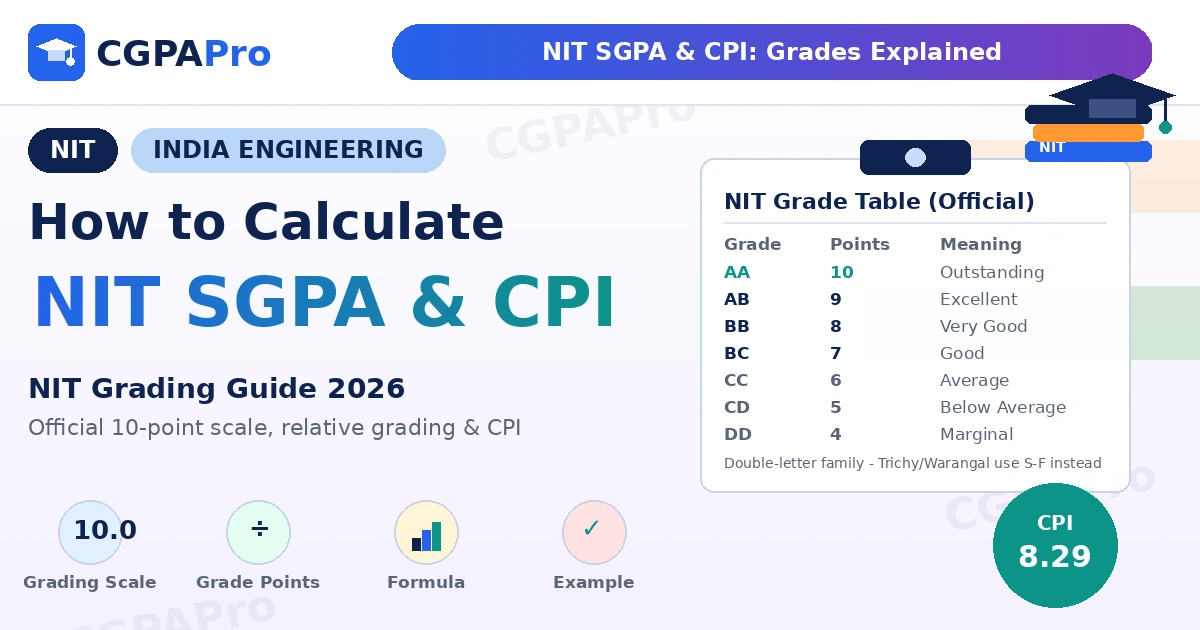
Every NIT runs on a 10-point grading scale — but ask three NIT students to name the grades and you’ll get three different answers. One says AA, AB, BB; another says S, A, B, C; a third talks about Ex, A, B, C. All three are right. The 31 NITs were never given a single common grade table: each institute’s Senate writes its own, so the letters differ even though the maths underneath is nearly identical. This guide gives you the three official grade families actually in use (each verified against a real NIT’s published regulations), explains relative grading — the curve that decides your grade after the exam — shows the SGPA and CPI formulas with hand-worked numbers, quantifies exactly what one failed course costs your CPI, and settles the great percentage-conversion confusion once and for all.
Quick answers: NIT grades are mostly relative — your letter depends on how the class performed, not just your marks. SGPA = Σ(credits × grade points) ÷ Σ(credits) for one semester; CPI is the same calculation stretched across all semesters. The most common official table is AA=10, AB=9, BB=8, BC=7, CC=6, CD=5, DD=4, FF=0 — but NIT Trichy and NIT Warangal use S=10 … E=5, F=0 instead, and NIT Durgapur uses Ex=10, A=9 … P=5, F=0. And no — CGPA × 10 is not the official percentage formula everywhere; several NITs print (CGPA − 0.5) × 10 on the back of the report card.
Try the NIT SGPA calculator
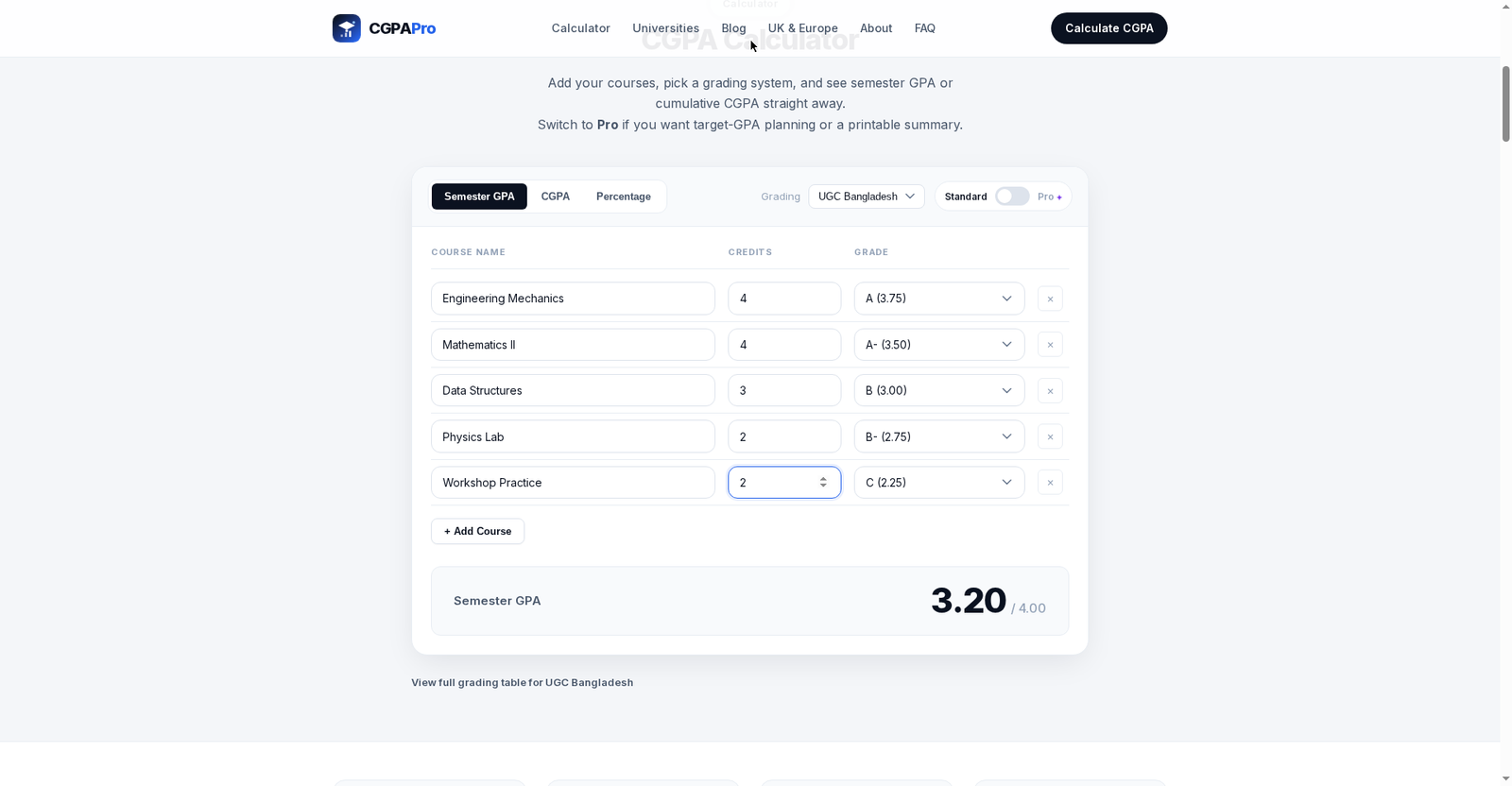
The quickest way to feel the maths is to run a semester through a calculator. Enter each course, its credits, and the grade you expect, and the weighted average does the rest. Here is a real 5-course example on CGPAPro’s general calculator — note how much a single 4-credit grade swings the total:
The official NIT grade tables (verified)
There is no single NIT grade table. What the regulations of different NITs show is three families of letter grades, all on the same 0–10 scale. Find your institute below — and if it isn’t listed, check your academic regulations or the back of your grade card, because the table printed there is the only one that counts for you.
Family 1: AA–FF (the double-letter table)
Used by institutes including VNIT Nagpur and NITK Surathkal. From VNIT’s official B.Tech grading regulations and NITK’s curriculum regulations:
| Grade | Grade point | Meaning |
|---|---|---|
| AA | 10 | Outstanding |
| AB | 9 | Excellent |
| BB | 8 | Very good |
| BC | 7 | Good |
| CC | 6 | Average |
| CD | 5 | Below average |
| DD | 4 | Marginal |
| FF | 0 | Fail / unsatisfactory / absent from end-semester exam |
Family 2: S–F (the single-letter table)
Used by NIT Trichy (from its official FAQ and B.Tech regulations) and NIT Warangal (from its Rules and Regulations, section 9). At Warangal there is an extra P = 4 grade:
| Grade | Grade point | NIT Trichy | NIT Warangal |
|---|---|---|---|
| S | 10 | ✓ | ✓ |
| A | 9 | ✓ | ✓ |
| B | 8 | ✓ | ✓ |
| C | 7 | ✓ | ✓ |
| D | 6 | ✓ | ✓ |
| E | 5 | ✓ | ✓ |
| P | 4 | — | ✓ (pass, barely) |
| F | 0 | ✓ | ✓ |
NIT Trichy’s published bands for its absolute-grading mode are: 91–100 → S, 81–90 → A, 71–80 → B, 61–70 → C, 51–60 → D, 40–50 → E, below 40 → F. And the pass rule is not “F = fail” alone: at Trichy you need at least 5 grade points — the E grade — to complete a course, plus a minimum of 30% in the end-semester examination. Grades X (absent) and V (insufficient attendance) carry 0 and mean you redo the course.
Family 3: Ex–P/F (the excellence table)
Used by NIT Durgapur (from its Senate notice on the 7-scale grade system):
| Marks | Grade | Grade point | Performance |
|---|---|---|---|
| 90 and above | Ex | 10 | Excellent |
| 80–89 | A | 9 | Very good |
| 70–79 | B | 8 | Good |
| 60–69 | C | 7 | Fair |
| 50–59 | D | 6 | Average |
| 35–49 | P | 5 | Pass |
| Below 35 | F | 0 | Fail |
Two honest caveats. First, some NITs have their own outliers: NIT Hamirpur grades absolutely (A=10 for above 80 marks, AB=9, B=8, BC=7, C=6, CD=5, D=4, F=0), and NIT Kurukshetra uses A+=10, A=9, B=8, C=6, O(Pass)=4, F=0 — with an official percentage formula of CGPA × 9.0, not × 10. Second, the same double letter can mean different things in different places: never copy a friend’s table from another NIT. Your institute’s regulations are the only authoritative source.
Relative vs absolute grading: why the same marks get different grades
Most NITs grade relatively. NIT Trichy’s official FAQ says it plainly: semester examinations are evaluated using relative grading only. NITK Surathkal’s regulations describe grades as based on “class performance distribution, and not based upon any fixed a-priori mappings” from marks to grades. In plain language: the instructor looks at the whole class’s scores, picks the cut-offs, and only then assigns letters.
Here is how that plays out. Imagine a 60-student Heat Transfer class with a class average of 66 and a standard deviation of 9. The instructor announces these bands: AA ≥ 84, AB 75–83, BB 66–74, BC 57–65, CC 48–56, CD 40–47, DD 35–39, FF below 35. A student scoring 78 gets AB (9 points).
Next semester the paper is easier and the class average rises to 74 with the same spread. The bands shift up, and the same 78 now lands in BB (8 points) — one full grade point lower for identical marks. Nothing was unfair; the grading simply measures you against your batch, not against a fixed bar.
Two practical consequences follow. First, you cannot predict your grade from your marks alone — which is why asking seniors “how many marks for an AA?” gets you a shrug and a range, not a number. Second, instructors usually cap the top grades: NIT Trichy’s regulations say the S grade is generally restricted to about 20% of the registered students, and a Performance Analysis Committee reviews the final grade ranges. In a small class, the curve can feel brutal — in a large one, it can be generous. If you’re targeting a specific CPI, plan for the grade you need relative to the batch, not a marks total.
Step-by-step: calculating your SGPA
The formula is the same at every NIT (NIT Warangal’s regulations print it verbatim):
SGPA = Σ (credits × grade points) ÷ Σ (credits)
The steps:
- List every course of the semester with its credits.
- Look up each grade’s point value in your NIT’s table.
- Multiply each course’s credits by its grade points.
- Add all the products, add all the credits, divide.
Failed courses count 0 × their credits — the credits stay in the denominator, dragging the average down. NITs round SGPA to two decimal places.
Worked example: SGPA 8.29 (Family 1 table)
A second-semester student at a double-letter NIT takes five courses. Using AA=10, AB=9, BB=8, BC=7, CC=6:
| Course | Credits | Grade | Points | Credits × points |
|---|---|---|---|---|
| Thermodynamics | 4 | AA | 10 | 40 |
| Fluid Mechanics | 4 | AB | 9 | 36 |
| Engineering Mathematics | 4 | BB | 8 | 32 |
| Electric Circuits | 3 | BC | 7 | 21 |
| Thermodynamics Lab | 2 | CC | 6 | 12 |
Total grade points = 40 + 36 + 32 + 21 + 12 = 141. Total credits = 4 + 4 + 4 + 3 + 2 = 17.
SGPA = 141 ÷ 17 = 8.2941… → 8.29 (rounded to two decimals, as NIT grade cards record it).
Notice the leverage: the two 4-credit AA/AB courses contribute 76 of the 141 points — over half the total from two courses. At NITs, where core theory courses carry 3–4 credits and labs carry 1–2, your heavy theory courses decide your SGPA. A BB in a 4-credit course costs you twice what a BB in a 2-credit lab costs.
From SGPA to CPI: the cumulative formula
NITs call the overall number CPI (Cumulative Performance Index) — it is the same thing most universities call CGPA. NIT Delhi’s and NIT Warangal’s regulations both compute it from semester SGPAs:
CPI = Σ (semester credits × semester SGPA) ÷ Σ (semester credits)
Take the same student one semester earlier: in semester 1 they scored SGPA 8.10 over 23 credits (8.10 × 23 = 186.30). In semester 2 they scored 8.29 over 17 credits (8.29 × 17 = 140.93).
CPI = (186.30 + 140.93) ÷ (23 + 17) = 327.23 ÷ 40 = 8.18075 → 8.18.
Because semester 1 carried more credits, its 8.10 pulls slightly harder than semester 2’s 8.29 — CPI is credit-weighted, not a simple average of SGPAs. (A plain average would have given 8.20.) As semesters pile up, each new semester moves the CPI less: a 22-credit semester 3 at 9.00 would only lift this CPI to 8.40 — early semesters set the trajectory, which is why seniors keep telling freshers that first year matters.
SGPA vs CGPA — the full worked comparison with more examples
What one failed course costs your CPI: the F-grade math
Students treat a backlog as a scheduling problem — “I’ll clear it next sem.” It is also a maths problem, and the maths is harsh because the failed course’s credits stay in the denominator at 0 points. Watch what happens in a 22-credit semester:
| Course | Credits | Grade | Credits × points |
|---|---|---|---|
| Thermodynamics | 4 | AA (10) | 40 |
| Mechanics of Solids | 4 | AB (9) | 36 |
| Mathematics III | 4 | BB (8) | 32 |
| Electric Circuits | 3 | BC (7) | 21 |
| Electronics | 4 | FF (0) | 0 |
| Machines Lab | 3 | CC (6) | 18 |
Total = 147 points over 22 credits → SGPA = 6.68. Now remove the failed course’s drag (as if it didn’t exist): 147 ÷ 18 = 8.17. That single F in a 4-credit course costs 1.49 SGPA points — roughly the difference between a comfortable 8+ semester and one that locks you out of most placement shortlists.
And the damage doesn’t end with the semester. When you clear the backlog in a makeup or re-registration, the new grade replaces the old one — NIT Warangal’s regulations cancel your previous marks/grades entirely and make you attend all classes and examinations again. But rules have limits: Warangal gives you a maximum of two chances per course (one regular examination + one makeup); miss both and you must re-register in “study mode.” You also need a CGPA of 5.0 or above to register for the next semester normally; below 5.0 you’re placed on “slow-paced learning” with a reduced credit cap. The message is blunt: clear backlogs in the very next attempt, because the 0-point semester keeps counting against your CPI until you do.
How backlogs drag your CGPA down — and the maths of clearing them
The percentage-conversion question, settled honestly
Ask “what is my CGPA in percentage?” and the internet gives you one answer: × 10. Your NIT may officially disagree — and the difference is worth real marks:
| Formula | Used by | 8.18 CPI becomes |
|---|---|---|
| (CGPA − 0.5) × 10 | NIT Durgapur, NIT Warangal (printed on the report card) | 76.8% |
| CGPA × 10 | Many IITs and other institutes (accepted informally elsewhere) | 81.8% |
| CGPA × 9.0 | NIT Kurukshetra (official certificate) | 73.6% |
That’s a 5-point spread for the same CPI — easily the difference between clearing a 75% cutoff and missing it. The rule: use the formula printed on the back of YOUR semester report card. NIT Durgapur’s own student Q&A confirms the (CGPA−0.5)×10 formula is printed right there on the card. For job applications and government forms, attach a screenshot or scan of that printed formula — recruiters accept the institute’s own conversion without argument. Never invent your own multiplier, and never assume × 10 is universal.
CGPA to percentage: formulas, worked examples & country-wise rules
Common mistakes NIT students make
- Using the wrong NIT’s grade table. The AA=10 table from a VNIT friend’s notes does nothing for you at Trichy, where the top grade is S. One wrong letter value in the table throws off every calculation.
- Averaging SGPAs instead of credit-weighting. (8.10 + 8.29) ÷ 2 = 8.20 looks right and is wrong — the real CPI in our example is 8.18 because the semesters carried different credits. Over eight semesters this error compounds.
- Assuming × 10 for percentage everywhere. As shown above, it can overstate your marks by 5 points — or understate them at Kurukshetra. Cutoffs don’t care which formula you wish applied.
- Ignoring the P grade’s 4 points. At Warangal, a P clears the course but drags the average — it’s a pass, not a free pass. Students who treat P as “done, no damage” get a nasty surprise on their SGPA.
- Letting one backlog roll into two semesters. The 0-point course keeps its full credit weight in your CPI every semester it sits uncleared, and the two-attempt rule means the window closes fast.
How to actually raise your CPI (what works at NITs)
- Weight your effort by credits, not by difficulty. An extra grade step in a 4-credit core course is worth four times the same step in a 1-credit lab. Students instinctively over-invest in labs because they’re “scorable” — flip that instinct.
- Target the relative curve, not a marks number. Since grading is relative, your rank in the class matters more than your raw score. Study the topics your batch finds hardest — that’s where the curve separates AA from AB.
- Protect the 4-credit courses first. From the F-grade math above: one failed heavy course costs ~1.5 SGPA points. Before chasing an AA in an elective, make sure no core course is at risk of a DD or FF.
- Clear backlogs immediately. Every semester the F sits uncleared is a semester your CPI carries dead weight. The makeup attempt is the cheapest CPI repair you’ll ever get.
- Remember early semesters set the ceiling. A 22-credit semester at 9.00 moves an 8.18 CPI to only 8.40. Front-load your effort in years 1–2; recovery in year 4 is arithmetically brutal.
What CPI do you need? Placements and MS abroad
These are the bands NIT students actually encounter — not official rules, but the cutoffs recruiters and admissions committees apply in practice:
- 8.5+ — safe for tier-1 recruiters (top product companies, quant firms) and competitive for funded MS/PhD admits abroad. At this level, relative-grading rigor works for you: evaluators know an 8.5 from an NIT on a curve is not the same as an 8.5 from an absolute-grading college.
- 7.5–8.5 — eligible for most IT, consulting, and core-company shortlists. This is where the bulk of NIT batches sit, and it’s a strong position.
- 7.0–7.5 — the most common shortlist floor. Below 7.0, options thin out noticeably.
- 6.0–6.5 — typical minimum eligibility to sit for placements at all, and the floor most PSUs and government recruitments reference.
- Below 6.0 — priority one is clearing backlogs and crossing 6.0; recruiters rarely look further until the transcript is clean.
For MS abroad: WES and similar evaluators convert your 10-point scale course-by-course rather than trusting a single multiplier, and admissions committees read NIT transcripts in context — they know about relative grading and institutional rigor. An 8.0+ CPI from an NIT with strong projects and recommendations is competitive at good universities; below that, your SOP, GRE (where required), and work experience carry more of the weight. Don’t chase a magic “× 0.4 = US GPA” number you saw on a blog — committees don’t use it.
Converting your 10-point CGPA to a 4.0 GPA for foreign applications · WES conversion: how your Indian CGPA is evaluated abroad
Frequently asked questions
What is CPI in NIT? Is it different from CGPA?
CPI (Cumulative Performance Index) is what most NITs call the overall credit-weighted average across all semesters — it is the same quantity other universities call CGPA. NIT Delhi’s and NIT Warangal’s regulations compute it as Σ(semester credits × SGPA) ÷ Σ(semester credits), rounded to two decimals. If a form asks for “CGPA” and you’re from an NIT, enter your CPI — they’re interchangeable.
Is CGPA × 10 the official percentage formula for NITs?
Not universally. NIT Durgapur and NIT Warangal officially use (CGPA − 0.5) × 10 — it’s printed on the back of the semester report card. NIT Kurukshetra uses CGPA × 9.0. Many other institutes do accept × 10. Using the wrong formula shifts your percentage by up to 5 points, so always use the one printed on your report card.
What does a “P” grade mean? Does it hurt my CPI?
P means Pass — the course is cleared, so there’s no backlog. But it carries grade points (4 at NIT Warangal, 5 at NIT Durgapur), so it drags your SGPA below what a C-grade average would give. It’s much better than an F, but worse than any normal passing grade. Don’t treat it as free.
How do backlogs affect my CPI?
Until cleared, the failed course contributes 0 × its full credits — the credits stay in the denominator, so one 4-credit F in a 22-credit semester costs about 1.5 SGPA points (worked out above). When you clear it via makeup or re-registration, the new grade replaces the old one. But you get limited attempts — NIT Warangal allows two per course — and you need a CGPA of 5.0+ to register for the next semester normally. Clear every backlog at the first opportunity.
What is the difference between SGPA and CPI?
SGPA covers one semester: Σ(credits × grade points) ÷ Σ(credits) for that semester’s courses. CPI covers your whole degree so far: Σ(semester SGPA × semester credits) ÷ Σ(semester credits). SGPA tells you how the last six months went; CPI is the number recruiters and foreign universities actually read.
What is a good CPI at an NIT for placements and MS abroad?
8.5+ opens every door — tier-1 recruiters and competitive funded MS/PhD admits. 7.5+ keeps you eligible for most company shortlists. 6.0–6.5 is the common minimum eligibility floor. For MS abroad, evaluators like WES read your 10-point transcript course-by-course in the context of relative grading — an 8.0+ from an NIT is genuinely competitive, and below that your projects and recommendations matter more than squeezing out another 0.2.
The bottom line
The NIT grading system is one 10-point scale wearing three different letter systems — AA–FF, S–F, or Ex–P — and your first job is knowing which one your institute uses. After that, the system is beautifully mechanical: grades are relative, the average is credit-weighted, one failed heavy course costs you ~1.5 points, and the percentage formula is whatever your report card prints. Run your actual courses through the calculator, check them against the hand-worked example above, and you’ll never be surprised by your grade card again.