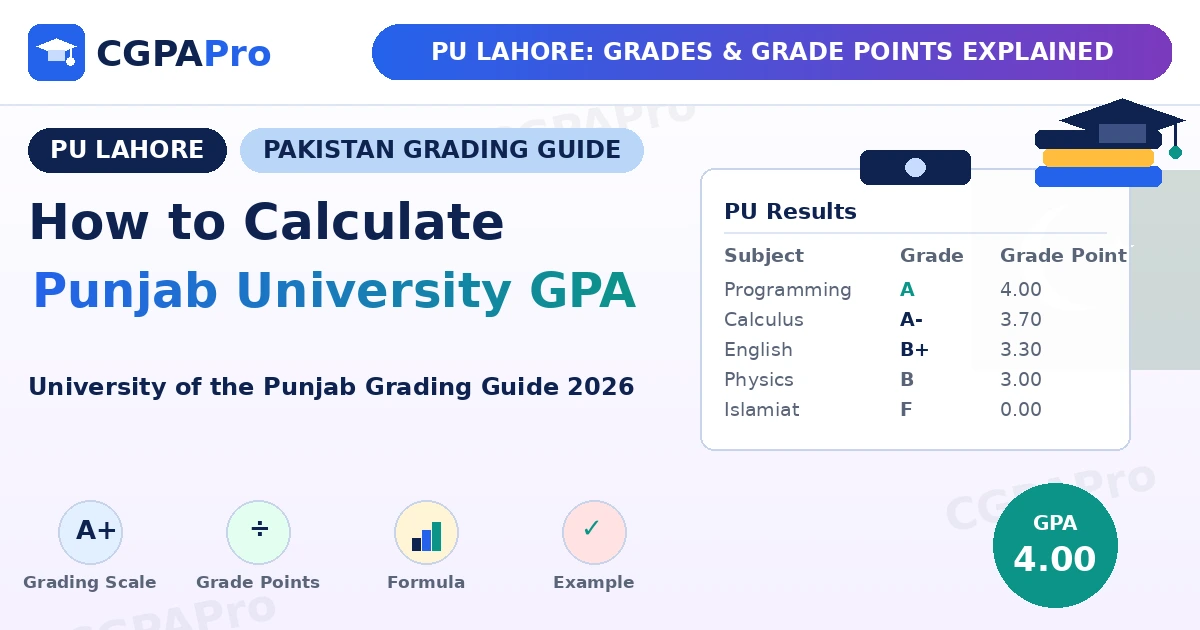
The University of the Punjab — PU Lahore, Pakistan’s oldest public university, founded in 1882 — runs its BS programs on a 4.00 grade-point scale under HEC’s semester system. Your final marks in each course (0–100) are converted into a letter grade (A down to F) with a fixed grade point, and your semester GPA is the credit-hour weighted average of those points. The maximum possible GPA is 4.00, you need at least a D grade (50%) to pass a course, and a 2.00 CGPA to graduate.
One quick warning before you trust the first calculator you find online: a lot of “PU grading” pages mix up the University of the Punjab (Lahore, Pakistan) with Panjab University in Chandigarh, India — a completely different university with a different scale. Some even publish a grade table with “A+ at 90–100, D at 40–49, F below 40” for “PU Lahore.” That table does not exist in PU’s official semester rules. This guide uses the real, official PU scale — verified against the university’s published semester regulations and cross-checked against an actual PU result transcript.
How to Calculate Your PU GPA (Step-by-Step)
The fastest way is to plug your grades into the PU GPA calculator. Here’s how it works — and what to double-check before you trust any number:
- List every course this semester with its credit hours (usually 3 for theory courses, 1–2 for labs).
- Enter the letter grade you received in each — A, A−, B+, B, B−, C+, C, C−, D, or F. The calculator maps each letter to its official PU grade point.
- Multiply each course’s grade point by its credit hours → quality points.
- Add up all quality points, and add up all credit hours.
- Divide total quality points by total credit hours. That’s your semester GPA.
The two most common mistakes students make here: averaging the semester GPAs directly when semesters have different credit totals (always re-weight by credit hours — shown in the worked example below), and rounding marks up a band before converting (“79 is basically an A−” — it isn’t; 79 is a B+).
The Official PU Grade Table (4.00 Scale)
This is the grade table from the University of the Punjab’s published semester rules for BS programs. Percent marks → letter grade → grade point:
| Percent Marks | Letter Grade | Grade Point |
|---|---|---|
| 85 – 100 | A | 4.00 |
| 80 – 84 | A− | 3.70 |
| 75 – 79 | B+ | 3.30 |
| 70 – 74 | B | 3.00 |
| 65 – 69 | B− | 2.70 |
| 61 – 64 | C+ | 2.30 |
| 58 – 60 | C | 2.00 |
| 55 – 57 | C− | 1.70 |
| 50 – 54 | D | 1.00 |
| Below 50 | F | 0.00 |
A few things worth noticing, because they surprise students every year:
- There is no A+ at PU. The top band is plain “A” at 85–100 worth 4.00. If a website shows “A+ 90–100” for PU Lahore, it copied the wrong university.
- 81 marks is an A−, not an A. That two-mark gap costs you 0.30 grade points — the single most expensive band edge on the table.
- D (50–54) is a pass, but barely. It’s worth only 1.00 grade point, so a D drags your GPA down almost like an F does — you just don’t have to repeat the course.
- C− (55–57) exists. Many generic Pakistani grading tables skip it and jump from C to D. PU has it, and it’s worth 1.70.
This table matches real PU transcripts exactly: a student scoring 77 gets B+ (3.3), 71 gets B (3.0), 81 gets A− (3.7), and 68 gets B− (2.7). The numbers line up band for band.
How Your Course Marks Are Built (Assessment Breakdown)
At PU’s main Lahore campus, your final marks in each course come from three components:
- Mid-term exam — 35% (held after 8 study weeks)
- Final exam — 40% (held after 16 study weeks)
- Semester work — 25% (quizzes, assignments, presentations, and other class work during the semester)
Two things students underestimate here. First, you need 75% attendance to be eligible for the final exam — fall below it and you can be barred from sitting, which turns into an F. Second, that 25% semester work is the steadiest grade insurance you’ll get: it’s spread across the whole term, and it’s fully in your control.
PU’s affiliated colleges (the dozens of colleges across Punjab teaching PU’s curriculum) use a different split, published on PU’s own board-of-studies pages: sessional/assignments 15%, mid-term 25%, final term 60%. The grade table is the same everywhere — only the weighting of the components differs.
GPA Formula: The Exact Math
Semester GPA at PU is a weighted average. For each course:
Quality points = Grade point × Credit hours
Semester GPA = Total quality points ÷ Total credit hours
Credit hours are the weight. A 4-credit theory course counts twice as much as a 2-credit lab — the same grade moves your GPA twice as far. That is why a B in a 4-credit subject affects your result more than an A in a 1-credit practical.
Worked Example: A Real PU Semester
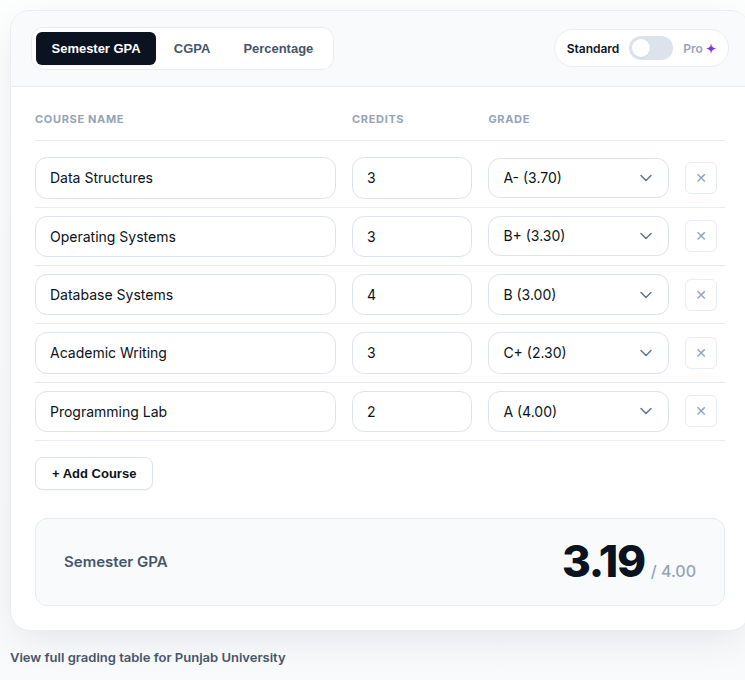
Take a typical 5-course semester and walk through it the way PU’s own system does — this is the same semester shown in the calculator screenshot above:
| Course | Credit Hours | Marks | Grade | Grade Point | Quality Points |
|---|---|---|---|---|---|
| Data Structures | 3 | 82 | A− | 3.70 | 11.10 |
| Operating Systems | 3 | 76 | B+ | 3.30 | 9.90 |
| Database Systems | 4 | 71 | B | 3.00 | 12.00 |
| Academic Writing | 3 | 63 | C+ | 2.30 | 6.90 |
| Programming Lab | 2 | 88 | A | 4.00 | 8.00 |
Total quality points = 11.10 + 9.90 + 12.00 + 6.90 + 8.00 = 47.90
Total credit hours = 3 + 3 + 4 + 3 + 2 = 15
Semester GPA = 47.90 ÷ 15 = 3.19
Notice the Database Systems effect: the B there contributes 12.00 quality points — more than the A in the 2-credit lab (8.00). If the student had earned an A− in the 4-credit course instead of the 2-credit lab, the GPA would have been (47.90 + 2.80) ÷ 15 = 3.38. Your highest-credit courses are where GPA is won and lost.
GPA vs CGPA vs OPM at PU
Three numbers appear on PU transcripts, and students mix them up constantly:
- GPA (Semester GPA) — one semester only, computed as above.
- CGPA (Cumulative GPA) — your entire degree so far. Same formula, but summed across ALL semesters: total quality points from every course ÷ total credit hours from every course. Crucially, this is not the average of your semester GPAs — that only works if every semester had identical credit totals, which they almost never do.
- OPM (Overall Percentage of Marks) — your actual obtained marks, weighted by credit hours, as a percentage. This is the number employers and some foreign universities ask for.
A real PU transcript (BS English, 5th semester) reads: “CH: 18, GPA 3.3, Promoted, CGPA: 3.3, OPM: 74.66, Credit Hours Earned: 18.” The OPM there is computed from real marks — not from GPA × 25 or CGPA × 25. The popular “just multiply your GPA by 25 to get your percentage” shortcut is an estimate, and it breaks down at the edges: a 3.30 GPA maps to ~82.5 by that shortcut, but the real marks behind it might sit anywhere in a band. Wherever an exact percentage is required (jobs, admissions), use your actual marks or the transcript OPM.
Read more: How to Convert CGPA to Percentage in 2026: Formulas & Examples — the official HEC and UGC conversion rules, and why the quick shortcuts lie.
Common Mistakes PU Students Make
1. Trusting a calculator built for the wrong “PU”
Panjab University (Chandigarh, India) and the University of the Punjab (Lahore, Pakistan) share an abbreviation and nothing else — different scale, different country. If a page mentions “UIET,” a 10-point scale, or “CGPA × 9.5,” it’s the Indian one. PU Lahore is the 4.00 scale in the table above.
2. Averaging semester GPAs
Semester 1: 3.00 over 18 credits. Semester 2: 3.50 over 12 credits. The naive average says 3.25. The real CGPA is (54.00 + 42.00) ÷ 30 = 3.20. Small difference — until you’re sitting on a scholarship cutoff line.
3. Treating 50% as “safe”
50% is a D: technically a pass, worth 1.00. One D in a 3-credit course needs roughly an A− in another 3-credit course just to drag the pair back to 2.35. “Passed but hurt” is the honest description.
4. Ignoring the 75% attendance line
You can have a 90 average and still be barred from the final exam if your attendance falls below 75%. The final is 40% of your course marks — a zero there is unrecoverable.
5. Confusing the A band edge
84 marks = A− (3.70). 85 = A (4.00). One mark is worth 0.30 grade points there — roughly 0.02 of your semester GPA per credit-hour-weighted band. In your final year, borderline courses are worth a polite, evidence-backed re-check request to your department.
Passing, Probation, Repeat & Improvement Rules
PU’s semester rules draw several hard lines. Know them before you need them:
- Minimum to pass a course: D grade (50%). Below 50 is F.
- Minimum to graduate: CGPA of 2.00 at the end of the degree program.
- Normal promotion: CGPA ≥ 2.00 moves you to the next semester cleanly.
- Promotion on probation (first semester): if your CGPA lands between 1.50 and 2.00, you can be promoted on probation.
- Promotion on probation (later semesters): if your CGPA lands between 1.70 and 2.00, you can be promoted on probation.
- Probation is allowed only twice during the whole study period. A third stint below the line means you’re dropped from the rolls.
Repeating and improving courses: you can repeat or improve courses graded D (up to a maximum of two courses per semester) or graded F, by enrolling in the same semester of the next academic year. You need the principal’s permission within seven days of the commencement of the next semester, and there’s a prescribed fee per course. Because a D repeat replaces 1.00 grade points with whatever you earn, repeating a D is one of the cheapest CGPA repairs available — a D-to-B+ jump on a 3-credit course adds 6.90 net quality points.
Read more: How Retaking a Course Affects Your CGPA (2026 Guide) and Dean’s List CGPA Requirements & Probation Rules 2026.
Tips for PU Students
- Attack the band edges. The 84→85, 79→80, and 74→75 edges each buy 0.30–0.40 grade points. In the last two weeks before finals, prioritize the course where you’re 1–2 marks from the next band, not the one where you’re mid-band.
- Load your effort by credit hours. A 4-credit course deserves roughly double the revision time of a 2-credit one — the GPA math says so directly.
- Bank the 25% semester work. Quizzes and assignments are spread across the term and almost fully controllable. Students who sleep on sessional work spend finals trying to dig out of a hole.
- Guard the 75% attendance. No final exam = F. It’s the most expensive way to lose a course.
- Use the D-repeat window deliberately. If you’re sitting on a D in a 3- or 4-credit course, repeating it is usually better ROI than squeezing a B+ out of a new elective.
- Track after every mid-term. With 35% of your marks decided by week 8, a mid-term GPA check tells you exactly which bands are still in reach.
Frequently Asked Questions
What is the maximum GPA at the University of the Punjab?
4.00. The top grade is A (85–100), worth 4.00 grade points, and no course can contribute more than that. Your semester GPA can never exceed 4.00.
What are the passing marks at PU?
50%. That earns a D grade (1.00 grade point) — a pass, but a weak one for your GPA. Below 50 is F (0.00).
What is the minimum CGPA required to graduate from PU?
2.00 CGPA at the end of the degree program, per the university’s semester rules. Individual courses need at least a D.
How do I convert my PU GPA to a percentage?
The official number is your OPM (overall percentage of marks), computed from your actual obtained marks — it appears on your transcript. A rough estimate is GPA ÷ 4 × 100, but it’s an estimate: a 3.19 GPA suggests roughly 79.75%, while your real marks could sit anywhere nearby. Use actual marks wherever precision matters.
Do PUCIT students use the same grading table?
PU’s computing programs (including PUCIT) follow the same official university 4.00 grade table unless a specific department handbook says otherwise. If your course outline lists a different scale, the outline wins — always check it.
What happens if my CGPA falls below 2.00?
You can be promoted on probation: CGPA between 1.50 and 2.00 in your first semester, or between 1.70 and 2.00 in later semesters. Probation is allowed at most twice during your degree; fall below the line a third time and you’re dropped from the rolls.
Can I improve a D or repeat a failed course at PU?
Yes. You may repeat or improve courses graded D (up to two courses per semester) or graded F by re-enrolling in the same semester of the next academic year. Get the principal’s permission within seven days of the new semester starting and pay the prescribed per-course fee.
Conclusion
The University of the Punjab’s grading system is straightforward once you strip away the wrong-university tables floating around the internet: the official 85–100 = A (4.00) table, a 35/40/25 assessment split (or 15/25/60 at affiliated colleges), a 75% attendance gate for finals, a 2.00 CGPA graduation floor, and probation lines at 1.50 and 1.70. The math that matters most is simple: grade points times credit hours, divided by total credit hours — with your highest-credit courses doing the heaviest lifting. Run your real grades through the PU GPA calculator after every mid-term, keep one eye on the band edges, and never let attendance decide your semester for you.
Sources: University of the Punjab semester rules for BS programs (grade table, assessment weightage, promotion, probation, and repeat rules); PU board-of-studies pages for affiliated-college assessment criteria; PU result intimation transcript (BS English, 2019–2023 session) for table cross-validation; pu.edu.pk (official university site); HEC semester-system policy guidance. Grade scales and rules change — confirm against your current department handbook.