SRM’s grading system is a 10-point letter-grade scale — O, A+, A, B+, B, C for passes and F for fails — with grade points from 10 down to 5. SRM calls the semester number SGPA and the running total CGPA, both weighted averages of grade points by credits, rounded to two decimals. What confuses most students: an O starts at 91% (not 90 or 95 as many third-party tables claim), your raw marks are normalized before bands are applied, and passing a course requires 50% overall AND 50% in the end-semester exam — miss either one and you fail. This guide breaks down SRM’s official B.Tech/M.Tech Regulations (2021), with worked examples for SGPA, CGPA, pass rules, and the degree-classification system.
How to Calculate Your SRM SGPA With the Calculator
The fastest way to check where you stand is to run your actual grades through a calculator built on SRM’s real scale:
- List every course you registered this semester — name and credit value (check your course registration printout for exact credits).
- Enter the letter grade SRM awarded you for each course (O through F). Use the grade on your official result, not your raw marks — because of normalization, raw marks don’t map 1:1 to letters.
- Include any F-graded courses too — they carry 0 points but their credits stay in the denominator and drag your SGPA until cleared.
- Read your semester GPA, then switch to the CGPA mode and add past semesters to see your cumulative number.
Here’s what that looks like for a typical first-year semester — Engineering Mathematics (4 cr, A+), Engineering Physics (3 cr, O), Programming in C Lab (2 cr, A), Professional English (2 cr, B+), Environmental Science (1 cr, B):
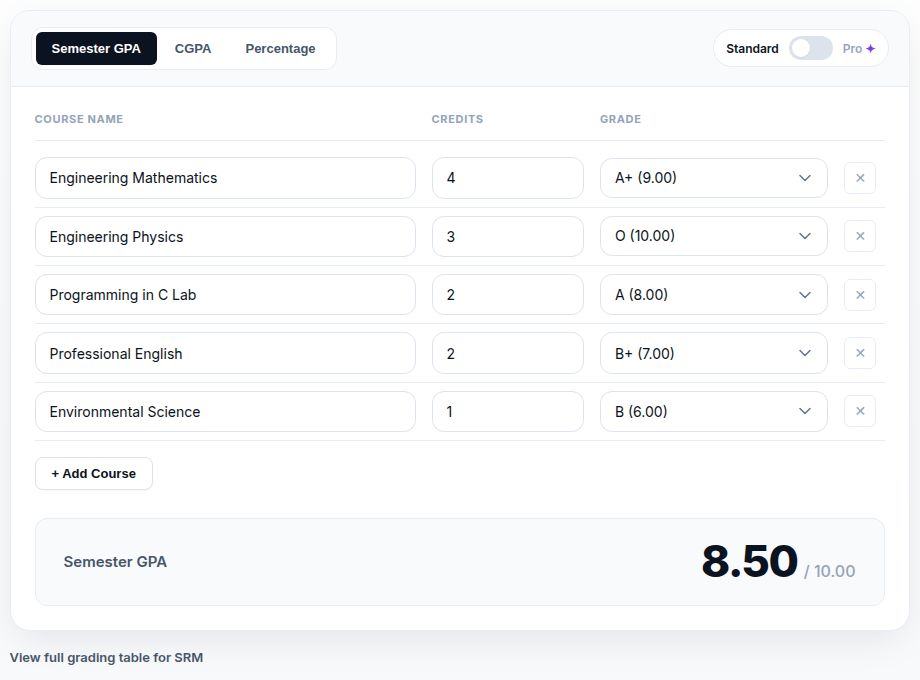
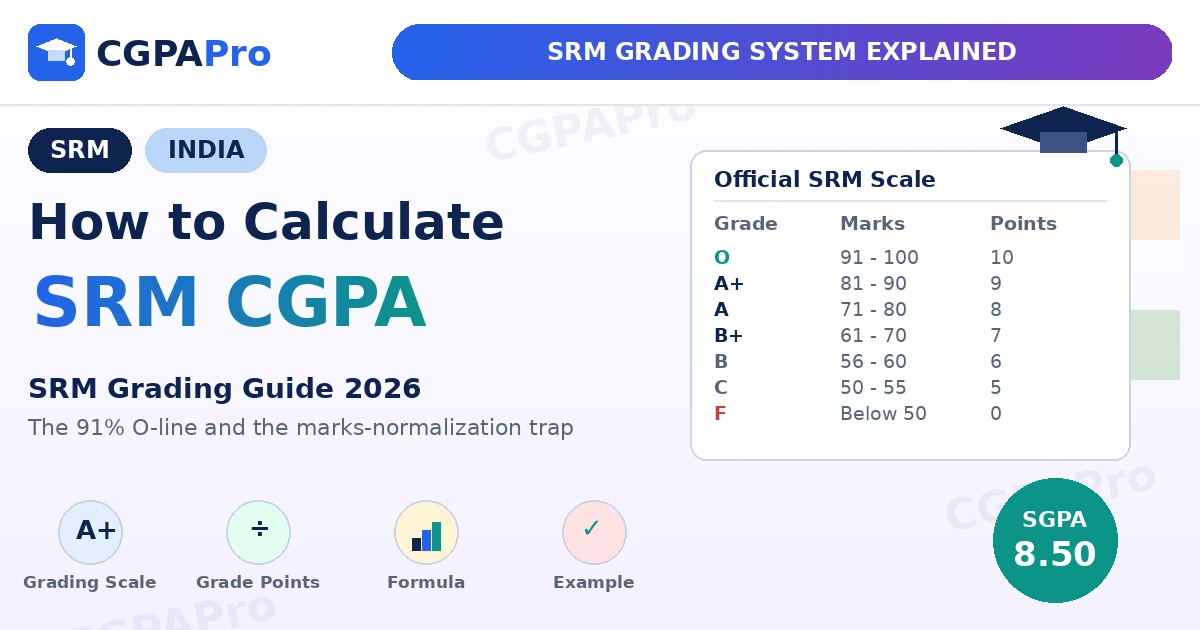
Figure: semester GPA 8.50 on SRM’s official 10-point scale, computed as (4×9 + 3×10 + 2×8 + 2×7 + 1×6) ÷ 12 = 102 ÷ 12. Try your own grades on the SRM CGPA calculator.
The Official SRM Grading Scale (Grade Points)
SRM’s official regulations use these letter grades. O, A+, A, B+, B and C are the performance grades — they all mean you passed the course:
| Letter Grade | Meaning | Grade Points | Normalized Marks Range |
|---|---|---|---|
| O | Outstanding | 10 | 91–100 |
| A+ | Excellent | 9 | 81–90 |
| A | Very Good | 8 | 71–80 |
| B+ | Good | 7 | 61–70 |
| B | Above Average | 6 | 56–60 |
| C | Average | 5 | 50–55 |
| F | Fail | 0 | Below 50 |
| Ab | Absent (missed the exam) | 0 | — |
| I | Incomplete (insufficient attendance) | 0 | — |
Two details most guides get wrong. First, there is no P grade in the current regulations — some older batches used P (Pass, 4 points), and many student-built calculators still show it. If your regulation year is 2021 or later, your scale has seven performance grades and stops at C. Second, the B and C bands are narrower than the internet thinks: B is 56–60 (not 51–60), C is 50–55 (not 45–50), and F is everything below 50 (not below 45). Several popular CGPA comparison pages print the corrupted bands — if a tool tells you 52 marks is a B, its table is wrong and its GPA math will be off.
One more thing worth knowing: mandatory non-credit courses (like value-added or audit-type courses) are marked only Satisfactory or Unsatisfactory instead of a letter grade, and they are excluded from SGPA and CGPA entirely.
The Normalization Trap — Why Your Raw Marks Don’t Map to Grades Directly
Here is the detail almost no student guide mentions, straight from the regulations: your internal (continuous-learning) marks are first normalized, combined with the normalized marks of your end-semester examination, and letter grades are awarded on the normalized totals — not on the raw marks you saw on your answer scripts.
What does that mean in practice? It means an 85 on your internal assessment does not automatically behave like “85 out of 100” when the Controller of Examinations assigns grades. Normalization rescales scores — typically to correct for a harder-than-usual test or a stricter evaluator — before the 91/81/71/61/56/50 cutoffs are applied. Two students with the same raw total in different sections or years can legitimately receive different letter grades, and your raw-mark mental math (“I got 83, so that’s an A+”) can be wrong in either direction.
The practical takeaway: never calculate your expected SGPA from raw marks. Wait for the official letter grades on your result, then map those letters to grade points. The calculator above works exactly this way — it takes letters, not marks.
SRM SGPA Formula
SRM’s formula is straightforward once you have the letters:
SGPA = Σ (credits × grade points) ÷ Σ (credits), summed over every course you registered in the semester — including courses where you scored F. The failed course’s 0 points and its credits both stay in the calculation, which is why a single F hurts far more than a C.
Worked SGPA example
| Course | Credits | Grade | Points | Credits × Points |
|---|---|---|---|---|
| Engineering Mathematics | 4 | A+ | 9 | 36 |
| Engineering Physics | 3 | O | 10 | 30 |
| Programming in C Lab | 2 | A | 8 | 16 |
| Professional English | 2 | B+ | 7 | 14 |
| Environmental Science | 1 | B | 6 | 6 |
| Total | 12 | 102 |
SGPA = 102 ÷ 12 = 8.50 (reported to two decimals).
Notice the weighting: the 4-credit Mathematics course contributes 36 of the 102 quality points — nearly as much as the three smallest courses combined. At SRM, high-credit theory courses are where your SGPA is won or lost.
SRM CGPA Formula
CGPA = Σ (semester credits × SGPA) ÷ Σ (semester credits), over every semester completed since your first. CGPA is a credit-weighted average of your SGPAs — it is not the simple average of your semester numbers.
Worked CGPA example
Take the semester above (SGPA 8.50, 12 credits) plus a first semester of 21 credits at SGPA 7.90 (165.9 quality points):
CGPA = (165.9 + 102) ÷ (21 + 12) = 267.9 ÷ 33 = 8.118 → 8.12
Check the trap: (7.90 + 8.50) ÷ 2 = 8.20, which is wrong — the heavier 21-credit semester pulls the true CGPA down toward 7.90. Early semesters at SRM carry serious credit loads, so a weak first year anchors your CGPA for a long time. Read the full SGPA vs CGPA vs GPA breakdown if the terminology is new to you.
Read more: how to improve your CGPA — the credit-weighted math of recovering from a bad semester.
The Double-50 Pass Rule — the Part Everyone Misses
SRM does not let you pass on a high internal score alone. To pass any course, both of these must hold:
- At least 50% of the total marks prescribed for the course (internal + end-semester combined).
- At least 50% of the marks in the end-semester examination alone.
Miss either condition and you fail the course — even if your total is 55 because your internals were excellent but your end-sem paper scored 48%. Students who “passed on aggregate” in school find this one the hard way. Your internal marks can support your grade, but they can never rescue a failed end-sem paper.
F, Ab and I Grades: What Actually Happens Next
F grade (fail). You carry 0 grade points for the course and its credits drag your SGPA. To clear it, you must register and reappear for the examination in the next semester when the course is offered — and keep reappearing until you pass. The one mercy in the regulations: your internal assessment marks from the first attempt are retained and stay valid for subsequent attempts, so you only re-sit the exam component.
Ab grade (absent). You didn’t appear for the end-semester exam. Same treatment as F: 0 points, mandatory reappear, internal marks carried forward.
I grade (incomplete). You were prevented from writing the end-semester exam because of insufficient attendance — this connects directly to the 75% rule below. It counts as a failure in the course for grading purposes.
And here is the hard lock-in rule: a course you successfully completed can never be repeated. There is no improvement exam, no re-sitting a C to turn it into a B, no grade-replacement scheme. Whatever letter you earned stays on your transcript forever. (Contrast this with some other universities’ repeat policies — see how retaking a course affects your CGPA elsewhere.) Plan your effort accordingly: at SRM, the first attempt is the only attempt.
CGPA to Percentage: the Only Official Formula
SRM’s regulations state exactly one official conversion: equivalent percentage = CGPA × 10. An 8.50 CGPA is officially equivalent to 85.0%. That is notably different from universities like VIT, which also use ×10 officially but where students constantly debate ×9.5 — at SRM there is no such debate in the regulations: ×10 is the rule.
When a job form, scholarship portal, or higher-studies application asks for aggregate percentage, use CGPA × 10 — and if the stakes are high, ask the Controller of Examinations for an official equivalence certificate rather than converting by hand. See how VIT’s relative grading differs from SRM’s absolute bands if you’re comparing the two universities.
Degree Classification: What Your Final CGPA Earns You
Your degree certificate doesn’t just show a CGPA — SRM awards a class/distinction based on it. For the B.Tech programme completed within the normal duration:
| CGPA (all semesters) | Class / Distinction |
|---|---|
| ≥ 8.5, with no F, Ab, I or temporary withdrawal in any semester | First Class with Distinction |
| ≥ 8.5, with an F/Ab/I cleared subsequently | First Class |
| 6.0 – 8.5 | First Class |
| 5.5 – 6.0 | Second Class |
| 5.0 – 5.5 | Pass |
Read the first two rows carefully — this is the detail that ends placement-season arguments. A single backlog in your entire degree, even one you cleared the very next semester, permanently costs you the “with Distinction” tag. The 8.6-CGPA student with a first-semester F gets “First Class”; the 8.5-CGPA student with a clean sheet gets “First Class with Distinction.” If distinction matters to you, semester one is not a warm-up.
The 75% Attendance Rule
SRM requires 75% attendance in every course to be permitted to appear in the end-semester examination. Fall below it and you don’t just lose marks — you are barred from the exam, which converts to an I (Incomplete) grade: 0 points, a failure on your record, and a mandatory reappear.
There is a condonation mechanism: in genuine cases, a committee can condone a shortfall, but the condonation cannot exceed 10% — so 65% is the absolute floor, and even that is discretionary, not a right. Treat 75% as a hard wall, not a guideline.
Revaluation: Your 10-Day Window
If you believe your end-semester theory paper was evaluated unfairly, you can apply for revaluation of the answer script within 10 days of the result declaration, on payment of the prescribed fee, through a proper application to the Controller of Examinations forwarded by your Head of Department. The window is short and strictly enforced — mark the result date and decide fast, because day 11 is too late.
5 Mistakes SRM Students Make With CGPA
- Using a generic 10-point table. O/A+/A/B+/B/C/F with these exact bands is SRM-specific. A generic “A = 4.0” or Anna University table gives completely different numbers — always calculate with SRM’s published table.
- Trusting corrupted third-party bands. As shown above, several popular tools print B as 51–60 and C as 45–50. Verify any calculator against the official 56–60 / 50–55 bands before trusting its output.
- Averaging semester GPAs for CGPA. CGPA is credit-weighted (the 8.12 vs 8.20 trap above). The simple average is always wrong when semesters have different credit loads.
- Forgetting the end-sem 50% condition. Strong internals + a 47 in the end-sem paper = fail. The double-50 rule has no exceptions.
- Assuming a cleared backlog erases everything. Clearing an F fixes your CGPA math going forward, but the Distinction classification is gone forever — and some recruiters still ask about backlogs on the form.
6 Tips to Keep Your SRM CGPA High
- Front-load effort into high-credit courses. A 4-credit A+ is worth more than two 2-credit As. Check credit values at registration and allocate study hours proportionally.
- Protect the end-sem paper. Since 50% in the end-semester exam is a standalone pass condition, never walk into it underprepared — it is the single highest-leverage exam of the semester.
- Guard the 75% attendance line. An I grade from attendance shortage is the most avoidable 0 on your transcript.
- Chase the clean sheet, not just 8.5. If “First Class with Distinction” is your goal, zero backlogs matters as much as the number itself.
- Use the normalization reality. Because grades come from normalized marks, your rank within the section matters more than your raw total — past papers and the class average are better predictors than your own mark tally.
- Model scenarios before registration. Use the CGPA mode of the calculator to test “what if I get B+ in everything next semester” — you’ll see exactly how much each future grade moves the needle.
FAQs
Is 8.5 CGPA good at SRM?
Yes — 8.5 is the threshold for First Class with Distinction (with a clean record), which is the highest classification SRM awards. For placements, student reports from SRM’s drives consistently describe the day-1 company filter as roughly no active backlogs with 6+ CGPA (plus 60%+ in 10th and 12th) — an 8.5 clears every such filter comfortably.
What does the O grade mean at SRM?
O stands for Outstanding: 10 grade points, awarded for normalized marks of 91–100. It’s the highest grade on the scale — there is no A++ or anything above it.
Can I improve my grade by reappearing in a subject I passed?
No. The regulations state explicitly that a successfully completed course cannot be repeated. There is no improvement exam at SRM — your first attempt’s grade is final.
What happens to my SGPA if I get an F?
The F contributes 0 grade points but its credits stay in the SGPA denominator, so it drags the semester average down hard. Example: the 8.50 semester above would drop to (102 + 0) ÷ (12 + 3) = 6.80 if a 3-credit course had been failed instead of passed — one F costs nearly two full SGPA points. You must reappear for the course in a later semester; your internal marks from the first attempt are carried forward.
How do I convert my SRM CGPA to percentage?
Multiply by 10: percentage = CGPA × 10 — this is SRM’s official formula from the regulations. An 8.12 CGPA = 81.2%.
Is attendance counted in the CGPA calculation?
Not directly — GPA math uses only letter grades and credits. But attendance below 75% bars you from the end-semester exam, producing an I grade (0 points, a failure). So attendance affects your CGPA through the harshest possible channel.
Is the grading scale the same for all SRM branches and campuses?
The letter-grade system and formulas are uniform across programs under the same regulation year. However, the exact regulation document (2021 vs earlier) can differ by batch and program — check your program handbook for your regulation year’s bands before disputing a grade.
Read more: IIT grading system: CPI, SGPA and relative grading — how India’s other big technical universities grade differently.
Conclusion
SRM’s system rewards two things above all: consistency and clean sheets. The 10-point scale with its 91% O-line is generous at the top, but the double-50 pass rule, the normalization step, and the no-repeat lock-in punish carelessness quietly. Know the official bands (O 91–100 down to C 50–55), respect the end-semester 50% condition, keep attendance above 75%, and remember that a single backlog — however quickly cleared — permanently closes the door on “First Class with Distinction.” Run your actual letter grades through the SRM CGPA calculator each semester, and you’ll never be surprised by your own transcript.