UET Lahore Grading System 2026: GPA & CGPA Guide
If you search “what percentage do I need for an A at UET Lahore,” you will find confident-looking tables: A = 80% and above, B+ = 70–79%, and so on. They look official. They are not. UET Lahore’s Undergraduate Semester Regulations prescribe relative grading for theory subjects and set no university-wide percentage band for any letter grade at all. The marks you need for an A in one class can be completely different from the next class over — because your grade depends on how your own class performed.
This guide gives you the real system: the official 12-grade point table straight from the regulations, how relative grading actually works, the credit-weighted GPA/CGPA formula with a fully worked 5-course example, the warning-to-probation-to-separation ladder, the repeat rule most students learn the hard way, and the honours and medal gates nobody explains until convocation. Everything below traces to UET Lahore’s Undergraduate Semester Regulations 2015 — the governing regulation for all undergraduate degrees.
Try it: calculate your UET-style semester GPA
The fastest way to understand any grading system is to run your own numbers. Use the free CGPAPro calculator — enter your courses, credit hours, and letter grades, and it computes the semester GPA instantly. The screenshot below shows a 5-course engineering semester (the same one worked out by hand later in this article).
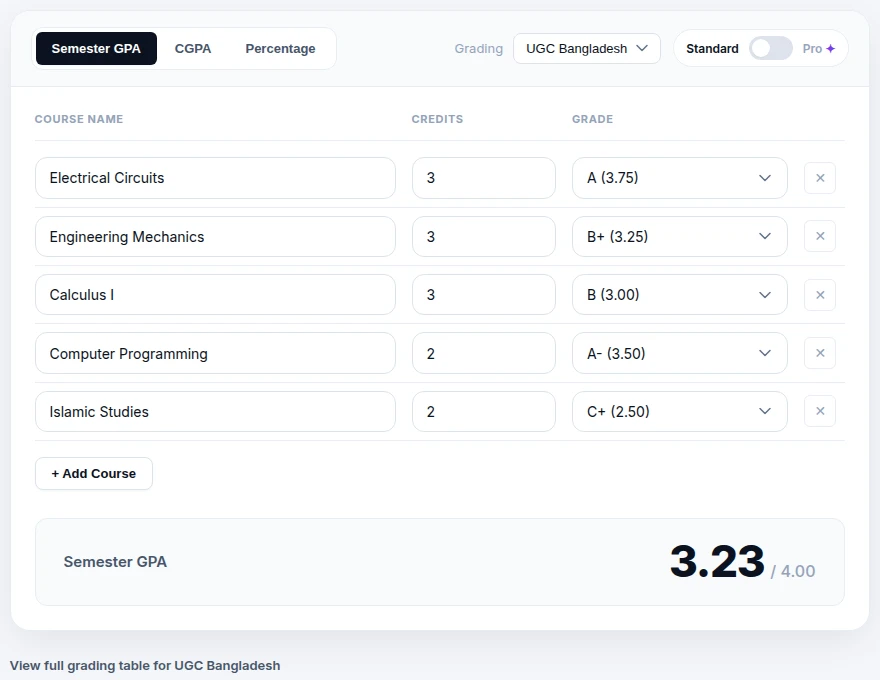
About this screenshot: it was taken on the CGPAPro homepage calculator, which uses a generic 4.0 scale — so the same five letter grades read 3.23 here, while UET Lahore’s official grade points (A− = 3.70, B+ = 3.30, C+ = 2.30 instead of the generic 3.50/3.25/2.50) would give 3.30. Same letters, different numbers — which is exactly why the scale table below matters more than any calculator.
The official UET Lahore grade table (from the regulations)
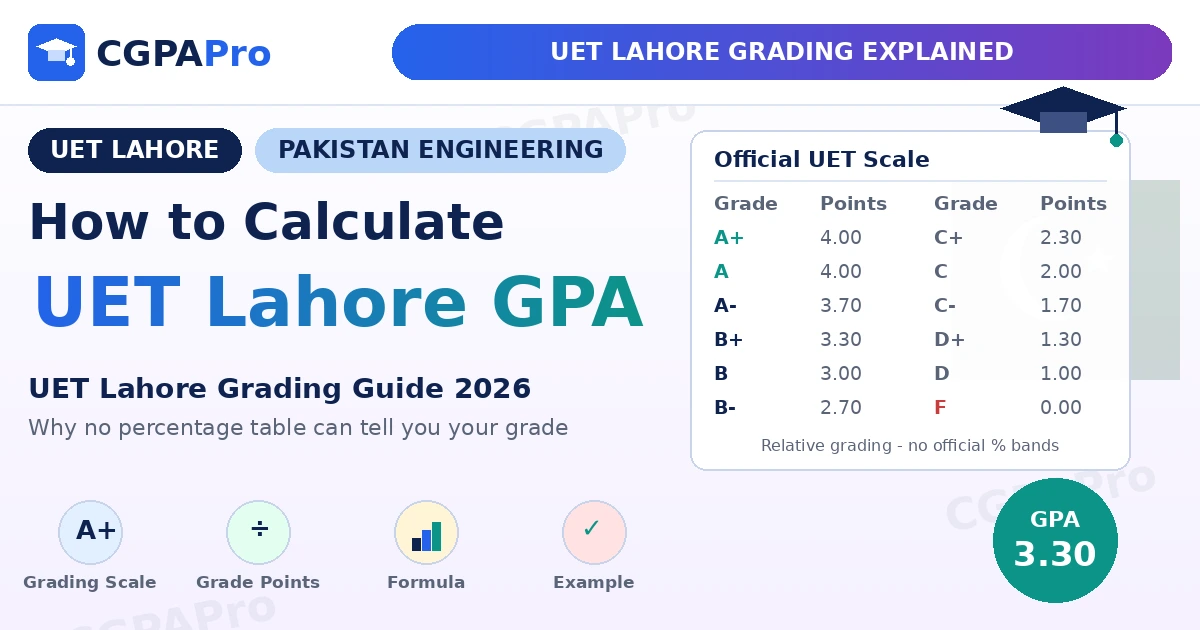
This is the complete table from the Undergraduate Semester Regulations — all twelve letter grades with their official grade points. Two things the simplified tables on calculator sites usually get wrong: A+ and A both carry 4.00 (an A+ is recognition, not a bonus), and the in-between grades (A−, B−, C−, D+) exist with their own points.
| Grade | Grade points | What it means in practice |
|---|---|---|
| A+ | 4.00 | Crossed the subject’s expected maximum threshold; exceptional performance (same points as A) |
| A | 4.00 | Top of the class on the relative scale |
| A− | 3.70 | Excellent — just below the top cluster |
| B+ | 3.30 | Very good |
| B | 3.00 | Good, solid performance |
| B− | 2.70 | Above average |
| C+ | 2.30 | Average to satisfactory |
| C | 2.00 | The minimum “safe” grade — the good-standing benchmark |
| C− | 1.70 | Weak pass; drags the average down |
| D+ | 1.30 | Very weak pass |
| D | 1.00 | Lowest passing grade |
| F | 0.00 | Fail — must be repeated |
Four special grades also appear on UET transcripts but carry no grade points and are excluded from GPA computation:
- W — Withdrawn from the subject.
- WF — Withdrawn-failing, typically the forced grade when attendance falls below 75%.
- I — Incomplete; temporary, awarded when illness or another acceptable cause prevents you from finishing required work. You must complete the outstanding work within the following semester, or the Controller of Examinations converts it to an F. Students with under 50% attendance are not even eligible for an I.
- IP — In Progress; used for Type-C subjects (theses, projects, studio work) spread over more than one semester. The grade awarded in the semester the subject is completed is the one that counts.
How relative grading actually works at UET (and why no percentage table is official)
This is the part that surprises students most. For Type-A subjects — your theory courses, the bulk of an engineering degree — letter grades must be awarded on a relative scale. Type-B subjects (practicals, labs, studio work) and Type-C subjects (projects) may use an absolute scale if the teacher decides it fits. The subject teacher awards the grades, with the department chairperson consulted before finalisation.
The regulations lay out the procedure a teacher may follow:
- A minimum marks threshold for a passing grade is set. Score below it and you get an F, regardless of anything else.
- An expected maximum marks threshold is also set. Anyone crossing it gets an A+.
- Everyone between the two thresholds is ranked by merit, and the class average and standard deviation are computed.
- The cluster within half a standard deviation of the average may be graded C+ or B−. Passing grades run from A down to D.
- The rest are assigned by clustering (classes under 100) or on a normal curve (larger classes), with an optional cap on how many students can earn a given grade.
Three consequences catch students out:
1. A class might award no A at all. The regulations explicitly allow that no student is, in the instructor’s opinion, eligible for an A — or that some intermediate grade goes unawarded in a particular class. Grades are not a fixed pie you can count on.
2. Your section-mate’s grade is not your grade. Two sections of the same subject can set different thresholds, so comparing marks across sections is meaningless.
3. Grade thresholds cannot be appealed. The grievance procedure excludes both assessment marks and grade thresholds from review.
The fixed-band myth, debunked: you will see tables claiming “A = 80%+, B+ = 70–79%” for UET Lahore. The regulations contain no such bands. Those tables are unofficial — sometimes borrowed from other universities, sometimes invented for calculator pages — and following them can genuinely mislead you about where you stand. The only official mapping is letter grade → grade points (the table above); the marks → letter grade step happens inside your classroom.
How UET calculates GPA and CGPA: the formula
Both the semester GPA and the cumulative CGPA are credit-hour weighted: each subject’s grade points are multiplied by its credit hours, and the total is divided by the credit hours counted. A 4-credit subject moves your average four times as much as a 1-credit one. The Controller of Examinations computes and notifies both at the end of each semester.
Semester GPA = Σ (grade points × credit hours) ÷ total semester credit hours
CGPA = Σ (grade points × credit hours for all subjects across all completed semesters) ÷ total credit hours
W, WF and IP subjects are excluded from the computation; an I is temporary and not treated as an F while it stands. And a failed elective can be taken out of the CGPA if you studied an alternate elective in its place — but that is not automatic; you must apply to the Controller of Examinations.
Worked example: a real 5-course semester, by hand
Let us run a realistic engineering semester through the official UET grade points. Same five courses as the calculator screenshot above — so you can compare the hand calculation with the tool.
| # | Course | Credits | Grade | Grade points | Quality points |
|---|---|---|---|---|---|
| 1 | Electrical Circuits | 3 | A | 4.00 | 3 × 4.00 = 12.00 |
| 2 | Engineering Mechanics | 3 | B+ | 3.30 | 3 × 3.30 = 9.90 |
| 3 | Calculus I | 3 | B | 3.00 | 3 × 3.00 = 9.00 |
| 4 | Computer Programming | 2 | A− | 3.70 | 2 × 3.70 = 7.40 |
| 5 | Islamic Studies | 2 | C+ | 2.30 | 2 × 2.30 = 4.60 |
| Total | 13 | 42.90 |
Semester GPA = 42.90 ÷ 13 = 3.30. Now compare with the screenshot at the top: the same letters on the generic calculator scale gave 3.23, because the generic scale values A− (3.50), B+ (3.25) and C+ (2.50) differ from UET’s official 3.70 / 3.30 / 2.30. That 0.07 gap is the whole lesson — always check which scale a calculator is using before trusting its number.
The CGPA roll-up works the same way. Say your previous CGPA was 3.10 over 30 completed credits, and this semester you earned 3.30 over 13 credits: new CGPA = (3.10 × 30 + 3.30 × 13) ÷ 43 = (93.00 + 42.90) ÷ 43 = 3.16. Notice how the 30 older credits anchor the average — early semesters weigh heavily, which is why protecting your first-year CGPA pays off for years.
GPA vs CGPA at UET — the distinction that decides your standing
UET uses both numbers for different decisions, and confusing them is how students misread their own danger. Semester GPA covers one term — it’s behind the Dean’s Honour Roll (3.70+, no W/WF/F, at least 15 credit hours; summer doesn’t count). CGPA covers everything — it’s behind Warning vs Probation, the 2.00 graduation floor, honours, and medals. A strong semester GPA while your CGPA is under 2.00 means you’re climbing out of probation — good, but not safe yet. Always read the two numbers together.
The survival ladder: Warning → Probation → Separation
UET’s academic-standing rules escalate in two steps, both pinned to 2.00. Learn this ladder once and you will never misread a result notification again:
- Warning — your semester GPA falls below 2.00 in any semester, while your CGPA stays above 2.00. A bad term, but your overall record is still healthy.
- Probation — your CGPA falls below 2.00 after any semester. This is the serious one: your cumulative record is now under the line.
- Separation from the University — you remain on probation for two consecutive regular semesters. The regulations give you one break: the advantage of repetition in a summer semester, falling in between or after the two probation semesters, counts in your favour.
Separation is not quite the end: you may apply to the Vice Chancellor for re-admission. If accepted, the department transfers your eligible subjects and assigns a new entry session and registration number. But a student separated a second time gets no second re-admission.
If your CGPA dips under 2.00, treat the next regular semester as a rescue mission. Repeat your weakest subjects in summer if you can — summer repetition counts in your favour — and get your CGPA back above 2.00 before the two-semester clock runs out.
The repeat gamble: the new grade replaces the old one — even if it is lower
This is the rule UET students most often get wrong, because other universities do it differently. Under the regulations, you may repeat subjects to improve your grades within your maximum credit-hour registration limit — and for combined theory+lab subjects, you can even repeat the theory part or the lab part separately. But here is the catch:
The new grade earned on repetition replaces the previous grade, whether it is higher or lower. There is no “better of the two” safety net. If you repeat a C+ and earn a C, the C stands.
That makes repeating a genuine gamble. Before you enrol for a repeat, ask yourself honestly: will I actually perform better this time — different teacher, better preparation, more time? Repeating a subject you scored C+ in, taught by the same teacher, while carrying a full new-semester load, is how students turn a recoverable grade into a worse one. The smart repeats are the ones where something concrete changes: an F you must clear anyway, a subject whose teacher or format suits you better the second time, or a summer repeat where the subject gets your full attention.
Two more repeat facts worth knowing: an F must be repeated (or, for an elective, replaced by an alternate elective studied in its place), and any repeated subject is taken within your credit-hour registration limit — it is not free extra capacity.
W, WF, I and IP — decoded, plus the 75% attendance trap
Students treat W and WF as harmless because they don’t touch the GPA. They are harmless to the number — and dangerous to everything else:
- W (Withdrawn): on the transcript, excluded from GPA. But no compulsory subject may carry a W, WF, I or F when you claim your degree — you must clear it first. And any W or WF disqualifies you from a Degree with Honours.
- WF (Withdrawn-Failing): the grade for falling below 75% attendance in a subject (up to 10% relaxation possible via the Dean). It doesn’t lower your GPA, but the subject stays outstanding — and honours is gone.
- I (Incomplete): temporary, not an F — while it stands. Miss the following-semester deadline and the Controller of Examinations converts it to an F.
- IP (In Progress): for multi-semester projects and theses; the final grade lands in the semester you complete the work.
The attendance rule deserves its own warning: 75% is not a suggestion. Drop below it and the subject is effectively lost for the semester — WF on the transcript, subject outstanding, honours gone. Track attendance from week one, especially in labs, where a few absences eat the percentage fast.
What it takes to actually graduate
The degree-award bar is higher than “just pass everything.” You need all of the following:
- Minimum CGPA of 2.00.
- No compulsory subject left with a W, WF, I or F outstanding in any semester.
- Electives with a W, WF or F repeated, or replaced by an alternate elective, so the credit-hour requirement is met.
- The prescribed credit hours: 130–136 for 4-year programmes, 162–170 for 5-year programmes — including at least 6 credit hours of final-year design project spread over two semesters.
- Form 2 — the Degree Requirements Completion Form — submitted to your chairperson for onward transmission to the Controller of Examinations. Degree status is decided only after that form is received.
And the clock: six academic years maximum for a 4-year programme, seven for a 5-year programme. The Vice Chancellor may grant up to one further year; beyond that, you are separated. Repeats, withdrawals and slow semesters all consume this budget — plan your degree like it has an expiry date, because it does.
Honours, medals and the Dean’s Honour Roll — the gates nobody explains early
UET recognises strong performance at two levels, and both have disqualifiers students usually discover too late:
Degree with Honours requires all four: CGPA ≥ 3.70; no subject repeated; no W or WF; no F in any subject during the whole degree. Medals and merit positions go only to honours earners, compared within the same entry session among those graduating in minimum duration. Migrated and re-admitted students are not eligible for medals at all.
A single W in your second semester — the “safe” way to drop a failing subject — permanently closes the honours door. If you’re chasing a medal, every repeat, withdrawal and F is a disqualifier, not just a GPA dent.
Dean’s Honour Roll (the per-semester honour): semester GPA of 3.70 or above, with no W, WF or F, while registered in at least 15 credit hours that semester. There is no roll for summer results. So a brilliant 3.9 in a light 12-credit semester doesn’t make the roll — load matters.
Transferred credits don’t help your CGPA
If you migrate into UET from another HEC-recognised, PEC/PCATP-accredited university, your accepted credits (up to 50% of the programme, and only with at least 40% marks or a C grade under a similar letter system) count toward your degree — but not toward your CGPA. The transcript simply says “Transferred” against those subjects, and your UET CGPA is built only from subjects studied at UET. Migrating students are also excluded from honours and medals. So if you arrive with a strong record elsewhere, your UET CGPA still starts from zero — plan your first two semesters accordingly.
Common mistakes UET students make
- Trusting unofficial percentage bands. “A = 80%” tables aren’t from the regulations. Your grade comes from your class’s relative scale — not a fixed percentage.
- Chasing an A+ for GPA. A+ and A both carry 4.00. It buys recognition, not points.
- Repeating blindly. The new grade replaces the old one even if it’s lower. Only repeat when something concrete will change.
- Treating W/WF as free. They spare your GPA but kill honours eligibility and leave compulsory subjects outstanding.
- Confusing semester GPA with CGPA. A Warning (semester GPA < 2.00) is a bad term; Probation (CGPA < 2.00) is a bad record.
- Forgetting Form 2. Meeting every academic requirement still isn’t graduation until the Completion Form reaches the Controller of Examinations.
Tips for protecting (and raising) your UET CGPA
- Front-load your effort. Credit-weighted CGPA means early semesters anchor the average for years — the worked example above shows a 3.10 over 30 credits barely moving after a 3.30 semester.
- Weight your study time by credit hours. A 4-credit theory subject deserves roughly four times the revision energy of a 1-credit lab.
- Learn your teacher’s thresholds early. Since grading is relative, ask in week one how the minimum and maximum thresholds are set — it tells you what “safe” looks like in that specific class.
- Use summer strategically. Summer repetition counts in your favour on the probation clock — it’s the designed escape hatch, not a punishment.
- Guard the honours gates from day one if a medal matters to you: no repeats, no withdrawals, no F, 15+ credits a semester, 3.70+.
- Verify any calculator’s scale. As the screenshot comparison shows, the same letters give 3.23 on a generic scale and 3.30 on UET’s official points — always match the scale to the university.
For a broader comparison of how Pakistani universities grade differently — NUST, FAST-NU, IBA and LUMS all use different scales and different A-thresholds — see the NUST grading system guide and the IBA grading system guide.
Frequently asked questions
What percentage do I need for an A at UET Lahore?
There is no official answer. UET’s Undergraduate Semester Regulations set no percentage bands for letter grades — theory (Type-A) subjects are graded on a relative scale, so the marks needed for an A depend on your class’s performance in that subject. Any fixed “A = 80%” table you see online is unofficial.
Is an A+ worth more than an A at UET?
No. The regulations state the grade points of A+ and A are the same — both 4.00. An A+ recognises exceptional performance (crossing the subject’s expected maximum threshold) but does not raise your GPA above what an A gives.
Do W and WF grades affect my CGPA?
Neither is counted in GPA computation, so they don’t move the number. But they appear on your transcript, a WF leaves the subject outstanding (compulsory subjects can’t carry W/WF/I/F at graduation), and any W or WF disqualifies you from a Degree with Honours.
If I repeat a subject and get a lower grade, which one counts?
The new one — even if it’s lower. UET’s rule is that the repeated grade replaces the previous grade whether high or low. There is no “better of the two” protection, so only repeat when you’re confident of doing better.
What is the difference between Warning and Probation at UET?
Warning: your semester GPA fell below 2.00 but your CGPA is still above 2.00. Probation: your CGPA itself is below 2.00. Stay on probation for two consecutive regular semesters and you’re separated from the university (with summer repetition counting in your favour).
What CGPA do I need to graduate from UET Lahore?
A minimum CGPA of 2.00, plus no outstanding W/WF/I/F in compulsory subjects, repeated or replaced electives, 130–136 credit hours (4-year programmes) including 6 credits of final-year design project, and a submitted Form 2 — all within the 6-year maximum duration.
Do transferred credits count in my UET CGPA?
No. Transfer credits are recorded as “Transferred” and excluded from the CGPA entirely — your UET CGPA is built only from subjects studied at UET. Migrated students are also ineligible for honours and medals.
The bottom line
UET Lahore’s grading system rewards students who understand that the game is relative: your letter grade comes from where you stand in your class, your grade points from the official twelve-grade table, and your CGPA from credit-weighted arithmetic that remembers every semester. The traps — unofficial percentage tables, the repeat gamble, the WF attendance line, the honours disqualifiers — are all in the regulations; most students just never read them until something goes wrong. Now you have.
Run your own numbers on the CGPAPro calculator — and remember to mentally swap in UET’s official points (A− 3.70, B+ 3.30, C+ 2.30) for the generic scale’s values before you trust the result.
Currency note: this guide is based on UET Lahore’s Undergraduate Semester Regulations 2015, the latest publicly accessible consolidated regulation. UET may issue newer internal circulars — confirm critical decisions (repeats, withdrawals, honours eligibility) with your department or the Controller of Examinations. Official site: uet.edu.pk.