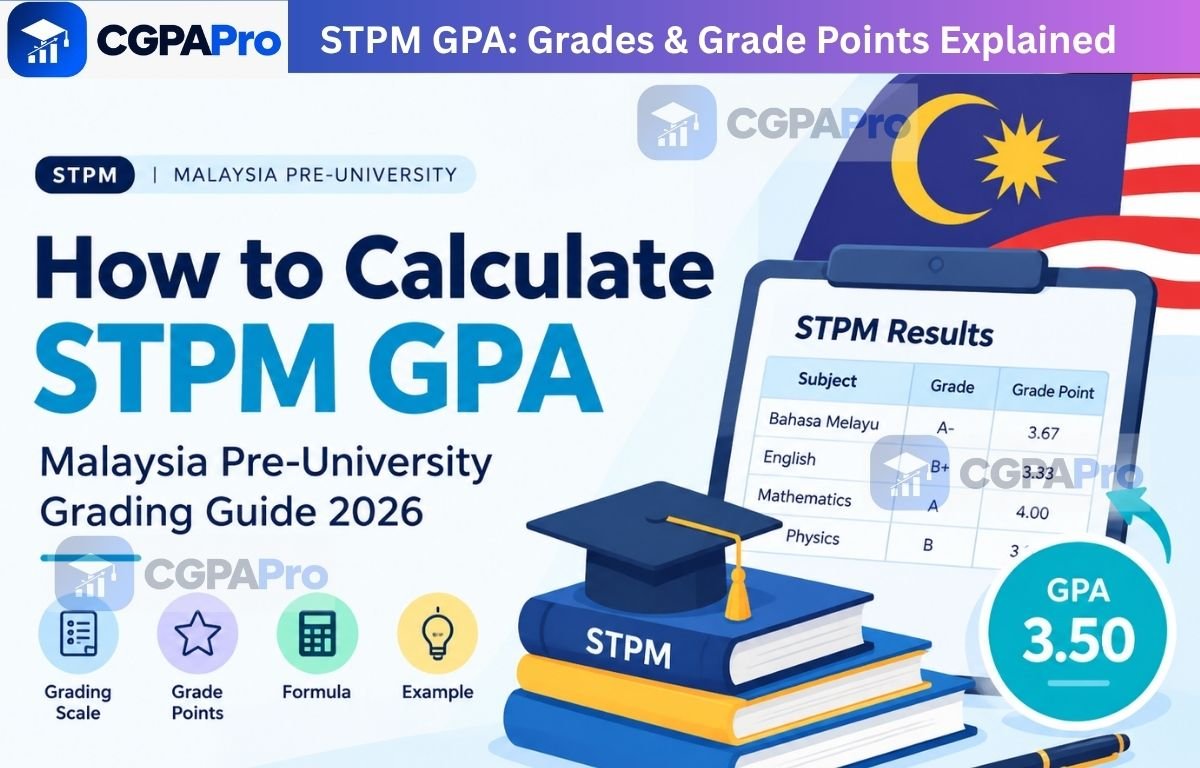
STPM, which stands for Sijil Tinggi Persekolahan Malaysia is the version of A-Levels. Students take STPM after finishing school normally over three terms in two years. Universities in Malaysia and overseas look at STPM results to decide which students get into their degree programmes. Because of this STPM is one of the important qualifications that a Malaysian student will sit for.
In the STPM system performance is not judged by marks. Each subject gets a grade on a scale. Those grades turn into grade points. GPA or Grade Point Average is the average of these grade points across all subjects in a term. The GPA gives one number that shows academic performance, which helps universities and students follow progress and compare results.
Click Here: Free CGPA Calculator — GPA, Percentage & Semester Grades
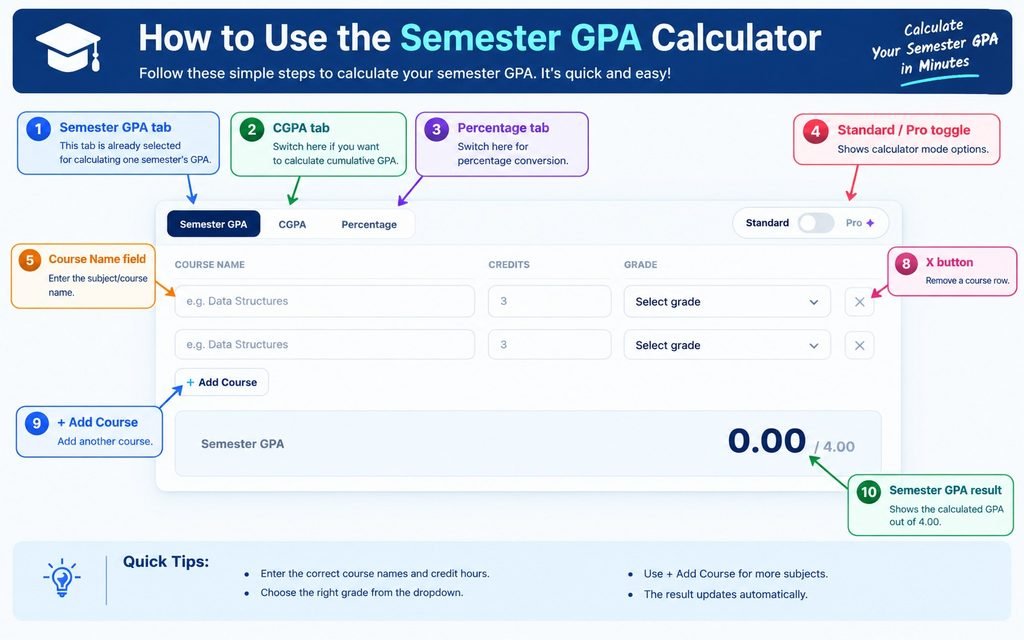
How to Use the Semester GPA Calculator
What Is STPM GPA?
GPA or Grade Point Average is a number that shows how well a student has performed in one STPM term. Each subject grade turns into points on a scale and those points are averaged to give one overall figure. In words it is a snapshot of how a student did in all subjects during that term.
GPA alone does not tell the story of a student’s academic performance. It shows one term so a strong or weak GPA in Term 1 does not always predict how a student will do in Term 2 or Term 3. STPM performance really builds over all three terms with each term adding to the picture of a student’s ability and consistency.
This is where the difference between GPA and CGPA matters. GPA refers to one term while CGPA or Cumulative Grade Point Average is the average, across all terms done so far. If a student has finished two terms their CGPA mixes the results from both terms giving a balanced view of their overall standing. Universities normally look at the CGPA after all three terms are done because it shows sustained performance instead of just one term.
Visit Now: Taxsal.comHow Does the STPM Grading System Work?
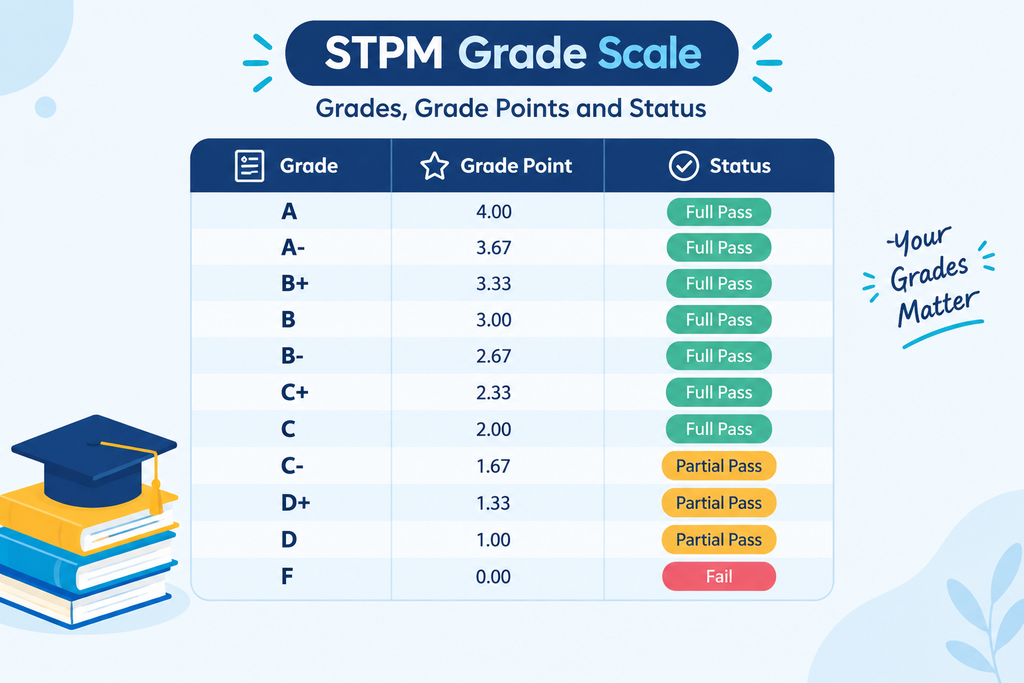
STPM grades are based on an 11-point scale, and each grade carries a fixed Subject Grade Point (SGP). This is different from a percentage-based system, since your raw exam marks are converted into a letter grade first, and that letter grade is what determines your grade point.
Sure, here is the clean table:
| Grade | Grade Point | Status |
|---|---|---|
| A | 4.00 | Full Pass |
| A- | 3.67 | Full Pass |
| B+ | 3.33 | Full Pass |
| B | 3.00 | Full Pass |
| B- | 2.67 | Full Pass |
| C+ | 2.33 | Full Pass |
| C | 2.00 | Full Pass |
| C- | 1.67 | Partial Pass |
| D+ | 1.33 | Partial Pass |
| D | 1.00 | Partial Pass |
| F | 0.00 | Fail |
What Information Do You Need to Calculate STPM GPA?
Before you use the calculator, I find it helpful to have a few details ready. This will make the GPA calculation faster and will show you an accurate result.
Subject grades
I always keep the letter grades for each subject by, such as A, B+ or C-. These grades come directly from your STPM result slip.
Grade points
I do not need to memorize these because the calculator turns grades into points automatically. I still like to know where the numbers come from though as shown in the grading table earlier.
Number of subjects
I also need to know how many subjects I will include in the STPM GPA calculation. The number of subjects affects the average because STPM GPA is the grade points divided by the number of subjects.
Weighting information
I remember that unlike some university systems, STPM does not use credit hours to weight subjects differently. Each subject normally carries the same weight in the STPM GPA calculation, so I do not need to enter any separate weighting figures. What matters is which subjects I include, because some students only count their four subjects, including the compulsory Pengajian Am, when they calculate their overall result. The choice depends on what the STPM GPA calculation is used for pgai calculators rewsults choices depends on what GPA is included
Why accuracy matters
I always double-check each entry against my result slip before calculating because a small mistake can change my STPM GPA enough to matter. This is especially important if I use the STPM GPA for a university application or scholarship because the exact number can affect whether I qualify.
How to Calculate STPM GPA Step by Step
| Step | What to Do | Example / Details |
|---|---|---|
| 1. List your STPM subjects | Write down every subject you took in the term and the grade you received. | Make sure your list matches your official result slip exactly. |
| 2. Find the grade point | Convert each letter grade into its corresponding grade point using the grading table. | A = 4.00, B+ = 3.33, C = 2.00 |
| 3. Add the grade points | Add the grade points for all applicable subjects. | 4.00 + 3.33 + 3.00 + 3.67 = 14.00 |
| 4. Divide by the number of subjects | Divide the total grade points by the number of subjects included. | 14.00 ÷ 4 = 3.50 GPA |
| 5. Check and round | Double-check your entries and round the final GPA if required. | STPM GPA is usually presented to two decimal places. |
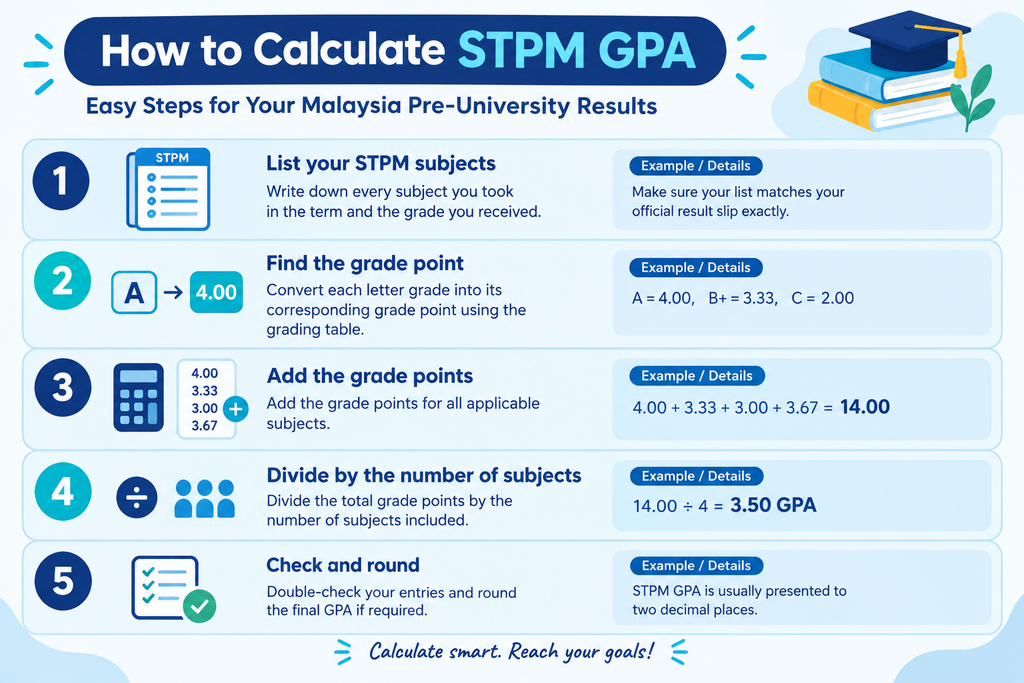
Example: If your grades are A, B+, B, and A-, the total is 14.00. Dividing by 4 subjects gives a GPA of 3.50.
STPM GPA Formula
GPA = Total Grade Points divided by Number of Subjects
Total Grade Points
This is the sum of the grade points earned across all subjects in a term. Each subject’s letter grade is converted to its grade point value using the grading table. These values are added together.
Total Grade Points
This is the sum of the grade points earned across all subjects in a term. Each subject’s letter grade is converted to its grade point value using the grading table. These values are added together. Grade converted grade
Number of Subjects
This is simply the number of subjects included in the calculation. It is important that this number matches the subjects used to work out the grade points since leaving one out or adding an extra will change the result.
Example: STPM GPA Calculation
| Grade | Grade Point |
|---|---|
| A | 4.00 |
| B+ | 3.33 |
| B- | 2.67 |
| A- | 3.67 |
| C+ | 2.33 |
| Total | 16.00 |
| Calculation | Result |
|---|---|
| Total Grade Points | 16.00 |
| Number of Subjects | 5 |
| GPA | 16.00 ÷ 5 = 3.20 |
Final GPA: 3.20
Available next action: Create a downloadable DOCX file here in this chat containing the editable prose above.
Difference Between GPA and CGPA
| GPA | CGPA |
|---|
| Measures performance in one term. | Measures performance across multiple terms. |
| Shows your recent academic performance. | Shows your overall academic performance. |
| Can change more from term to term. | Usually changes more gradually. |
| Helps track performance in a specific term. | Helps track overall academic progress. |
| Example: Term GPA = 3.20 | Example: Overall CGPA = 3.35 |
How to Interpret Your STPM GPA
Once you get your GPA number, the next thing is to understand what it really means about how you did.
What a higher GPA shows
A higher GPA usually means you did well. You stayed consistent in most of your subjects for that term. If your GPA is close to 4.00, it likely means most or all of your grades were A or A minus. On the hand, a GPA between 2.00 and 3.00 shows a mix of grades mostly in the B and C range.
How each grade shapes the result
Since GPA is a simple average, every subject changes the number up or down. If you do well in subjects, your GPA goes up. If you struggle in some, it pulls the average down. All subjects count equally. No single subject has more power than others. This means being steady across all subjects is just as important as doing well in one or two.
Why one low grade can make a difference
One weak grade can affect your GPA more than you think—especially when you’re taking only a few subjects. For example, if you have four subjects and one drops from a B plus to a C, your overall GPA will drop noticeably because there are no other grades to balance it out. That’s why it’s important to pay attention to every subject, not the ones you find easier.
What your GPA does and doesn’t tell you
A strong GPA is a sign of good academic performance. It’s not the only thing colleges look at. Other factors, like subject requirements, co-curricular activities, interviews, or how competitive the course is might also play a role. A high GPA helps your chances. It doesn’t guarantee you’ll be accepted into any particular program. It’s one part of the picture.
Common Mistakes When Calculating STPM GPA
Even though the formula is simple, small mistakes can easily appear when you calculate STPM GPA by hand. Below are the common mistakes to watch out for.
Using the grade point
It is easy to read a grade incorrectly or mix up similar values; for example, confusing B+ (3.33) with B- (2.67). Always double‑check each grade against the grading table before you use it in the calculation.
Adding grades of grade points
Adding the letter grades or raw marks instead of converting them to grade points is a common mistake.
You must first transform each letter grade into a grade point. The formula works with grade points, so skipping this step will give a wrong STPM GPA.
Dividing by the number
The number of subjects used in the division must match the number of subjects that were added to get the total. Leaving a subject out of the count or counting one that should not be there will throw off the STPM GPA.
Combining different grading systems
STPM uses its grading scale, which is different from the scales used in UK universities or other pre‑university qualifications. Using the scale or comparing STPM points directly with a different system without proper conversion will lead to inaccurate STPM GPA results.
Rounding early
Rounding grade points before adding them together instead of rounding only the final STPM GPA can create small errors that add up across several subjects. Keep the values through each step and round only at the end.
Entering subject results
A simple typo or a grade copied from memory instead of the official result slip can change the outcome. Always work from the result slip rather than relying on recall.
Being aware of these mistakes makes it easier to spot errors before they affect an application or decision. Using a calculator removes most of this risk because it applies the formula consistently and leaves room, for manual slip‑ups.
Tips for Improving Your STPM GPA
Once you know where your GPA stands, the next step is working on how to improve it. A few practical habits can make a difference over time.
Focus on subjects
It’s tempting to spend time on subjects you already do well in, but the biggest GPA gains usually come from bringing up your weakest subjects. Since every subject carries weight in the calculation a low grade in one area can pull down an otherwise strong average.
Track results after each assessment
STPMs modular structure means you get feedback through coursework and assessments along the way not at the end of the term. Keeping track of these results as they come in makes it easier to spot patterns early than being surprised by a final grade.
Set realistic grade targets
Working backwards from the GPA you want to achieve can help you figure out what grades you need in each subject. This keeps your revision focused. Gives you a clear benchmark to work towards, rather than aiming vaguely for “better results.”
Review mistakes
Going through papers, assignments or mock exam results to understand where marks were lost is one of the most effective ways to improve. It’s not just about knowing you got something but understanding why so the same mistake doesn’t repeat in the next assessment.
Use your GPA calculation to monitor progress
Recalculating your GPA regularly after mock exams or coursework results gives you an early sense of where you stand before the actual term results are released. This also lets you test scenarios, such as seeing how a grade improvement in one subject would affect your overall GPA so you know exactly where to focus your effort.
Small consistent improvements across each term add up over time. Keeping a close eye on your GPA along the way makes it easier to stay on track for your target CGPA by the end of STPM.
Frequently Asked Questions
How is STPM GPA calculated?
STPM GPA is calculated by converting each subject grade into its grade point, adding all the grade points together, and dividing by the number of subjects taken in that term.
What is the formula for STPM GPA?
The formula is GPA = Total Grade Points ÷ Number of Subjects. Each grade point comes from the official STPM grading table, which runs from A (4.00) down to F (0.00).
Is STPM GPA the same as CGPA?
No. GPA measures performance for a single term, while CGPA represents cumulative performance across all terms completed so far. GPA can vary term to term, but CGPA gives a more stable overall picture.
How do I calculate my GPA from STPM grades?
List your subjects and grades for the term, convert each grade to its grade point using the grading table, add the grade points together, then divide by the number of subjects.
Can I calculate STPM GPA manually?
Yes, the formula is simple enough to work out by hand. The main risk is small errors, like using the wrong grade point or dividing by the wrong number of subjects, which is why many students prefer using a calculator for accuracy.
How accurate is an STPM GPA calculator?
An STPM GPA calculator is as accurate as the information entered into it. As long as the grades entered match your official result slip, the calculator applies the formula correctly and removes the risk of manual calculation errors.
How many subjects are used to calculate STPM GPA?
This depends on the term and the student’s subject combination, since STPM students typically take four to five subjects per term, including the compulsory Pengajian Am. All subjects taken in that term are generally included in the GPA calculation, though some students only count their best four subjects when reporting an overall result.
How can I improve my STPM GPA?
Focus on weaker subjects since every subject carries equal weight, track results after each assessment rather than waiting for final grades, set realistic targets for each subject, and review past mistakes so they aren’t repeated in future assessments.
Conclusion
Calculating your STPM GPA comes down to one simple formula: convert each subject grade into its grade point, add them together, and divide by the number of subjects taken in that term. Whether you’re checking a single term’s result or working out how each term contributes to your overall CGPA, the process stays the same.
The most important part is using the correct grade points from the official STPM grading table, since even a small mix-up between grades like B+ and B- can shift your final GPA more than expected. Always work from your actual result slip rather than relying on memory, and keep the full values through each step rather than rounding too early.
If you’d rather skip the manual working out, the STPM GPA Calculator does all of this instantly. Just enter your subject grades and get an accurate GPA in seconds, so you can spend more time focusing on your studies and less on arithmetic.